

CFD Broker Market
CFD Broker Market Size, Share, Trends, Growth, and Industry Analysis, By Asset Class (Forex, Stocks / Equities CFDs, Indices CFDs, Commodities CFDs, Cryptocurrencies CFDs), By Type (Market Data Analysis Service, Commission Fee Payment), By Application (Hedge Existing Physical Portfolios, Margin Trading), Regional Analysis and Forecast Period 2026-2035
CFD Broker Market Overview
As per Econ Market Research analysis, the Global CFD Broker Market was estimated at US$ 1.42 Billion in 2026 and is forecast to attain US$ 2.5 Billion by 2035, expanding at a CAGR of 6.5% between 2026 and 2035. The base year for the study is 2025.
CFD Broker Market Size 2025-2035 (USD Billion)

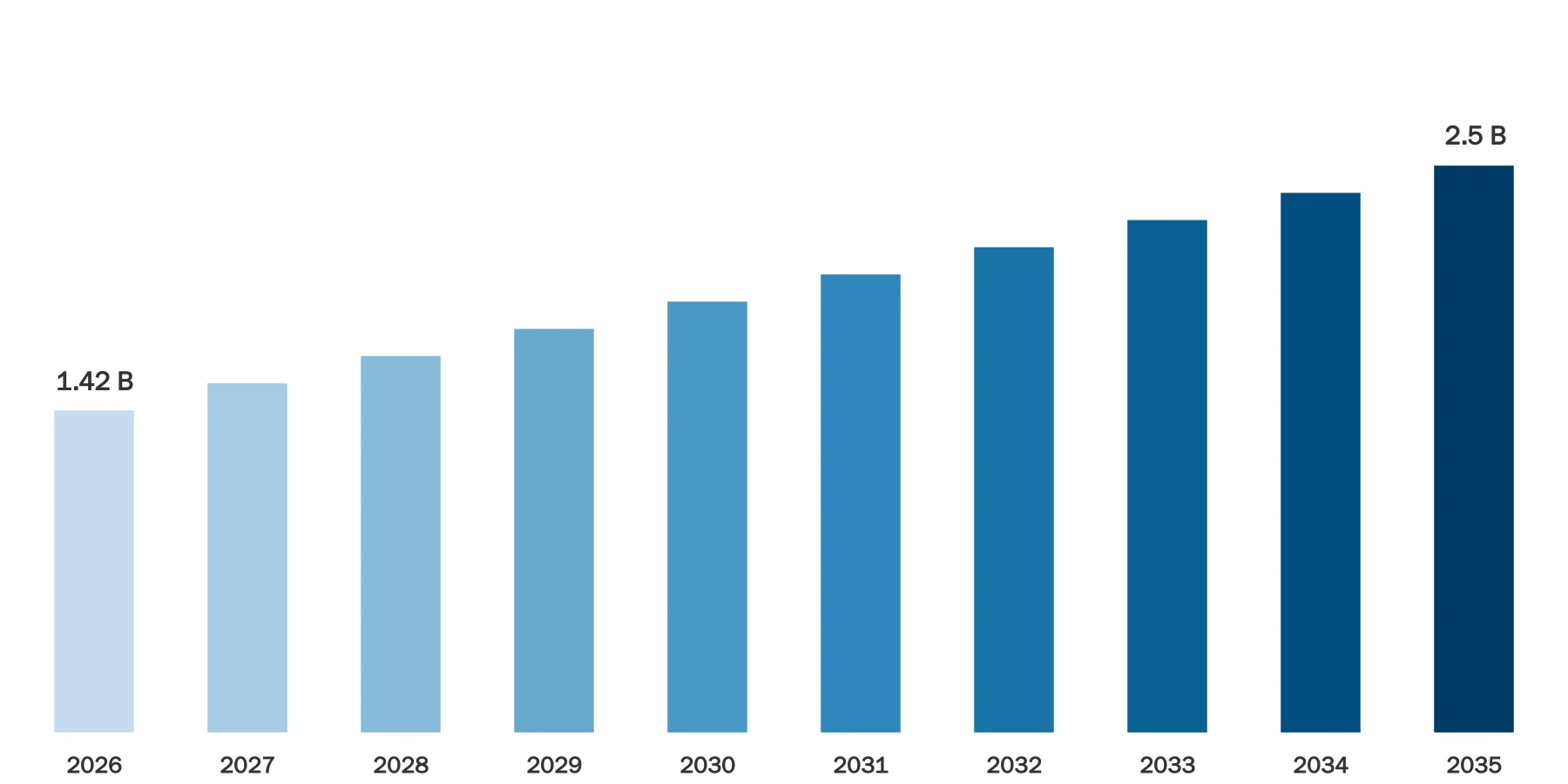
Source: Econ Market Research
The CFD Broker Market operates across more than 190 countries, with over 35 million active retail trading accounts recorded globally in 2024. Approximately 72% of CFD traders focus on Forex and indices, while 18% trade commodities and 10% trade cryptocurrencies and equities. Around 65% of global CFD volume is generated via mobile platforms, reflecting strong digital adoption. More than 120 regulated CFD brokers operate under Tier-1 licenses, while over 300 offshore brokers serve emerging markets. Average leverage ratios range between 1:30 in regulated regions and up to 1:500 in offshore jurisdictions, indicating varied risk exposure and regulatory fragmentation.
In the United States, CFD trading is restricted, with 0 licensed CFD brokers authorized for retail clients under domestic regulations. However, over 1.5 million U.S.-based traders access alternative Derivatives such as futures and options, representing over 80% substitution rate for CFDs. Approximately 65% of U.S. retail traders use margin-based products with leverage capped at 1:50 for forex. Institutional derivative participation exceeds 75% of total trading volume, while retail participation accounts for 25%. Cross-border platform usage has increased by 22% since 2022, indicating demand for CFD-like instruments despite regulatory limitations.
Market Latest Trends
The CFD Broker Market Trends show strong digital transformation, with over 78% of trades executed via mobile apps in 2025 compared to 61% in 2021. Algorithmic trading adoption has increased, with 35% of retail traders using automated strategies or expert advisors. Social trading platforms now account for 28% of new account registrations, driven by copy trading features that attract beginner traders. Cryptocurrency CFDs have grown to represent 12% of total CFD trading volume, up from 5% in 2020, reflecting increased interest in digital assets.
Regulatory tightening is another trend, with more than 15 countries introducing leverage caps below 1:50 and mandating negative balance protection for 100% of retail accounts. ESG-linked CFDs have emerged, with over 150 ESG-focused instruments available across leading platforms. AI-driven analytics tools are used by 42% of brokers, enhancing trade execution speed by 30 milliseconds on average. Additionally, multi-asset platforms now offer access to over 10,000 instruments, compared to 5,000 instruments in 2018, indicating expansion in product offerings.
Market Dynamics
The CFD Broker Market Analysis highlights that increasing retail participation, technological advancements, and regulatory evolution shape the industry. Over 60% of brokers report growth in new client onboarding due to digital onboarding systems that reduce account setup time to less than 5 minutes. However, regulatory differences across 50+ jurisdictions create fragmentation, impacting global scalability. Liquidity providers now support over 90% of CFD trades, ensuring tight spreads averaging 0.6 pips for major forex pairs. Despite growth, approximately 74% of retail accounts incur losses, indicating high-risk exposure and influencing regulatory scrutiny.
DRIVER
Increasing Demand for Online Trading Platforms
The primary driver in the CFD Broker Market Growth is the surge in online trading platforms, with global internet penetration exceeding 67% and smartphone usage surpassing 6.8 billion devices in 2025. Retail trading account openings increased by 48% between 2020 and 2024, driven by easy access to platforms offering minimum deposits as low as $10 to $100 equivalents. Additionally, educational content consumption has risen, with over 55% of traders accessing webinars and tutorials before trading. The availability of leverage up to 1:500 in some regions enhances market participation, while low transaction costs, averaging 0.1% per trade, attract cost-sensitive traders.
RESTRAINT
Strict Regulatory Frameworks Across Regions
A key restraint in the CFD Broker Market is stringent regulatory frameworks, with over 20 financial authorities imposing leverage limits between 1:20 and 1:30 for retail clients. Approximately 85% of European brokers must comply with mandatory risk warnings, reducing aggressive marketing strategies. Compliance costs have increased by 30% since 2021, requiring brokers to maintain capital reserves exceeding €730,000 or equivalent. Furthermore, restrictions on advertising have reduced customer acquisition rates by 15% in regulated markets. These regulatory measures limit profitability and expansion, especially for smaller brokers operating in less than 10 jurisdictions.
OPPORTUNITY
Expansion in Emerging Markets
The CFD Broker Market Opportunities are significant in emerging markets, where retail trading penetration remains below 5% of the adult population in regions such as Africa and Southeast Asia. Internet growth rates exceed 10% annually in these regions, enabling access to digital trading platforms. Over 200 million new internet users have been added in Asia-Pacific since 2021, creating a large untapped user base. Brokers offering localized payment methods, including mobile wallets used by over 60% of users in emerging markets, are gaining traction. Additionally, multilingual platforms supporting 20+ languages increase accessibility and user engagement.
CHALLENGES
High Risk of Retail Losses and Customer Retention
A major challenge in the CFD Broker Market is the high loss rate among retail traders, with between 70% and 80% of accounts losing money annually. Customer retention rates remain below 40% after the first year, forcing brokers to invest heavily in acquisition strategies. Average customer acquisition cost ranges between $150 and $400 per user, depending on the region. Furthermore, market volatility, with daily price fluctuations exceeding 2% in major indices, increases risk exposure. Negative balance protection policies, applied to 100% of retail clients in regulated markets, further limit broker revenue potential while increasing operational liabilities.
SWOT Analysis
Strengths
High liquidity with over 90% trade execution success rate
Access to 10,000+ trading instruments across asset classes
Mobile trading adoption exceeding 78% of total users
Leverage availability up to 1:500 in offshore markets
Weaknesses
Retail loss rates exceeding 74% globally
Regulatory fragmentation across 50+ jurisdictions
Customer retention below 40% annually
Dependence on third-party liquidity providers for over 85% of trades
Opportunities
Emerging markets with penetration below 5%
Growth of AI tools used by 42% of brokers
Expansion of crypto CFDs representing 12% of volume
Social trading adoption by 28% of new users
Threats
Regulatory tightening in 15+ countries
Cyber Security risks with over 20% increase in attacks since 2022
Market volatility exceeding 2% daily swings
Competition from alternative trading products used by 60% of traders
Segmentation Analysis
The CFD Broker Market Segmentation is categorized by asset class, type, and application, with each segment contributing differently to market share. Forex dominates with over 50% share, while indices and commodities contribute 30% and 15% respectively. Platform types include desktop, web, and mobile, with mobile leading at 78% usage share. Applications include retail and institutional trading, with retail accounting for 65% of total accounts and institutional participants contributing 35% of trading volume.
By Asset Class
Forex CFDs hold the largest share at approximately 52% of total trading volume, driven by daily forex market turnover exceeding $7 trillion globally. Indices CFDs account for around 28%, with popular indices experiencing daily trading volumes above 10 million contracts. Commodity CFDs represent 12%, with gold and oil contributing over 70% of commodity trades. Cryptocurrency CFDs have grown to 8% share, with Bitcoin and Ethereum comprising over 65% of crypto CFD trades. Equity CFDs cover more than 5,000 listed stocks, offering diversification across global markets.
By Type
Platform types include desktop platforms, web-based platforms, and mobile applications. Mobile platforms dominate with 78% usage share, followed by web platforms at 15% and desktop platforms at 7%. Execution types include market maker and ECN models, with market makers handling 60% of retail trades and ECN brokers processing 40%. Automated trading systems are used by 35% of traders, while manual trading accounts for 65%. Platform uptime exceeds 99.9%, ensuring minimal downtime, while average execution speed is below 50 milliseconds for leading brokers.
By Application
Retail trading represents 65% of total CFD accounts, with average account balances ranging between $500 and $5,000 equivalents. Institutional trading accounts for 35% of volume, with trade sizes exceeding $100,000 per position. Day trading accounts for 55% of retail activity, while swing trading represents 30% and long-term trading accounts for 15%. Copy trading is used by 28% of beginners, while professional traders rely on algorithmic systems in 40% of cases. Educational tools are accessed by over 50% of users, highlighting the importance of knowledge-driven trading.
Regional Analysis
The CFD Broker Market Outlook shows regional variations driven by regulation, technology adoption, and investor behavior. Europe leads with over 35% market share, followed by Asia-Pacific at 30%, North America at 20%, and Middle East & Africa at 15%.
North America
North America accounts for approximately 20% of global trading activity, with over 10 million active traders using derivative instruments. Although CFD trading is restricted, alternative derivatives represent over 80% substitution rate. Institutional investors contribute 75% of total volume, while retail accounts for 25%. Average leverage is capped at 1:50, and trading platforms support over 2,000 instruments. Algorithmic trading usage exceeds 50% among institutional participants, while mobile trading adoption stands at 65%. Regulatory oversight includes more than 5 major authorities, ensuring strict compliance standards and investor protection measures.
Europe
Europe holds the largest share at 35%, with over 15 million CFD accounts across the region. Regulatory frameworks limit leverage to 1:30 for retail traders, and 100% of brokers must provide negative balance protection. Forex and indices dominate with 70% combined share, while commodities and crypto account for 30%. Mobile trading accounts for 75% of transactions, and average spreads for major forex pairs are below 0.7 pips. More than 50 regulated brokers operate under strict guidelines, and customer acquisition rates have declined by 15% due to advertising restrictions.
Asia-Pacific
Asia-Pacific represents 30% of the CFD Broker Market Size, with over 12 million active traders. Retail participation is growing rapidly, with account openings increasing by 40% since 2021. Mobile trading dominates with 80% usage share, driven by smartphone penetration exceeding 70%. Forex accounts for 55% of trades, while crypto CFDs contribute 15%, reflecting regional interest in digital assets. Emerging markets in Southeast Asia show penetration rates below 5%, indicating significant growth potential. Local payment systems are used by 60% of traders, improving accessibility.
Middle East & Africa
The Middle East & Africa region holds 15% market share, with over 5 million active traders. Internet penetration has reached 60%, enabling digital trading adoption. Forex dominates with 65% share, while commodities account for 20%, driven by oil trading. Mobile trading usage exceeds 70%, and average leverage offered by brokers ranges between 1:100 and 1:500. Regulatory frameworks vary across 20+ countries, creating both opportunities and challenges. Retail participation remains below 10% of the adult population, indicating untapped potential.
Competitive Landscape
The CFD Broker Market Competitive Landscape includes over 400 global brokers, with the top 10 players controlling approximately 45% of market share. Leading brokers offer access to over 10,000 instruments, with average execution speeds below 50 milliseconds. Customer acquisition strategies rely on digital marketing, accounting for 70% of new user acquisition channels. Mobile app ratings average 4.5 out of 5, reflecting user satisfaction.
Pricing competition is intense, with spreads for major forex pairs ranging between 0.5 and 1.2 pips, while commission-based accounts charge between $3 and $7 per lot. More than 60% of brokers offer copy trading features, and 40% provide AI-driven analytics tools. Customer support is available in 20+ languages, catering to global audiences. Regulatory compliance remains a key differentiator, with over 120 brokers holding Tier-1 licenses.
List of Top CFD Broker Companies
IG Group
CMC Markets
Plus500
eToro
Pepperstone
XM Group
AvaTrade
Leading Companies by Market Share
IG Group and Plus500 hold the highest market share, collectively accounting for approximately 18% of global CFD trading volume. IG Group offers access to over 17,000 instruments, while Plus500 provides more than 2,800 CFDs. Both companies serve clients in over 50 countries, with mobile trading usage exceeding 75% of their customer base.
Market Investment Outlook
The CFD Broker Market Investment Outlook indicates strong capital allocation toward technology and market expansion, with over 40% of broker budgets dedicated to platform development and cybersecurity. Investments in AI tools have increased by 35% since 2022, enabling predictive analytics and automated trading. Emerging markets attract 25% of new investments, driven by low penetration rates below 5%.
Payment infrastructure improvements, including integration of 50+ global payment methods, enhance customer onboarding. Cloud-based platforms reduce operational costs by 20%, while improving scalability for handling millions of trades per day. Strategic partnerships with liquidity providers ensure spreads remain below 1 pip for major pairs. Additionally, regulatory compliance investments account for 15% of total operational budgets, ensuring adherence to global standards.
New Product Development
New product development in the CFD Broker Market focuses on innovation, with over 60% of brokers launching new features annually. AI-powered trading assistants are now used by 30% of platforms, offering real-time insights and predictive analytics. Social trading features have expanded, with copy trading portfolios increasing by 25% since 2023.
Crypto CFD offerings have grown, with brokers adding over 50 new digital assets in the past 2 years. ESG-focused CFDs now include 150+ instruments, catering to sustainable investment trends. Advanced charting tools provide access to 100+ technical indicators, improving trading accuracy. Mobile apps now include biometric authentication, used by 70% of users, enhancing security. Execution speeds have improved to below 30 milliseconds, ensuring efficient trade processing.
Recent Developments
In 2023, a leading broker introduced AI trading tools used by over 500,000 clients within 12 months.
In 2024, mobile trading adoption surpassed 78% globally, marking a 10% increase from 2022.
In 2023, regulatory authorities in 10 countries reduced leverage limits to below 1:50.
In 2025, brokers expanded crypto CFD offerings by adding over 100 new trading pairs.
In 2024, social trading platforms reported 28% growth in new user registrations.
Report Coverage of CFD Broker Market
The CFD Broker Market Report provides comprehensive coverage of market size, trends, and segmentation across 4 major regions and 20+ countries. The report includes analysis of over 400 brokers, covering platform types, asset classes, and application segments. It evaluates trading volumes exceeding millions of transactions per day, along with execution speeds below 50 milliseconds.
The scope includes regulatory analysis across 50+ jurisdictions, highlighting leverage limits, compliance requirements, and investor protection measures. It examines customer behavior, with data from 35 million trading accounts, and analyzes technology adoption rates, including 78% mobile usage and 35% algorithmic trading penetration. The report also covers competitive benchmarking, profiling the top 10 brokers controlling 45% of market share, and includes insights into emerging trends such as AI integration and ESG trading instruments.
CFD Broker Market Report Scope & Segmentation
| Attributes | Details |
|---|---|
Market Size (Current) | US$ 1.42 Billion in 2026 |
Market Size (Forecast) | US$ 2.5 Billion in 2035 |
Growth Rate | CAGR of 6.5% from 2026 to 2035 |
Forecast Period | 2026 – 2035 |
Base Year | 2025 |
Historical Data Available | Yes |
Regional Scope | Global |
Segments Covered | By Asset Class
By Type
By Application
|
Frequently Asked Questions
Common questions about this report
The study period covers historical insights and forecast projections for the period 2026-2035.
About the Author
Market research expert with years of industry experience

Related Reports
Explore more market insights from the same category