

Business Jet Market
Business Jet Market Size, Share, Trends, Growth, and Industry Analysis, By Type (Light, Medium, Large), By Business Model (On-Demand Charter, Ownership), By Range (Less than 3000 NM, 3000-5000 NM, More than 5000 NM), Regional Analysis and Forecast Period 2026-2035
Business Jet Market Overview
As per Econ Market Research analysis, the Global Business Jet Market was valued at US$ 50.6 Billion in 2026 and is expected to reach US$ 75.56 Billion by 2035, registering a CAGR of 4.56% during the forecast period 2026–2035. The base year considered is 2025.
Business Jet Market Size 2025-2035 (USD Billion)

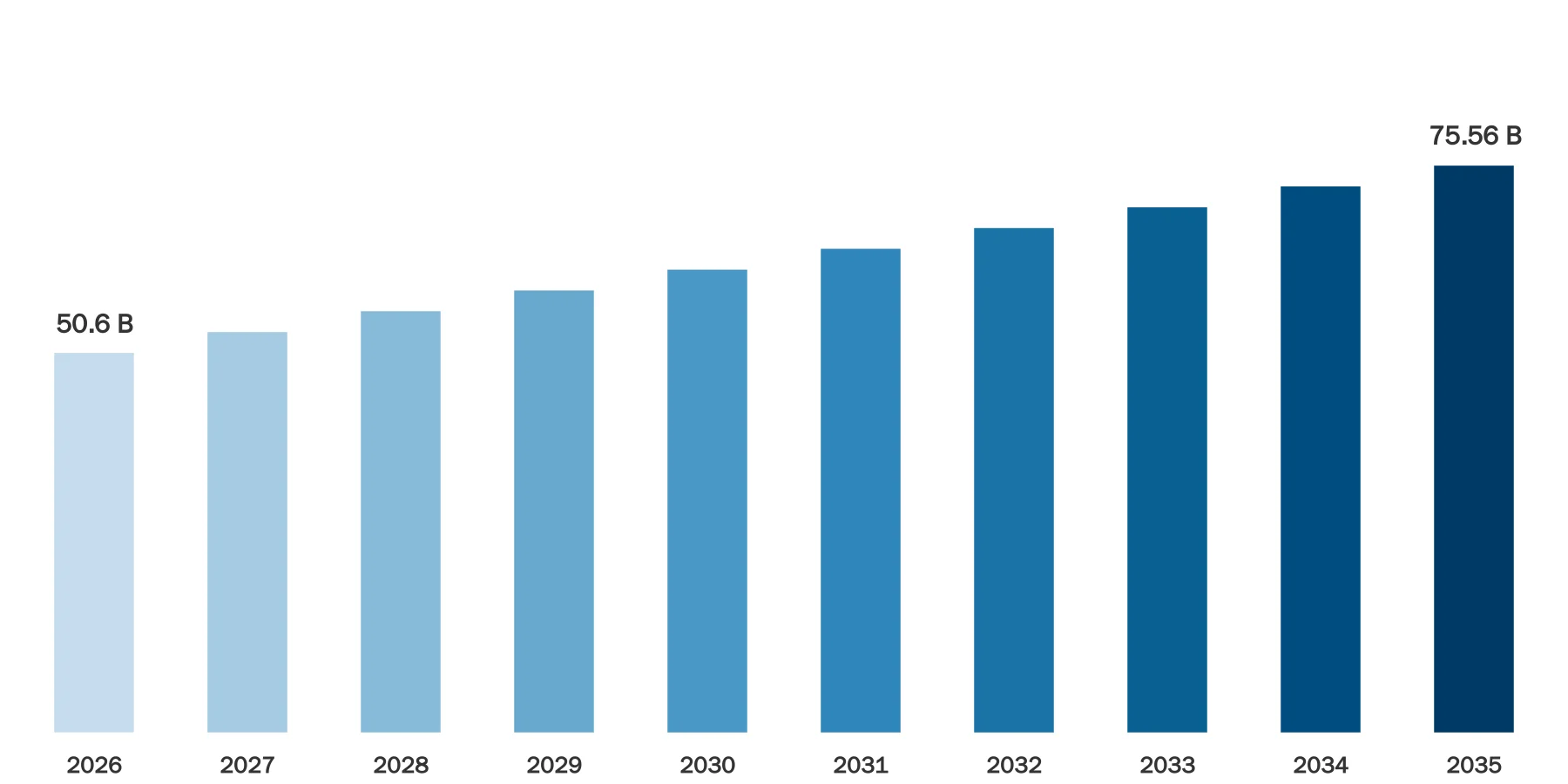
Source: Econ Market Research
A business jet is a small, private aircraft that is usually utilized by corporations and affluent individuals for executive travel. These aircraft meet the unique requirements of business passengers for effective and adaptable transportation by providing opulent amenities and comfort. They enable travellers to access a variety of airports across the globe while offering privacy and convenience. These jets provide luxurious amenities for a comfortable and efficient travel experience, offering privacy and flexibility in scheduling. The market offers various aircraft types from small light jets for short trips to large, long-range jets for intercontinental travel.
The global business jet industry has been steadily growing in recent years, driven by rising demand from emerging economies, expanding corporate fleets, and technological advancements enhancing aircraft performance and efficiency. While occasional fluctuations in demand can occur due to economic and regulatory changes, the long-term outlook for the market is optimistic.
Leading companies in the industry include well-known manufacturers such as Gulfstream Aerospace, Bombardier Inc., and Textron Aviation, as well as emerging players from nations like China and Brazil. Furthermore, the business jet market is projected to see continued growth in the upcoming years due to factors like increasing disposable incomes for affluent individuals, the expansion of global businesses, and the growing demand for effective transportation solutions.
Business Jet Dynamics
Economic conditions play a significant role, with factors like GDP growth, corporate profits, and business confidence influencing the demand for business jets. In times of economic growth, companies invest in upgrading or expanding their fleets to support their expansion plans. Similarly, affluent individuals can increase their spending on luxury items, including private jet travel. On the other hand, during economic downturns, there can be a decrease in demand as businesses cut costs and individuals reduce their discretionary spending. This can impact both the purchase of new aircraft and the use of charter services.
Advancements in technology greatly influence the business jet market. Through innovations in aircraft design, propulsion systems, avionics, and cabin amenities, performance, efficiency, safety, and passenger comfort are constantly improving. Manufacturers aim to stand out by offering state-of-the-art features like better connectivity, advanced cockpit systems, and eco-friendly propulsion technologies. Compliance with regulations and industry norms also spurs innovation as manufacturers strive to meet strict safety standards, noise guidelines, emissions regulations, and operational efficiency goals.
The advancement of technology has not only improved the competitiveness of business jets but also caters to the changing preferences of customers for modern, efficient, and environmentally friendly aircraft solutions. The global business jet market is influenced by economic, technological, regulatory, and consumer factors, leading to innovation, competition, and market expansion.
Business Jet Drivers
Economic Growth
The growth of the economy, especially in developing countries, leads to an increase in the need for business jets as companies aim to expand their global presence and wealthy individuals have more travel requirements. When the economy is performing well, companies tend to see higher profits and more business opportunities, prompting them to invest in private aviation for executive travel and logistics. Additionally, as rich individuals have more disposable income, there is a greater demand for private jet travel for both leisure and business reasons. Because of this, strong economic growth boosts the market for business jets, resulting in increased sales and charter activity.
Technological Advancements
The ongoing progress in technology is leading to impressive developments in the business jet industry, resulting in improved aircraft performance, efficiency, and safety. Innovations in aerodynamics, materials, propulsion systems, and avionics are allowing manufacturers to create planes with longer flying distances, faster cruising speeds, and better fuel economy.
Additionally, advancements in cabin design and amenities are enhancing passenger comfort and productivity, providing travellers with luxurious experiences. Furthermore, improvements in connectivity solutions are enabling smooth communication and data access while in the air, ultimately adding more value to business jets. These technological advancements not only attract customers seeking modern and efficient aircraft but also drive replacement demand as older aircraft become obsolete, stimulating market growth and innovation.
Restraints:
Regulatory Challenges
Meeting regulatory requirements is a big challenge for the business jet industry. Manufacturers have to follow strict rules on safety, emissions, and noise set by aviation authorities around the world. Keeping up with these changing regulations means investing a lot in research and development to create and certify new technologies and designs. Changes in airspace rules and operational needs can also drive-up costs and limit market access for business jet operators. This can affect their profits and ability to compete.
Environmental Concerns
The business jet market is facing challenges due to increased environmental awareness and sustainability efforts. Business jets are seen as contributors to carbon emissions and noise pollution, leading to more scrutiny from regulators and environmental organizations. Manufacturers are under pressure to create greener and more fuel-efficient aircraft to address these concerns and meet stricter emissions standards. Thus, environmental concerns represent a restraint on the growth of the business jet market, necessitating investments in eco-friendly technologies and sustainable practices to address these challenges effectively.
Opportunities:
Emerging Markets
Business jets are seeing great potential in emerging markets as wealth, urbanization, and globalization increase. China, India, Brazil, and Russia are leading this growth, creating more high-net-worth individuals, companies, and government organizations with travel needs. Improved infrastructure, regulatory changes, and more open airspace also make it easier to access private aviation services in these markets, boosting demand for business jets. Consequently, manufacturers and operators can capitalize on the expanding market opportunities in emerging economies by offering tailored products and services to cater to the unique needs and preferences of customers in these regions.
Segment Overview
By Business Jet Type
By Type, market is segmented into three main categories, light, medium, and large. Light jets are perfect for short-haul flights and regional travel as they have fewer seats and less range. Medium jets, on the other hand, offer more seating and range, catering to small to medium-sized businesses and wealthy individuals who need to travel longer distances. Finally, large jets are designed for intercontinental travel and come equipped with luxurious amenities to cater to multinational corporations, government agencies, and ultra-wealthy individuals.
By System
By System, business jets market is segmented into aerodynamics, cabin interiors, propulsion systems, avionics, and other specialized systems. Aerostructures are made up of the airframe, wings, and control surfaces, which play a crucial role in determining aircraft performance and efficiency. Cabin interiors cover seating layouts, furniture, entertainment systems, and amenities that improve passenger comfort and convenience.
Propulsion systems consist of engines, thrust reversers, and auxiliary power units that are responsible for powering the aircraft and generating power. Avionics includes navigation, communication, and surveillance systems, enabling safe and efficient flight operations. Other specialized systems include environmental control systems, fuel systems, and hydraulic systems, supporting various aircraft functions and operations.
By Owner
Segmentation by owner distinguishes between pre-owned and new deliveries of business jets. Pre-owned aircraft refer to previously owned or used jets that are available for resale or lease in the secondary market. New deliveries include newly manufactured or customized aircraft delivered directly from the manufacturer to the end-user. Owners can include private individuals, corporations, government agencies, charter operators, and leasing companies, each with unique acquisition preferences and budgetary constraints.
By End-User
By End-User market is segmented into main two types of users, operators and private individuals. Operators consist of commercial airlines, charter operators, fractional ownership providers, and aircraft management companies that provide business jet services to other customers.
Private individuals, on the other hand, are made up of high-net-worth individuals, corporate executives, government officials, and celebrities who either own or rent business jets for personal or business trips. By recognizing the unique needs and preferences of each user group, companies can create specialized marketing plans and service packages to meet their specific demands.
Business Jet Overview by Region
The market for business jets varies by region, affected by economic growth, regulations, infrastructure, and cultural preferences. North America is the biggest market, with leading manufacturers, a robust corporate sector, and many wealthy individuals. Europe is also significant, with a mix of corporate and private operators, strong demand for fractional ownership, and charter services.
Asia-Pacific is a growing region, driven by economic growth, urbanization, and higher disposable incomes among high-net-worth individuals. China and India, in particular, stand out as key growth markets, supported by government initiatives to develop aviation infrastructure and promote business aviation. Meanwhile, the Middle East experiences steady demand for business jets driven by the region',s oil wealth, luxury tourism, and corporate travel needs. Latin America and Africa present opportunities for market growth, albeit with challenges related to economic instability, regulatory constraints, and infrastructure limitations.
Business Jet Market Competitive Landscape
Major aircraft key players such as Gulfstream Aerospace, Bombardier Inc., Textron Aviation, and Dassault Aviation dominate the market with a diverse portfolio of business jet offerings catering to varying customer needs and preferences. These industry giants leverage their extensive R&,D capabilities, technological expertise, and global distribution networks to maintain a competitive edge in the market.
Additionally, niche players and start-ups, particularly from emerging economies like China and Brazil, are entering the market with innovative designs and cost-effective solutions, challenging established players and reshaping market dynamics. Furthermore, suppliers of aircraft components, systems, and services play a crucial role in the competitive landscape, providing critical support to OEMs and operators to enhance aircraft performance, safety, and operational efficiency. As competition intensifies, industry players are focusing on product innovation, customer service excellence, and strategic partnerships to differentiate themselves and capitalize on emerging market opportunities in the dynamic business jet industry.
Business Jet Market Leading Companies:
Gulfstream Aerospace Corp.
Textron Aviation
Bombardier Inc.
Dassault Aviation
Embraer Executive Jets
Honda Aircraft Company
Cessna Aircraft Company
Boeing Business Jets
Airbus Corporate Jets
Pilatus Aircraft Ltd.
Piaggio Aerospace
Cirrus Aircraft
Daher
Diamond Aircraft Industries
One Aviation
Business Jet market Recent Developments
Oct 2023, Textron Aviation announced a purchase deal with Fly Alliance for up to 20 Cessna Citation jets, with an option for 16 more, intended for Fly Alliance',s luxury private jet charter services. The first delivery, an XLS Gen2, was slated for 2023.
June 2023, Gulfstream Aerospace Corp. revealed plans for expanding its completions and outfitting operations at St. Louis Downtown Airport, with a USD 28.5 million investment to enhance operations and modernize facilities.
June 2023, Gulfstream Aerospace Corp. announced the approval of the Gulfstream G280 for operations at La Mô,le Airport in France, following successful take-off and landing demonstrations at the short-field airport.
December 2022, The Indian government inaugurated a luxury business jet terminal at Kochi, Kerala, boasting a record-breaking 100-meter car-to-aircraft distance, facilitating rapid passenger access to aircraft after security and immigration procedures.
Business Jet Report Segmentation
Business Jet Market Report Scope & Segmentation
| Attributes | Details |
|---|---|
Market Size (Current) | US$ 50.6 Billion in 2026 |
Market Size (Forecast) | US$ 75.56 Billion in 2035 |
Growth Rate | CAGR of 4.56% from 2026 to 2035 |
Forecast Period | 2026 – 2035 |
Base Year | 2025 |
Historical Data Available | Yes |
Regional Scope | Global |
Segments Covered | By Type
By Business Model
By Range
|
Frequently Asked Questions
Common questions about this report
The study period covers historical insights and forecast projections for the period 2026-2035.
About the Author
Market research expert with years of industry experience

Dipali Bhingare serves as the Market Research Director at Econ Market Research. With a focus on translating complex global economic shifts into actionable business intelligence, she oversees the strategic direction of comprehensive market studies. Her work empowers organizations to navigate volatile industries through data-driven forecasting and deep-dive competitive analysis.
Related Reports
Explore more market insights from the same category