Budgeting Management Software Market Overview
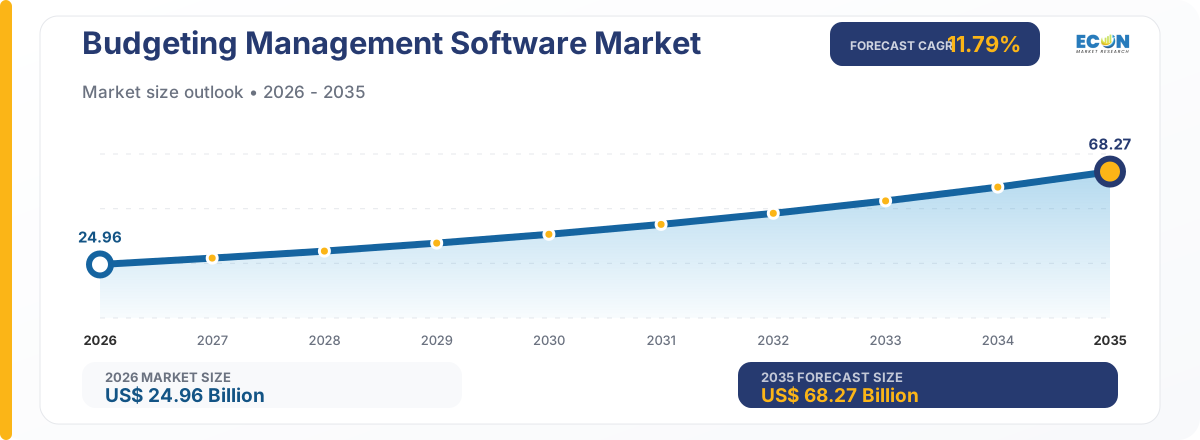
As per Econ Market Research analysis, the Global Budgeting Management Software Market generated revenue of US$ 24.96 Billion in 2026 and is forecast to achieve US$ 68.27 Billion by 2035, at a CAGR of 11.79% during the study period 2026–2035. The base year considered is 2025.
Budgeting Management software solutions include budgeting, forecasting financial performance, analysing spending, and reporting on financial activities. Companies can use budgeting software to streamline their financial processes, reduce errors, and enhance collaboration among teams, which will lead to better decision-making and resource allocation. In recent years, there has been a surge in demand for budgeting management software because of increased demands for financial clarity and accountability in businesses across all sizes.
Others include the increasing complexity of financial regulations, the need for access to data in real-time, and the growing prevalence of remote work. From simple budgeting applications to fully-fledged financial management platforms that integrate with other business systems, the market has a wide range of products. As organizations continue seeking ways to optimize their financial management practices, the Global Budgeting Management Software market is expected to expand further, offering innovative solutions to meet evolving needs.
Dynamic Insights
The most important reason is growing demand for accurate financial information and budget management results. Over the last few years, organizations have come to understand that proper budgeting leads to financial health and successful achievement of strategic objectives. This has been followed by increased demand for software solutions that can provide real-time Data Analytics, team-based capabilities, and automated reporting.
Challenges include the high cost of implementation and the complexity of integrating new software with already existing systems. In addition, most businesses are not willing to move away from traditional budgeting, which may eventually disrupt the process. Still, these possible drawbacks have increasingly presented opportunities alongside the advancements happening in technology that comprises Artificial Intelligence and machine learning and impact the budgeting software. These innovations enable more accurate prediction and tailored insights and, consequently, better-informed financial decisions from organizations.
Drivers Insights
Increased Demand for Financial Accuracy and Efficiency
Organizations are looking to have accurate financial management that will improve their decision-making process. This demand for accuracy is brought about by the allocation of resources, minimization of waste, and compliance with the financial regulations.
Budgeting management software provides real-time data tracking, automated calculations, and comprehensive reporting in advanced tools, enabling business organizations to create accurate budgets and forecasts. It makes it easier to have more visibility into financial performance, and organizations are able to identify the variance from budgeted figures, thus allowing for immediate adjustments of strategies that ultimately lead to improved financial health and strategic success.
Adoption of Cloud-Based Solutions
The shift towards Cloud Computing has significantly influenced the budgeting management software market. Cloud-based solutions offer numerous benefits, including scalability, flexibility, and cost-effectiveness. Organizations can easily access their budgeting tools from any location with internet connectivity, enabling collaboration among team members regardless of physical location. Additionally, cloud solutions reduce the burden of IT maintenance and infrastructure costs, making it easier for small and medium-sized enterprises (SMEs) to adopt budgeting software. This trend is particularly relevant in the context of remote work, where teams need to collaborate seamlessly on financial planning and analysis.
Restraints Insights
Resistance to Change
In most organizations, there was an adoption of the budgeting process over time to a traditional budgeting way of doing things. Adoption to budgeting management software necessitates a change of culture in organizations. As discussed earlier, there exists the possibility of such cultures causing employee resistance to adopting any changes.
This will most likely be the case, because employees are quite anxious and concerned about such disruptions such as learning curve difficulties, workflow interruptions, as well as uncertainty with the new technology',s reliability. This resistance can slow down the growth of the overall market for budgeting software as the organizations weigh their risks and benefits in change.
Opportunities Insights
Integration of Artificial Intelligence and Machine Learning
One of the biggest opportunities for growth in the market is through the integration of AI and machine learning into budgeting management software. These technologies can enhance budgeting tools by offering predictive analytics, which can enable organizations to predict financial trends more accurately.
AI can analyse historical data to identify patterns and suggest budget adjustments, thereby enabling proactive financial management. This will make budgeting easier and enables organizations to make decisions based on data, thereby maximizing the overall efficiency of financial strategies.
Segment Analysis
By Type
The budgeting management software market can broadly be classified into two variants: cloud-based and on-premises solutions. Cloud-based budgeting software is increasingly used due to flexibility, scalability, and ease of accessibility. Since it allows accessing budgeting tools from remote locations, it thus enables the geographically dispersed working team and allows them to collaborate amongst themselves.
Solutions run under a subscription model basis as well, thereby reducing the amount of upfront cost and load of IT maintenance. On-premises software is installed locally on a company',s servers. That provides the highest control over data and security. On-premises software solutions are more often chosen by organizations with specific regulatory requirements or high customization requirements.
By Application
The application segment of the budgeting management software market will comprise SMEs and large enterprises. As a need for efficiency and more excellent financial insights arises, there have been increased instances of usage of budgeting software amongst SMEs for the facilitation of improved capabilities with regard to financial planning and management. Budgeting software will allow these businesses to effectively utilize resources, account for expenditures, and financially make decisions without a financial team of an enormous nature.
A bigger enterprise would need a stronger solution to accommodate heavy budgeting processes in multiples of departments and geographies. Their general expectation is a one-stop software that does not conflict with other Enterprise systems, supports large volume data, and provides detailed analytics for strategic financial planning.
By End-User
The end-user segment encompasses various industries, including IT and Telecom, BFSI (Banking, Financial Services, and Insurance), Government, Healthcare, Retail and E-commerce, Manufacturing, and others. Each of these sectors has unique budgeting needs driven by their operational complexities and regulatory environments. For instance, the IT and Telecom sectors focus on managing rapid growth and technological advancements, requiring agile budgeting solutions.
The BFSI sector emphasizes compliance and risk management, necessitating tools that ensure financial integrity. Governments often utilize budgeting software for transparent resource allocation and public accountability, while the healthcare industry seeks tools to optimize financial management in a highly regulated environment. Retail and e-commerce companies rely on budgeting software to track seasonal trends and consumer behaviour, while manufacturing firms require robust systems to manage costs and operational efficiencies.
Regional Analysis
North America leads as the largest shareholder in budgeting management software primarily due to developed technology infrastructure, a high concentration of software vendors, and an increased emphasis on financial management practices among businesses. Businesses are increasingly adopting cloud-based solutions to enhance efficiency and accuracy in budgeting processes. Europe follows closely primarily because of stringent regulatory requirements and a growing focus on financial transparency.
Most European organizations place their focus on compliance and in such compliance, the need for advanced budgeting tools would automatically increase, hence properly integrated with existing financial systems. The budgeting management software market is growing very fast in the Asia-Pacific region due to the rising number of small and medium enterprises worldwide and increasing digitization in countries like China, India, and Japan. As these countries develop their economies, their interest in adopting modern forms of financial management is going up, and budgeting software has become an indispensable tool in business operations.
Latin America and Middle East &, Africa are catching up, as people gradually realize that proper financial planning and analytics can have great importance. In this context, companies operating in the region start understanding how budgeting management software may improve resource utilization and strengthen the decision-making process.
Competitive Landscape
Market leaders such as Oracle, SAP, Microsoft, and IBM provide an enterprise-wide budgeting solution in line with the existing ERP system. They utilize their tremendous resources, brand value, and technological capabilities to produce highly rich functionalities such as analytics, real-time reporting, and customized dashboards. Their products are suitable for large-scale enterprises with extremely high scalability and a level of functionality sophistication.
Beyond the Goliaths, niche and cloud-based players, such as Adaptive Insights (now Workday), Anaplan, and Planful, have begun to make meaningful inroads with easy-to-use interfaces and SME-specific pricing models that make navigating budgets much easier for SMEs at cheaper prices. More focused on specialized features to encourage collaboration and budgeting, they are better for the SMEs.
The competitive landscape is also trending toward partnerships and collaborations as companies look to enrich their product offerings through integrations with other financial tools and systems. With the development of the market, artificial intelligence and machine learning are the focus that drives innovation, allowing providers to offer predictive analytics and automated budgeting capabilities.
List of Key Players:
Deltek
Microsoft Corporation
Solver
Float
SAP SE
TimeCamp
Clearview Software
Contractpedia
IBM Corporation
Riskturn
XL Reporting
BOARD
Global Budgeting Management Software Report Segmentation
Budgeting Management Software Market Report Scope & Segmentation
| Attributes | Details |
|---|---|
| Market Size (Current)Current market valuation | US$ 24.96 Billion in 2026 |
| Market Size (Forecast)Projected market valuation | US$ 68.27 Billion in 2035 |
| Growth RateCompound Annual Growth Rate | CAGR of 11.79% from 2026 to 2035 |
| Forecast PeriodAnalysis timeline | 2026 – 2035 |
| Base YearReference year for analysis | 2025 |
| Historical Data AvailablePast market data availability | Yes |
| Regional ScopeGeographical coverage | Global |
| Segments CoveredMarket segments analyzed | By Deployment
By Organization Size
By Vertical
|
Frequently Asked Questions
Common questions about this report
The study period covers historical insights and forecast projections for the period 2026-2035.
About the Author
Market research expert with years of industry experience