

Bookkeeping Services Market
Bookkeeping Services Market Size, Share, Trends, Growth, and Industry Analysis, By Organization Size (SMEs, Large Enterprises), By Delivery Mode (Online/Virtual, On-site), By Industry Vertical (BFSI, Retail andamp; E-commerce, Healthcare, Construction), Regional Analysis and Forecast Period 2026-2035
Bookkeeping Services Market Overview
As per Econ Market Research analysis, the Global Bookkeeping Services Market was recorded at US$ 12.68 Billion in 2026 and is projected to expand to US$ 28.39 Billion by 2035, registering a CAGR of 9.37% over the forecast period. The base year used is 2025.
Bookkeeping Services Market Size 2025-2035 (USD Billion)

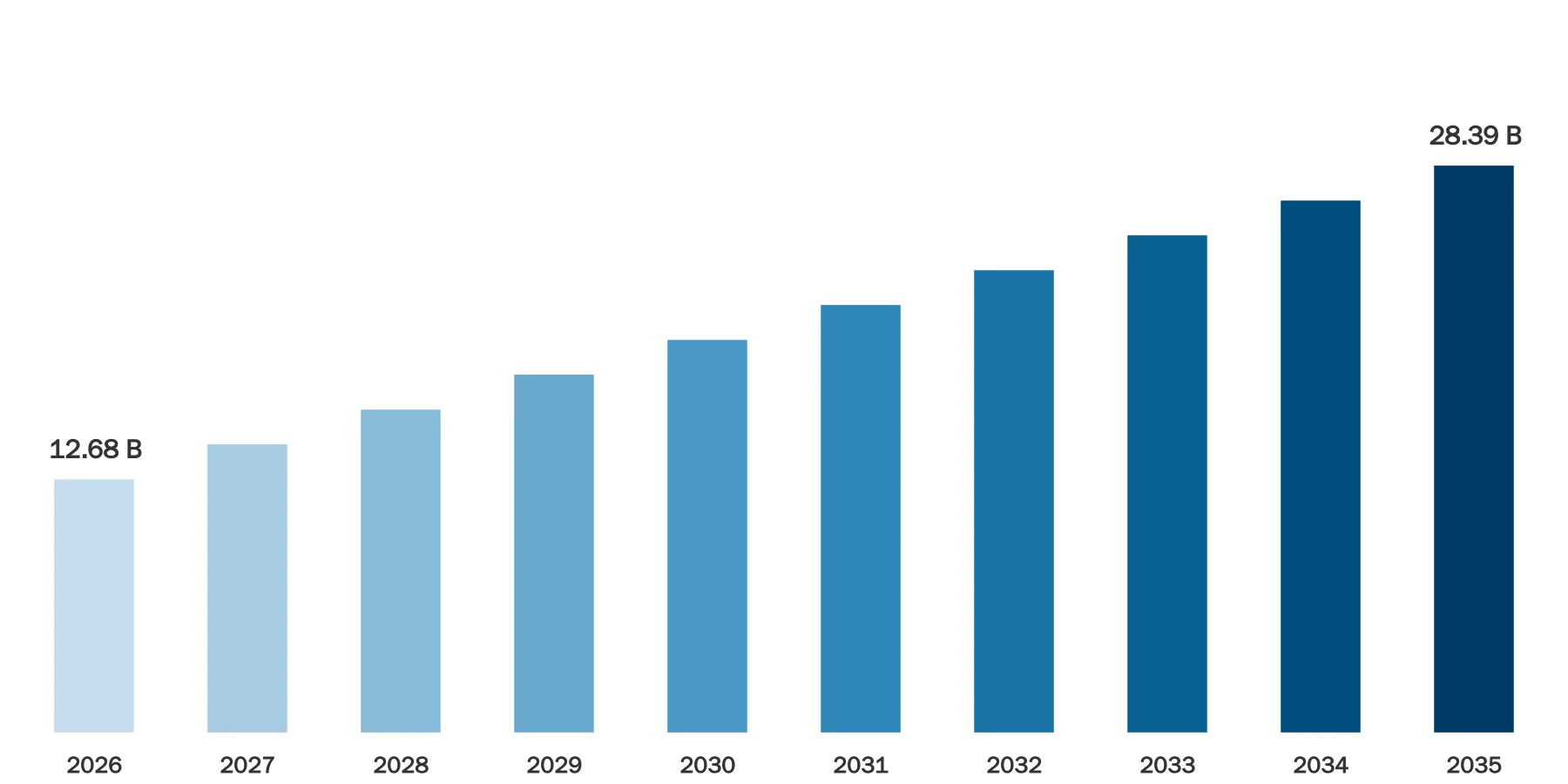
Source: Econ Market Research
Companies that require professional support but cannot afford to hire full-time accountants usually outsource bookkeeping services. Bookkeeping is a very important process for keeping accurate financial data, which keeps businesses organized and in compliance with legal regulations. The demand for bookkeeping services has been steadily increasing, driven by the growth in the number of small and medium-sized enterprises, increasing regulatory complexities, and the need for businesses to focus on core activities.
Technological advancements, such as cloud-based solutions and automated tools, have also made these services more accessible and efficient. Businesses, ranging from retail to healthcare, need professional bookkeeping services to ensure the accuracy, security, and currency of their financial data. In light of these developments, as more companies continue to shift toward digital solutions, the global bookkeeping services market is likely to grow, but this growth would be driven by affordability, accuracy, and integration with technology.
Dynamic Insights
A prime driver for bookkeeping is the need for SMEs to maintain accurate financial records while reducing their cost. SMEs grow into a business entity requiring specialized services that ensure the accuracy and regulatory compliance of the record-keeping system, and, therefore, more demand is experienced in the market for bookkeeping services. Other drivers for this industry are that the tax law and reporting requirements have increased, making companies turn to bookkeeping experts for risk-free compliance.
Another major driving factor of the growth of this market is technological advancement. Cloud-based software for bookkeeping and automation tools have simplified financial data management processes, making services more accessible and affordable for various business setups. Increasing the digital transition, companies prefer shifting away from traditional manual processes to more streamlined and automated processes of bookkeeping, which further increases demand. The other side of the marketplace also has its challenges, one of which is the constant need to update changes in regulatory requirements, besides competition from accounting teams within the larger organizations.
Drivers Insights
Increasing Number of SMEs:
The growth of small and medium-sized enterprises is one of the major drivers in the global bookkeeping services market. As new SMEs keep emerging in almost every corner of the world, especially in developing regions, there has been an increased demand for professional bookkeeping services. Usually, these SMEs lack financial expertise to independently handle complex bookkeeping tasks. Outsourcing to a bookkeeper will allow the SMEs to focus on core business growth and at the same time ensure proper maintenance of financial data. The cost-effectiveness of bookkeeping services is another advantage over having a full-time accountant, and this is helpful for businesses that have limited funds.
Technological Advancements and Automation:
The bookkeeping services market has been revolutionized by the adoption of cloud-based software and automation tools. Automation streamlines repetitive tasks such as data entry, invoicing, and payroll processing, thereby reducing errors and saving time. Cloud-based solutions enable real-time access to financial data from anywhere, enhancing collaboration and offering greater flexibility for businesses.
Technology has transformed how bookkeeping is done and serves a bigger pool of customers- from freelancers and start-up companies to fully established companies- with a highly scalable, more efficient approach to bookkeeping services. In addition, integrating this software with others in the company adds value through seamless business processes. Technological advancement remains the main driving factor for business growth, where proper financial information becomes available on their fingertips.
Restraints Insights
Lack of Trust and Data Security Concerns:
Data security is among the primary reasons that have stopped the growth of the bookkeeping services market. Companies may hesitate to outsource sensitive financial information to third parties, fearing some form of leakage, unauthorized access, or information loss. However, most professional bookkeeping service providers ensure adequate data protection levels, but this threat of cyber-attacks and breaches of privacy will continue to hamper the bookkeeping services market. This lack of trust can lead businesses to choose in-house bookkeeping or to outsource only the less sensitive financial tasks, which will limit the overall market growth.
Dependency on Technology and System Downtime:
While technological advancements made in bookkeeping have streamlined many things, they can also introduce new risks related to system reliability because dependence on these cloud-based, automated systems raises the risk level of technical malfunctions and systems downtime. Operational business can readily be affected negatively by a single system crash or server failure-or even a lone software bug-due to significant delays in viewing financial data, completing essential steps, and being operational. Operational inefficiencies costing money can take place. This, in turn may create frustration in businesses and deter their confidence towards outsourcing bookkeeping requirements that limits the market',s growth.
Opportunities Insights
Expansion of Cloud-Based Solutions:
A shift towards cloud-based bookkeeping solutions will open vast opportunities for market growth. Cloud technology allows for the storage, access, and analysis of financial data remotely, which is particularly useful for companies that operate in several locations or have remote teams. Infrastructure costs are also reduced, making it easier for SMEs and startups to adopt cloud-based services.
With the increasing adoption of Cloud Computing, bookkeeping services that offer secure, scalable, and easy-to-use cloud solutions are well-positioned to capture a growing customer base. This transition is also helping service providers develop more advanced features, such as integration with other business management tools and AI-powered financial insights, which enhances their appeal.
Segment Analysis
By Service Type:
The global bookkeeping services market has been segmented on the basis of service type which includes financial accounting services, management accounting services, payroll services, tax preparation services, and bookkeeping software solutions. Financial accounting services are primarily those services which look after a firm',s general ledger, preparing and ensuring all statutory and regulatory compliant financial statements, etc. Management accounting services can be regarded as providing an outlook on a firm',s financial information to facilitate proper decision-making and performance through budgeting, forecasting, and financial analysis.
Payroll services include salaries, employee benefits, and observance of the tax code of the various employees. Tax preparation services provide guidance to business on how to prepare and submit the tax return on time with proper observance of local and international regulations. Bookkeeping software solutions have gained popularity with its power to automate accounting tasks, enhance accuracy, and provide real-time access to financial data, thereby reducing human errors and increasing efficiency.
By End-User Industry:
The market for bookkeeping services is further bifurcated by end-user industry, consisting of small and medium enterprises, large enterprises, freelancers and startups, non-profit organizations, and government agencies. SMEs are one of the largest segments due to the growing number and need for affordable, outsourced bookkeeping services that help manage finances effectively.
Large corporations usually need more specialized accounting services to manage complex financial data and meet international regulatory standards. Freelancers and startups, often with fewer resources, look for scalable and affordable bookkeeping services to ensure the proper management of finances. Non-profit organizations need bookkeeping services to be compliant with regulations, transparent with their donors, and ensure that the funds are utilized appropriately. Government agencies depend on bookkeeping services for proper budget allocation, reporting, and accountability in financial operations.
By Mode of Delivery:
Bookkeeping services are delivered mainly in two modes: cloud-based services and on-premise services. Cloud-based services have gained popularity because of their accessibility, scalability, and flexibility. These services allow businesses to store their financial data on remote servers, enabling real-time updates, easy access from multiple devices, and seamless collaboration between team members, regardless of their location.
On the other hand, cloud-based solutions are often much cheaper for SMEs and start-ups since it does not call for a big upfront investment in hardware and infrastructure. On the other hand, on-premise services involve the installation of bookkeeping software in a company',s own servers or computers, allowing more control over the system and data. This mode of delivery is favored by major businesses or companies that need strong security regarding data and want to keep their finances within the organization.
By Business Model:
The market is divided into outsourced bookkeeping services and in-house bookkeeping services based on the business model. Outsourced bookkeeping services are offered by third-party service providers who manage a company',s financial records, so that businesses can focus on their core operations. This model is cost-effective, especially for SMEs and startups, as it reduces the need to hire full-time staff and invest in expensive accounting infrastructure.
Outsourcing also offers access to specialized expertise and technology without having to manage it internally. In-house bookkeeping services, on the other hand, require businesses to maintain their own internal accounting teams and infrastructure for financial tasks. This model is often adopted by larger organizations with more complex accounting needs or those that prioritize control over their financial data and prefer to have dedicated teams on-site for direct oversight and management of their financial activities.
Regional Analysis
North America is the dominating region in terms of market share in the market with the United States and Canada taking the lead, this is largely due to a large number of SMEs, regulatory complexities, and a very high level of digital adoption in the region. The region',s advanced cloud-based bookkeeping solutions and well-developed financial infrastructure make it one of the important regions in the market. Increasing preference for outsourcing bookkeeping services and the need for compliance with tax laws and financial reporting standards also strengthen the market in North America.
Market performance in Europe-The United Kingdom, Germany, and France are increasing steadily in regard to bookkeeping services. Many SMEs within these countries now embrace digital applications for financial operations. The regional regulatory frameworks adopted by the European Union are thus major contributors in the growth process of the compliance-driven bookkeeping services. Going forward, in Europe, shifts towards cloud solutions support businesses in keeping their financial undertakings stream-lined.
The Asia-Pacific region is undergoing rapid growth due to the expanding number of SMEs, start-ups, and increased emphasis on digitalization within countries like China, India, and Japan. The growth rate of the market is also furthered by increasing demand for proper financial management across emerging markets, as well as a trend of moving toward automated bookkeeping solutions. The rising international trade, complex tax systems, and business',s need to meet the standards of local as well as international financial regulations have further increased the demand for bookkeeping services in these regions.
Competitive Landscape
The major players in the market include large accounting firms such as Deloitte, PwC, and EY, offering comprehensive bookkeeping services in addition to their overall consulting and audit services. The market is dominated by these companies due to their well-established reputations, broad client bases, and capacity to handle complex accounting requirements, particularly for large-scale enterprises. Smaller firms and boutique accounting service providers serve small businesses, offering customized services and industry-specific expertise.
Along with old-style accounting companies, the technology-driven companies are growing more prominent within the competitive landscape, and even bookkeeping software applications like QuickBooks, Xero, and FreshBooks, which offer scalable, low-cost solutions for SMEs, freelancers, and startups. Using such solutions helps businesses manage their finance on such an easy and automated scale. A thorough integration of these solutions allows a seamless operation of other business tools and real-time tracking of financial status. The increasing trend of automation and Artificial Intelligence, even in bookkeeping, disrupts the market. Service providers are now using AI to make accounting more accurate and to reduce manual efforts.
As more firms go the outsourcing route for bookkeeping services, niche bookkeeping providers are sprouting up to target specific areas such as healthcare, Real Estate, and non-profits. In these firms, technology more than often is used to provide customized solutions to specific industry needs that result in further competitive strength. Thirdly, the field is becoming more competitive since there are even newer entrants, such as freelance bookkeepers and small firms utilizing cloud technologies, who are offering low-cost efficient alternatives to bookkeeping services.
List of Key Players:
AcuityCFO
HRB Innovations
Anderson Advisors
Bookkeeper360
Richards Financial Services
Accounting to Taxes
Maxim Liberty
Analytix Solutions
Xero
Virtual Pay
Logistis
Bench Accounting
Global Bookkeeping Services Report Segmentation
Bookkeeping Services Market Report Scope & Segmentation
| Attributes | Details |
|---|---|
Market Size (Current) | US$ 12.68 Billion in 2026 |
Market Size (Forecast) | US$ 28.39 Billion in 2035 |
Growth Rate | CAGR of 9.37% from 2026 to 2035 |
Forecast Period | 2026 – 2035 |
Base Year | 2025 |
Historical Data Available | Yes |
Regional Scope | Global |
Segments Covered | By Organization Size
By Delivery Mode
By Industry Vertical
|
Frequently Asked Questions
Common questions about this report
The study period covers historical insights and forecast projections for the period 2026-2035.
About the Author
Market research expert with years of industry experience

Dipali Bhingare serves as the Market Research Director at Econ Market Research. With a focus on translating complex global economic shifts into actionable business intelligence, she oversees the strategic direction of comprehensive market studies. Her work empowers organizations to navigate volatile industries through data-driven forecasting and deep-dive competitive analysis.
Related Reports
Explore more market insights from the same category