Bioenergy Market Overview
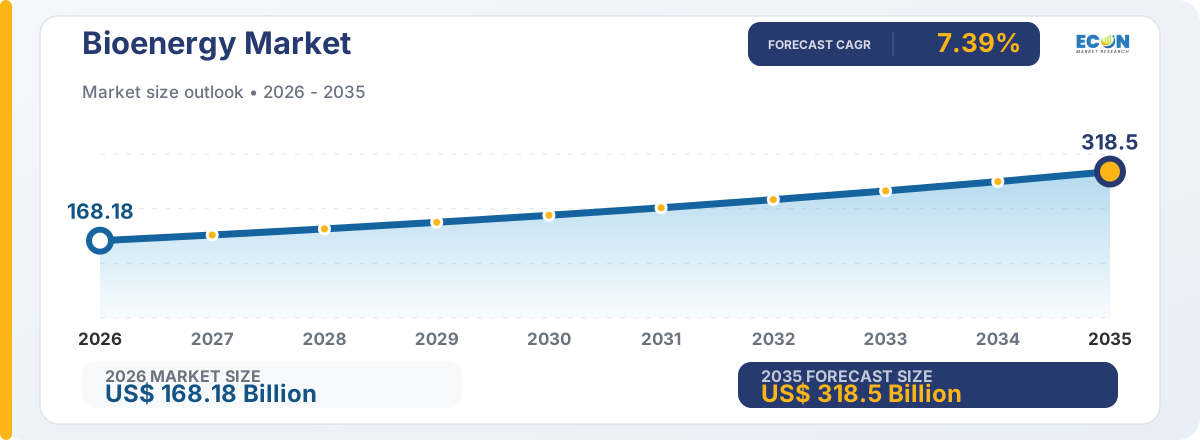
As per Econ Market Research analysis, the Global Bioenergy Market accounted for US$ 168.18 Billion in 2026 and is expected to surpass US$ 318.5 Billion by 2035, witnessing a CAGR of 7.39% throughout 2026–2035. The analysis is based on 2025 as the base year.
The global bio-energy market refers to the market of renewable energy that is produced when Biomass fuel is burned. Biomass fuels are made from organic materials including harvest residues, specially produced crops, and organic waste from our homes, businesses, and farms. Bio-energy is a low-carbon renewable energy source that can be used in place of carbon-intensive fossil fuels. Biomass fuels can be used in situations where there are limited renewable energy sources, such as fuel for airplanes, ships, and vehicles. The market is driven by the increase in demand for energy produced by bio-based fuels and government initiatives to reduce carbon emitting fossil fuel emissions.
Market Dynamics
The market dynamics of bio-energy are influenced by several factors. The increasing demand for energy produced by bio-based fuels and government initiatives to reduce carbon emitting fossil fuel emissions. However, high initial investment to build and manage a bio-energy facilities act as restraints. Opportunities arise from the rising demand of power generation from renewable energy sources and use of bio-fuels in vehicles. The nature of competition is intense, with various companies involved in the production, distribution and sales of products. As the market evolves and consumer demand continues to rise, the dynamics of the bio-energy market are expected to remain dynamic and highly competitive.
Market Drivers
Increase in demand for energy produced by bio-based fuels
The increase in demand for energy produced by bio-based fuels is one of the major drivers in the global bio-energy market. Bio-based fuels are regarded more environmentally benign than fossil fuels because, when properly managed and produced responsibly, they can dramatically cut carbon emissions. Bio-energy can improve energy security by diversifying the energy mix and decreasing reliance on fossil fuels, which are frequently vulnerable to price fluctuation and geopolitical uncertainty. Bio-energy plays an important part in countries efforts to transition to cleaner and more sustainable energy sources driving the market&rsquo,s growth. Thus, the rising demand for energy produced by bio-based fuels is driving the global bio-energy during the forecast period.
Government initiatives to reduce carbon-emitting fossil fuel emissions
The government initiative to reduce carbon-emitting fossil fuel emissions is one of the major drivers in the global bio-energy market. Governments all across the world are taking a range of steps to minimize carbon-emitting fossil fuel pollution. One of the most important measures is to encourage the use of renewable energy sources like bio-energy.
Bio-energy is energy obtained from biomass, which is organic matter found in plants and animals. Bio-energy can produce power, heat, and transportation fuels. Bio-energy is a renewable energy source since it may be created from sustainably cultivated biomass. Thus, the government initiatives to reduce carbon emitting fossil fuel emission are driving the growth of the global bio-energy market during the forecast period.
Restraints
The global bio-energy market faces a restraint in the form of high initial investment. The large initial investment necessary to build and manage bio-energy facilities is a major impediment to the global bio-energy market expansion. The cost of bio-energy facilities varies based on the technology utilized, the size of the facility, and its location. Bio-energy facilities, on the other hand, are often more expensive to create and run than fossil fuel-based facilities. Understanding the cost of investment and the technology required to establish a bio-energy facilities will be useful for the expansion of the bio-energy market. Thus, the high initial investment act as a major restraint in the global bio-energy market during the forecast period.
Opportunities
Power generation from renewable energy sources
The global bio-energy market presents significant opportunities driven by the rising demand from commercial fleets. Bio-energy can be used in a variety of ways to generate electricity, including combustion, gasification, and anaerobic digestion. Bio-energy power plants can produce base-load, mid-merit, and peak power. Bio-energy power generation has several advantages over other renewable energy sources (RES) such as solar and wind power.
Bio-energy power plants can generate electricity on demand since they are dispatchable. This makes them useful for grid balancing and backup power when other RES are unavailable. The growing adoption of bio-energy for power generation from renewable sources creates an opportunity in the global bio-energy market during the forecast period.
Segment Overview
By product type
The market for bio-energy is segmented based on product type into four categories: Solid biomass, liquid bio-fuel, biogas and others. Solid biomass dominates the market segment due to its usage in variety of purposes such as power generation, heat generation, and industrial applications. Wood, wood waste, agricultural waste, and municipal solid waste are all examples of solid biomass. Ethanol, biodiesel, and bio-jet fuel are examples of liquid bio-fuels. Vehicles and aircraft can run on liquid bio-fuels. Biogas is a methane and carbon dioxide combination created by anaerobic digestion of biomass.
Biogas can be converted into power, heat, and transportation fuels. Other bio-energy products include bio-char, bio-oil, and bio-chemicals. Bio-char can be used to increase soil fertility while decreasing greenhouse gas emissions. Bio-oil can be used to create electricity or to fuel vehicles. Bio-chemicals can be used to manufacture a wide range of goods, including polymers, medicines, and food additives. This segmentation allows consumers to choose the product type that best suits their specific needs, preferences.
By Technology
The bio-energy market is categorized based on technology types: combustion, gasification, fast pyrolysis, and anaerobic digestion. Combustion technology segment dominates the market due to its simple and inexpensive technology. The most frequent bio-energy technology is combustion. It entails burning biomass to produce heat or power. Although combustion technologies are very basic and mature, they can be inefficient and pollute the air. Gasification is the process of converting biomass into a synthetic gas known as syngas. Syngas can be converted into power, heat, or transportation fuel.
Gasification technologies are more efficient than combustion technologies and emit less pollutant into the atmosphere. Fast Pyrolysis is a process that converts biomass into bio-oil, bio-char, and syngas. Anaerobic digestion is a process that breaks down biomass in the absence of oxygen to produce biogas. This segmentation allows consumers to choose the technology of bio-energy that aligns with their specific needs and preferences.
Overview by Region
Europe
Europe currently dominates the bio-energy market, and this dominance is expected to continue in the future. The increasing demand for renewable energy, the rising cost of fossil fuels as energy prices in Europe are relatively high which makes bio-energy more competitive. The government support to develop the use of the bio-energy by providing financial incentive is the factors that drive the Europe region market. Thus, with the increasing demand for bio-energy, Europe region is expected to dominate the market in the forecast period.
Asia Pacific
Asia Pacific is experiencing significant growth in the bio-energy market, with a significant compound annual growth rate (CAGR). The region',s rapid economic growth, the rising energy prices, the abundant biomass resources and the government support are the factors driving the region market growth. Growing environmental awareness and the need to minimize greenhouse gas emissions are also driving the market growth. Thus, with the increasing demand for bio-energy market Asia Pacific is expected to witness a substantial CAGR in the coming years.
Competitive Landscape
The competitive landscape of the market is marked by a wide array of players competing for market dominance. The bio-energy market is consolidating. This is owing to the increasing size of expenditure necessary to establish and operate bio-energy plants. The market',s major players are acquiring smaller companies to increase their market share and acquire access to new technologies and resources. Government policies and regulations are also influencing the competitive environment of the bio-energy business.
Subsidies and other incentives are being provided by governments all over the world to encourage the development of the bio-energy sector. This contributes to a more advantageous climate for market participants. As consumer demand for bio-energy continues to grow, the market is anticipated to witness even more intense competition among these players.
Key Players:
Ørsted A/S
Enerkem Inc.
Babcock and Wilcox Enterprises, Inc.
Biomass Engineering Ltd.
EnviTec Biogas AG
Pacific BioEnergy Corporation
Shell plc
BP plc
BTG Biomass Technology Group
Fortum Oyj
MVV Energie AG
A2A S.p.A.
Hitachi Zosen Corporation
Renewable Energy Group, Inc.
Mitsubishi Heavy Industries, Ltd.
Recent Developments
March 2023, The European Union reached a provisional agreement between the Council and Parliament on the update of the Renewable Energy Directive (RED III). The agreement includes increasing sustainability criteria for the use of biomass for energy by employing the ",cascading", approach while taking into account national priorities. In addition, the European Union established a target of 35 billion cubic meters of bio-methane production per year by 2030 in 2022.
December 2022, The U.S. declared a considerable increase in funding through the Inflation Reduction Act, which allocates financial support for various stages of the bioenergy supply chain. This includes enhancing the utilization of sustainable biomass and waste materials in the U.S. for the production of sustainable aviation fuels, chemicals, and biomaterials, such as advanced fertilizers. Additionally, the Act aims to stimulate innovation in these industries, including technologies for conversion processes.
Bioenergy Market Report Scope & Segmentation
| Attributes | Details |
|---|---|
| Market Size (Current)Current market valuation | US$ 168.18 Billion in 2026 |
| Market Size (Forecast)Projected market valuation | US$ 318.5 Billion in 2035 |
| Growth RateCompound Annual Growth Rate | CAGR of 7.39% from 2026 to 2035 |
| Forecast PeriodAnalysis timeline | 2026 – 2035 |
| Base YearReference year for analysis | 2025 |
| Historical Data AvailablePast market data availability | Yes |
| Regional ScopeGeographical coverage | Global |
| Segments CoveredMarket segments analyzed | By Product Type
By Feedstock
By Application
|
Leading companies covered in this report
- Archer-Daniels-Midland (ADM)
- Cargill
- BP PLC
- Chevron (Renewable Energy Group)
- Enerkem
- Gevo
- Woodland Biofuels
- Alto Ingredients
Frequently Asked Questions
Common questions about this report
The study period covers historical insights and forecast projections for the period 2026-2035.
About the Author
Market research expert with years of industry experience

Dipali Bhingare serves as the Market Research Director at Econ Market Research. With a focus on translating complex global economic shifts into actionable business intelligence, she oversees the strategic direction of comprehensive market studies. Her work empowers organizations to navigate volatile industries through data-driven forecasting and deep-dive competitive analysis.