

Biodegradable Polymers Market
Biodegradable Polymers Market Size, Share, Trends, Growth, and Industry Analysis, By Type (PLA, Starch Blends, PHA, Biodegradable Polyesters), By Application (Packaging, Consumer Goods, Textile, Agriculture andamp; Horticulture, Others), Regional Analysis and Forecast Period 2026-2035
Biodegradable Polymers Market Overview
As per Econ Market Research analysis, the Global Biodegradable Polymers Market generated revenue of US$ 15.5 Billion in 2026 and is forecast to achieve US$ 90.39 Billion by 2035, at a CAGR of 21.4% during the study period 2026–2035. The base year considered is 2025.
Biodegradable Polymers Market Size 2025-2035 (USD Billion)

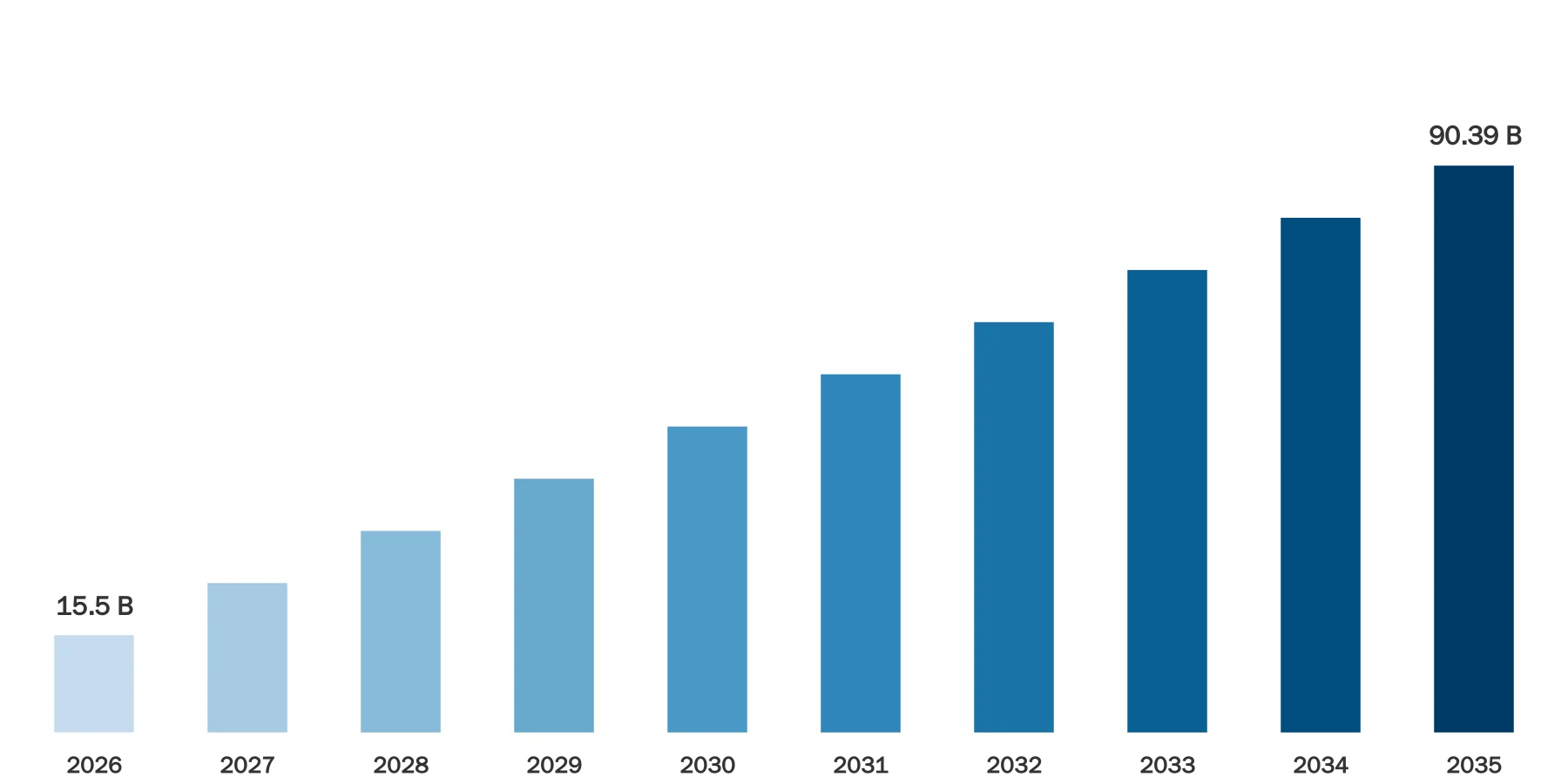
Source: Econ Market Research
The Global Biodegradable polymers market refers to the type of polymer that can be completely degraded by the influence of microorganisms found in the environment. Bio-polymers found in the bio-plastics sector come from the bio-based sources such as sugar cane corn or sugar beet. The ability of biopolymers to breakdown into compounds that can be absorbed by nature, such as water, carbon dioxide, or compost, through the action of microorganisms prevalent in the environment is referred to as biodegradability. The market is driven by increasing demand in the packaging industry and growing consumer demands due to industrialization and urbanization.
Market Dynamics
The market dynamics of biodegradable polymers are influenced by several factors. The increasing demand in the packaging industry and growing consumer demands due to industrialization and urbanization drives the market growth. However, higher price of biodegradable polymers act as restraints. Opportunities arise from the increasing investments on Sustainable Packaging. The nature of competition is highly intense, with various companies striving to gain a competitive edge through innovation and customer-centric offerings. As the market evolves and consumer demand continues to rise, the dynamics of the biodegradable polymers market are expected to remain dynamic and highly competitive.
Market Drivers
Increasing demand in the packaging industry
The global biodegradable polymers market is being driven by the increasing demand in the packaging industry. Biodegradable polymers are a more environmentally friendly alternative to typical petroleum-based plastics, and they are gaining popularity in the packaging business due to the government regulations to reduce the use of single use plastics and promote sustainable packaging solutions.
Additionally, consumers are opting for more sustainable packaging solutions as they are becoming more aware of the environmental impact of the harmful plastic packaging. As a result, due to the increasing demand from packaging industry the biodegradable polymers market is expected to grow during the forecast period.
Growing consumer demands due to industrialization and urbanization
The global Biodegradable polymers market is being fuelled by the growing consumer demands due to industrialization and urbanization. Population, income, and consumption are rising as a result of industrialization and urbanization. This increases demand for a wide range of goods and services, including packing materials. Biodegradable polymers are utilized in a range of packaging applications, including food packaging, beverage packaging, and personal care packaging. Thus, with the growing consumer demands due to industrialization and urbanization the biodegradable polymers market is expected to grow during the forecast period.
Restraints:
Higher price of Biodegradable Polymers
The global Biodegradable polymers market faces a restraint in the form of higher price of biodegradable polymers. Biodegradable polymers are typically more expensive than standard petroleum-based plastics. This is due to the fact that biodegradable polymers are generated from renewable resources such as maize starch and sugarcane, which are more expensive than crude oil. Furthermore, the synthesis of biodegradable polymers is generally more difficult and requires specialized equipment, which might add to the greater cost. Thus, the higher price of biodegradable polymers acts a major restraint in the global biodegradable polymers market.
Opportunities:
Investments on sustainable packaging
The global biodegradable polymers market presents significant opportunities driven by the rising investments on sustainable packaging. The investments in technological advancements to develop new and improved biodegradable polymers products with improved properties, such as higher strength, better biodegradability, and lower cost makes the biodegradable polymers more competitive.
The companies in the industry who can develop and manufacture high-quality, low-cost biodegradable polymers are well-positioned to prosper in the expanding market. Thus, with the increasing investments on sustainable packaging there is a significant opportunity in the global biodegradable polymers market during the forecast period.
Segment Overview
By Type
The market for Biodegradable polymers is segmented based on type into five categories: Polylactic Acid, Starch Blends, Polyhydroxy Alkanoates, Cellulose Derivatives, Others (polybutylene succinate (PBS), polycaprolactone (PCL), and poly (glycolic acid) (PGA)). Starch blends are dominating the market in the biodegradable polymers market. Starch is a renewable material that can be used to make biodegradable plastics like polylactic acid (PLA) and polyhydroxyalkanoates (PHAs). Polylactic acid (PLA) is a biodegradable material made from renewable sources like corn starch and sugarcane.
PLA is compostable and recyclable, making it a more environmentally friendly alternative to traditional plastics. Polyhydroxy Alkanoates (PHAs) are a type of biodegradable plastic that microorganisms generate. PHAs are biodegradable in a variety of environments, making them an adaptable material for a wide range of applications. Cellulose derivatives are biodegradable plastics made from cellulose, the primary constituent of plant cell walls.
Because cellulose derivatives are biodegradable and compostable, they offer a more environmentally friendly alternative to standard plastics. Other biodegradable polymers include polybutylene succinate (PBS), polycaprolactone (PCL), and poly(glycolic acid) (PGA). These polymers are used in a variety of applications, such as food packaging, Medical Devices, and agricultural products. This segmentation allows consumers to choose the type of biodegradable polymers that best suits their specific needs, preferences, and budgetary constraints.
By Application
The Biodegradable polymers market is segmented based on application into packaging, agriculture, healthcare and others. Packaging is the dominant segment in the global biodegradable polymers market. Biodegradable polymers are utilized in a range of packaging applications, including food packaging, beverage packaging, and agricultural packaging. Agriculture is another important application for biodegradable polymers. Biodegradable polymers are employed in a range of agricultural applications, including mulch films, seed coatings, and erosion control.
Biodegradable polymers are also employed in a number of medical devices such as sutures, stents, and Drug delivery systems. Biodegradable polymers are ideal for medical devices since they are biodegradable, biocompatible, and non-toxic. Consumer products, textiles, and electronics are some of the other applications for biodegradable polymers. Biodegradable polymers are found in a wide range of consumer products, including toys, kitchenware, and disposable dinnerware. Biodegradable polymers are also used to improve the performance and sustainability of textiles and electronics. This market segmentation enables tailored solutions for biodegradable polymers applications, catering to specific requirements and preferences.
Overview by Region
Europe
Europe currently dominates the biodegradable polymers market, and this dominance is expected to continue in the future. The region regulations and policies to address plastic waste and promote sustainable practices is restricting the use of single use plastic use products and promoting biodegradable plastics. As the demand for biodegradable polymers continues to rise, Europe is projected to maintain its leading position in the market in the coming years.
Asia Pacific
Asia Pacific is experiencing significant growth in the biodegradable polymer market, with a significant Compound Annual Growth Rate (CAGR). The region increasing awareness of the environmental impact from traditional plastics and the growing demand for compostable and recyclable plastics is driving the market growth. With the continuous advancements and the rising demand in biodegradable polymers technology, Asia Pacific is expected to witness a substantial CAGR in the coming years.
Competitive Landscape
The market for biodegradable polymers is characterised by fierce competition and a quickly changing environment due to the growing demand for environmentally friendly and sustainable materials. Leading companies in the sector are concentrating on R&,D endeavours to augment the functionality and adaptability of biodegradable polymers, consequently broadening their uses in diverse sectors.
Prominent corporations like NatureWorks LLC, BASF SE, and Corbion N.V. command a large share of the market thanks to their robust global reach and wide range of products. One of the industry',s pioneers, NatureWorks LLC, is well-known for its Ingeo brand of biopolymers made from renewable resources, mainly maize. To stay ahead of the competition, this company has continuously made investments in technological advancements and partnerships. Similarly, by utilising its knowledge of materials science, the massive chemical company BASF SE has made great progress towards creating biodegradable polymers. The ecoflex and ecovio brands of the company are well-known for their adaptability and sustainability.
The market has seen the rise of creative startups and small- to medium-sized enterprises (SMEs) in addition to well-established players, which has altered the dynamics of competition. These organisations frequently concentrate on unique formulations and niche applications, upending established players and adding variety to the market. Examples are FKuR Kunststoff GmbH, which specialises in compostable and biodegradable plastics, and Danimer Scientific, which is well-known for its biodegradable polymers based on polyhydroxyalkanoates (PHA).
Key Players:
BASF SE
NatureWorks LLC
Novamont S.p.A.
Total Corbion PLA
Mitsubishi Chemical Corporation
Danimer Scientific
Biome Bioplastics Limited
Corbion N.V.
Eastman Chemical Company
Toray Industries, Inc.
Plantic Technologies Limited
Arkema S.A.
FKuR Kunststoff GmbH
Cardia Bioplastics
Tianan Biologic Material Co., Ltd.
Recent Developments
May 2023, a new collaboration between the University of Nottingham, Croda International Plc, and the University of York has been formed. The initiative aims to pioneer the development of innovative and sustainable polymers tailored for liquid formulations. Experts from the University of Nottingham&rsquo,s School of Chemistry and the University of York will join forces with Croda, a company known for leveraging smart science to craft high-performance ingredients and solutions that enhance quality of life. Together, they will tackle the task of creating cutting-edge biobased and biodegradable polymers specifically designed for liquid polymer
March 2022, Solvay, a prominent player in naturally sourced beauty polymers, is broadening its portfolio of biodegradable guar-based solutions, initially unveiled in December 2021. The latest additions, Jaguar®, NAT SGI and Jaguar®, Excel, serve as advanced thickening and conditioning polymers for beauty care. These innovations empower beauty brands to meet increasingly rigorous global regulations and fulfil the rising consumer demand for beauty products that align with principles of responsibility and sustainability.
Biodegradable Polymers Market Report Scope & Segmentation
| Attributes | Details |
|---|---|
Market Size (Current) | US$ 15.5 Billion in 2026 |
Market Size (Forecast) | US$ 90.39 Billion in 2035 |
Growth Rate | CAGR of 21.4% from 2026 to 2035 |
Forecast Period | 2026 – 2035 |
Base Year | 2025 |
Historical Data Available | Yes |
Regional Scope | Global |
Segments Covered | By Type
By Application
|
Frequently Asked Questions
Common questions about this report
The study period covers historical insights and forecast projections for the period 2026-2035.
About the Author
Market research expert with years of industry experience

Dipali Bhingare serves as the Market Research Director at Econ Market Research. With a focus on translating complex global economic shifts into actionable business intelligence, she oversees the strategic direction of comprehensive market studies. Her work empowers organizations to navigate volatile industries through data-driven forecasting and deep-dive competitive analysis.
Related Reports
Explore more market insights from the same category