

Baby Wipes Market
Baby Wipes Market Size, Share, Trends, Growth, and Industry Analysis, By Product (Dry Wipes, Wet Wipes), By Distribution Channel (Hypermarket/Supermarket, Pharmacy and Drug Stores, E-commerce, Others), Regional Analysis and Forecast Period 2026-2035
Baby Wipes Market Overview
As per Econ Market Research analysis, the Global Baby Wipes Market valuation stood at US$ 6.53 Billion in 2026 and is expected to reach US$ 10.44 Billion by 2035, growing at a steady CAGR of 5.35% from 2026 to 2035. 2025 serves as the base year.
Baby Wipes Market Size 2025-2035 (USD Billion)

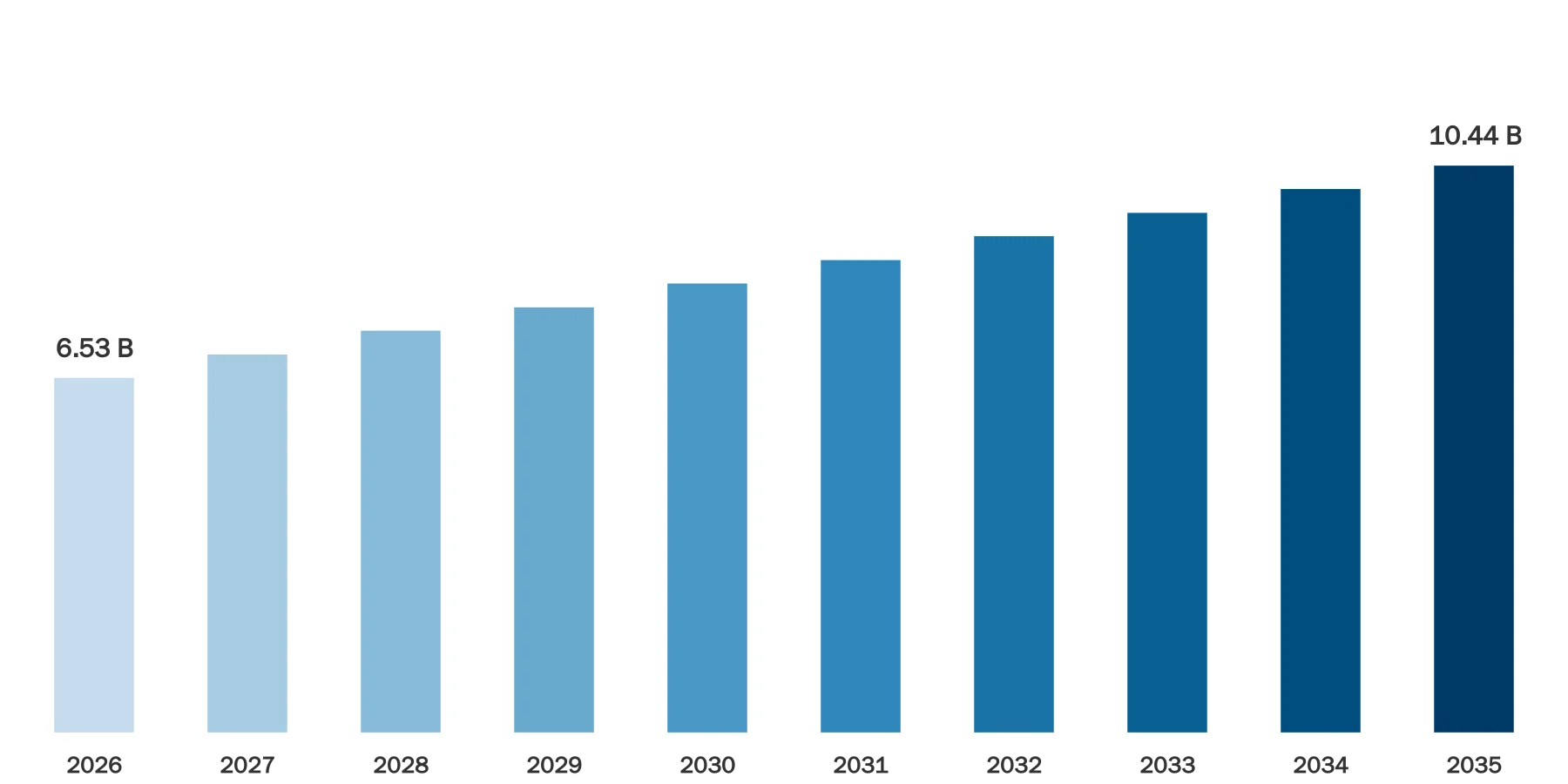
Source: Econ Market Research
The Baby Wipes Market is a critical segment of the global Personal Care industry, with over 420 billion units of baby wipes consumed annually worldwide as of 2024. Approximately 78% of households with infants aged 0–3 years use baby wipes daily, with average usage reaching 6–10 wipes per diaper change. The market includes wet wipes, dry wipes, biodegradable wipes, and medicated wipes, with wet wipes accounting for nearly 85% of total volume demand. Around 65% of global production is concentrated in Asia and North America combined. Increasing birth rates in developing economies contribute to over 55 million new consumers annually entering the baby wipes market.
The USA Baby Wipes Market accounts for nearly 18% of global consumption volume, with over 3.6 million births recorded annually and approximately 92% of parents using disposable wipes. Average monthly usage per infant in the United States exceeds 320 wipes, translating into nearly 115 billion wipes consumed annually. Private-label products account for around 28% of total retail sales volume, while premium organic wipes represent 14% of purchases. Online retail contributes approximately 34% of total distribution, reflecting a strong shift toward e-commerce. Nearly 70% of parents prefer Fragrance-free wipes, and 60% actively check ingredient lists, indicating a strong preference for safer and dermatologically tested products.
Market Latest Trends
The Baby Wipes Market Trends highlight a significant shift toward sustainable and chemical-free products, with over 48% of new product launches in 2024 labeled biodegradable or compostable. Manufacturers are increasingly using plant-based fibers such as bamboo and cotton, which now account for approximately 22% of total wipe materials globally. Plastic-free wipes have seen a 30% increase in shelf presence across retail stores in the last 2 years, reflecting changing consumer preferences.
In Baby Wipes Market Analysis, fragrance-free and hypoallergenic wipes dominate, comprising nearly 62% of product offerings in developed regions. The demand for sensitive-skin wipes has grown rapidly, with 1 in 3 parents reporting infant skin sensitivity issues. Smart packaging innovations, including resealable lids and moisture-lock technologies, are used in over 75% of premium products, improving product longevity by up to 20%.
Baby Wipes Market Insights also reveal growing demand for bulk packaging, with multi-pack bundles representing 55% of total sales volume. Subscription-based online purchases have increased by 40% between 2022 and 2025, driven by convenience. Additionally, dermatologically tested wipes now represent 68% of global offerings, highlighting the industry’s focus on safety standards.
Market Dynamics
The Baby Wipes Market Growth is influenced by rising infant population, urbanization rates exceeding 56% globally, and increasing hygiene awareness among parents. More than 72% of parents worldwide prioritize hygiene products as essential baby care items. The Baby Wipes Market Outlook is further supported by increased disposable income levels, particularly in emerging markets where middle-class households have grown by over 35% in the past decade.
DRIVER
Increasing Demand for Infant Hygiene Products
The primary driver in the Baby Wipes Market is the rising emphasis on infant hygiene, with over 85% of parents using wipes for diaper changes and cleaning purposes. Hospitals and maternity centers recommend wipes in 90% of newborn care kits, increasing adoption rates immediately after birth. The number of working mothers has increased by over 25% globally, boosting demand for convenient hygiene solutions. In urban households, baby wipes usage is nearly 2.5 times higher than rural areas. Additionally, product innovations such as alcohol-free and paraben-free wipes have increased consumer trust, with over 70% of parents preferring chemical-free formulations.
RESTRAINT
Environmental Concerns Related to Non-Biodegradable Wipes
A key restraint in the Baby Wipes Industry Analysis is environmental impact, as nearly 90% of conventional wipes contain synthetic fibers that take over 100 years to decompose. Approximately 11 billion wipes are disposed of daily worldwide, contributing to landfill overflow and sewer blockages. Regulatory pressures have increased, with over 25 countries implementing restrictions on plastic-based wipes. Consumer awareness has grown significantly, with 58% of parents expressing concerns about environmental sustainability. Additionally, wastewater systems report that wipes contribute to over 70% of blockages in urban sewage networks, creating operational challenges.
OPPORTUNITY
Expansion of Eco-Friendly and Organic Wipes
The Baby Wipes Market Opportunities are expanding with the adoption of eco-friendly wipes, which now represent 18% of total market volume. Demand for organic baby wipes has grown significantly, with over 45% of millennial parents preferring natural ingredients. Biodegradable wipes can decompose within 30–90 days, compared to over 100 years for synthetic wipes, making them attractive alternatives. Emerging markets in Asia-Pacific and Latin America are witnessing a 20% increase in organic product availability. Certifications such as dermatological testing and eco-labels influence purchasing decisions for over 65% of consumers, providing strong growth opportunities.
CHALLENGES
Rising Raw Material and Manufacturing Costs
The Baby Wipes Market Challenges include rising costs of raw materials such as nonwoven fabrics, which have increased by 15–20% in the last 3 years. Packaging materials account for nearly 25% of total production costs, and fluctuations in pulp prices impact overall profitability. Additionally, compliance with safety regulations has increased operational costs by 12–18% for manufacturers. Supply chain disruptions have LED to delays in production, affecting over 30% of global suppliers. Small manufacturers face challenges in maintaining quality standards, as over 40% of product recalls in 2023 were due to contamination or labeling issues.
SWOT Analysis
Strengths
High product penetration with over 90% usage in developed markets
Essential daily-use product with average consumption of 6–10 wipes per use
Strong brand loyalty, with 65% repeat purchase rates
Wide product variety including over 200 SKUs globally
Weaknesses
Environmental concerns with 90% of wipes being non-biodegradable
High dependency on raw materials, accounting for 60% of production cost
Limited shelf life of 18–24 months for most products
High packaging waste, contributing to 25% of total product waste volume
Opportunities
Eco-friendly wipes growing at 18% market share
Increasing demand in emerging markets with over 50 million births annually
Expansion of e-commerce contributing 34% of sales
Innovation in biodegradable materials reducing decomposition time to 30–90 days
Threats
Regulatory restrictions in 25+ countries on plastic wipes
Competition from reusable cloth wipes used by 12% of eco-conscious consumers
Supply chain disruptions affecting 30% of manufacturers
Rising production costs increasing by 15–20% over recent years
Segmentation Analysis
The Baby Wipes Market Segmentation is divided by product type and distribution channel, with each segment contributing significantly to overall Baby Wipes Market Share. Product segmentation includes wet wipes, dry wipes, and eco-friendly wipes, while distribution channels include supermarkets, pharmacies, and online platforms. Over 85% of sales volume is generated from wet wipes, while online channels contribute 34% of global sales.
By Product
Wet wipes dominate the Baby Wipes Market Size, accounting for approximately 85% of total volume, driven by convenience and widespread usage. Dry wipes hold around 10% market share, mainly used in combination with water for sensitive skin applications. Eco-friendly and biodegradable wipes account for 5–8% of total volume, but their adoption is increasing rapidly due to environmental awareness.
Sensitive-skin wipes represent 40% of total product demand, followed by antibacterial wipes at 25%. Fragrance-free wipes dominate with 62% share, reflecting consumer preference for safer products. Cotton-based wipes have gained traction, representing 22% of material usage, while synthetic fiber wipes still dominate with 78% share.
By Distribution Channel
Supermarkets and hypermarkets account for nearly 45% of total Baby Wipes Market Share, offering wide product availability and competitive pricing. Pharmacies contribute around 18% of sales, focusing on premium and medicated wipes. Online retail channels have grown significantly, accounting for 34% of global distribution, driven by convenience and subscription services.
Convenience stores represent approximately 8% of total sales, mainly catering to urgent purchases. Subscription-based sales models have increased by 40%, providing consistent demand for manufacturers. Bulk purchasing through online platforms has grown, with over 55% of consumers preferring multi-pack options, reducing cost per unit by up to 20%.
Regional Analysis
The Baby Wipes Market Outlook varies across regions, with North America and Asia-Pacific collectively accounting for over 60% of global consumption. Europe holds a significant share due to high hygiene standards, while Middle East & Africa is experiencing steady growth with increasing urbanization rates above 50%.
North America
North America accounts for approximately 30% of global market share
Over 90% household penetration rate for baby wipes
North America leads the Baby Wipes Market Analysis with high product adoption and advanced manufacturing capabilities. The United States dominates the region, contributing nearly 75% of regional consumption, followed by Canada at 15%. Around 92% of parents use baby wipes daily, with average usage exceeding 320 wipes per month per infant.
Premium and organic wipes account for 20% of regional sales, reflecting consumer preference for high-quality products. Online sales contribute 38% of total distribution, driven by subscription services. Sustainability initiatives have increased, with over 35% of new products launched in 2024 being biodegradable.
Europe
Europe holds around 25% of global Baby Wipes Market Share
Over 85% usage among households with infants
Europe shows strong demand for eco-friendly products, with 40% of consumers preferring biodegradable wipes. Countries such as Germany, France, and the UK account for 60% of regional consumption. Regulatory standards are stringent, with over 20 regulations governing product safety and environmental impact.
Private-label brands hold 30% market share, offering affordable alternatives. Fragrance-free wipes dominate with 65% share, reflecting health-conscious consumers. Retail distribution is led by supermarkets, contributing 50% of sales, followed by online platforms at 28%.
Asia-Pacific
Asia-Pacific accounts for nearly 35% of global consumption
Over 55 million births annually drive demand
Asia-Pacific is the fastest-growing region in the Baby Wipes Industry Report, driven by population growth and rising disposable incomes. China and India together account for 45% of regional demand, while Southeast Asia contributes 20%.
Urbanization rates exceeding 60% in major economies have increased product adoption. Local manufacturers dominate with 50% market share, offering cost-effective products. Online retail is expanding rapidly, contributing 30% of total sales, while supermarkets account for 40%.
Middle East & Africa
Holds approximately 10% of global Baby Wipes Market Share
Urbanization rates above 50% support growth
The Middle East & Africa region is witnessing increasing demand, with baby wipes usage growing in urban households by over 25%. Gulf countries account for 40% of regional consumption, driven by higher income levels.
Imported products dominate with 60% share, while local manufacturing is expanding. Supermarkets contribute 48% of sales, followed by pharmacies at 20%. Awareness campaigns on hygiene have increased usage rates, with over 70% of urban parents adopting wipes for infant care.
Competitive Landscape
The Baby Wipes Market Competitive Landscape is characterized by the presence of over 150 global and regional manufacturers, with the top 10 companies accounting for nearly 55% of total market share. Large players focus on innovation, launching over 200 new products annually, while smaller companies compete through pricing strategies.
Private-label brands have gained traction, accounting for 28% of total sales, especially in North America and Europe. Product differentiation is driven by features such as hypoallergenic formulations, biodegradable materials, and improved packaging technologies.
Research and development investments have increased, with leading companies allocating 8–12% of operational budgets toward innovation. Distribution networks play a critical role, with companies partnering with over 500,000 retail outlets globally. Brand loyalty remains strong, with 65% of consumers repurchasing the same brand, indicating competitive stability.
List of Top Baby Wipes Companies
Johnson & Johnson Services, Inc.
KCWW
Procter & Gamble
Unicharm Corporation
BABISIL
Cotton Babies, Inc.
Farlin-Global
Hengan International Group Company Ltd.
Himalaya Wellness Company
Pigeon Corporation
Leading Companies by Market Share
Procter & Gamble and Kimberly-Clark (KCWW) together hold approximately 30% of global Baby Wipes Market Share, with distribution networks covering over 180 countries. Procter & Gamble leads with around 17% share, supported by strong brand recognition and over 100 product variants, while Kimberly-Clark holds nearly 13% share, driven by innovation and presence in over 175 markets.
Market Investment Outlook
The Baby Wipes Market Investment Outlook indicates strong opportunities in product innovation and regional expansion, with over 200 manufacturing facilities globally dedicated to baby wipes production. Investments in eco-friendly materials have increased by 35% between 2022 and 2025, reflecting sustainability trends.
Emerging markets present significant opportunities, with over 60% of future demand expected from Asia-Pacific and Africa. Companies are investing in automation, reducing production time by 20–25% and improving efficiency.
E-commerce infrastructure investments have increased, with companies allocating 15% of marketing budgets to digital channels. Partnerships with retailers have expanded, covering over 500,000 distribution points globally. Venture capital investments in sustainable baby care products have grown by 40%, highlighting strong investor interest.
New Product Development
New product development in the Baby Wipes Market focuses on safety, sustainability, and convenience, with over 48% of new launches featuring biodegradable materials. Innovations include wipes made from bamboo fibers, which decompose within 60 days, compared to synthetic wipes taking over 100 years.
Dermatologically tested products now represent 68% of new launches, ensuring safety for sensitive skin. Companies are introducing water-based wipes with 99% purified water content, reducing chemical exposure. Packaging innovations such as moisture-lock lids have improved product lifespan by 20%.
Smart packaging with antibacterial surfaces has been adopted in 15% of premium products, enhancing hygiene. Multi-functional wipes designed for both baby and household use are gaining popularity, accounting for 12% of new product introductions.
Recent Developments
In 2023, over 50 new biodegradable wipe products were launched globally, increasing eco-friendly product share to 18%.
In 2024, a leading manufacturer introduced wipes with 99.9% water content, reducing chemical usage by 80%.
In 2025, packaging innovations improved moisture retention by 20%, extending shelf life by 6 months.
In 2023, online subscription services for baby wipes grew by 40%, increasing recurring purchases.
In 2024, over 25 countries implemented stricter regulations on plastic-based wipes, accelerating sustainable product development.
Report Coverage of Baby Wipes Market
The Baby Wipes Market Report provides comprehensive insights into market size, trends, segmentation, and regional performance, covering over 50 countries and 150 manufacturers globally. The report includes analysis of 200+ product variants, highlighting differences in materials, formulations, and packaging.
The Baby Wipes Market Research Report examines consumer behavior, showing that over 70% of parents prioritize safety and ingredient transparency. Distribution analysis covers supermarkets, pharmacies, and online platforms, which collectively account for over 95% of sales channels.
The report also evaluates regulatory frameworks, with over 30 policies impacting product development and labeling. Technological advancements such as biodegradable materials and smart packaging are analyzed, representing 48% of recent innovations.
Additionally, the Baby Wipes Market Insights section provides data on production capacity, with global output exceeding 420 billion units annually, and supply chain networks spanning over 500,000 retail outlets worldwide.
Baby Wipes Market Report Scope & Segmentation
| Attributes | Details |
|---|---|
Market Size (Current) | US$ 6.53 Billion in 2026 |
Market Size (Forecast) | US$ 10.44 Billion in 2035 |
Growth Rate | CAGR of 5.35% from 2026 to 2035 |
Forecast Period | 2026 – 2035 |
Base Year | 2025 |
Historical Data Available | Yes |
Regional Scope | Global |
Segments Covered | By Product
By Distribution Channel
|
Frequently Asked Questions
Common questions about this report
The study period covers historical insights and forecast projections for the period 2026-2035.
About the Author
Market research expert with years of industry experience

Related Reports
Explore more market insights from the same category