

Automotive 3D Printing Market
Automotive 3D Printing Market Size, Share, Trends, Growth, and Industry Analysis, By Technology (Stereolithography (SLA), Selective Laser Sintering (SLS), Fused Deposition Modeling (FDM), Electron Beam Melting (EBM)), By Application (Prototyping andamp; Tooling, Research andamp; Development, Manufacturing), By Material (Metals, Polymers, Ceramics), Regional Analysis and Forecast Period 2026-2035
Automotive 3D Printing Market Overview
As per Econ Market Research analysis, the Global Automotive 3D Printing Market valuation stood at US$ 6.67 Billion in 2026 and is expected to reach US$ 23.19 Billion by 2035, growing at a steady CAGR of 14.79% from 2026 to 2035. 2025 serves as the base year.
Automotive 3D Printing Market Size 2025-2035 (USD Billion)

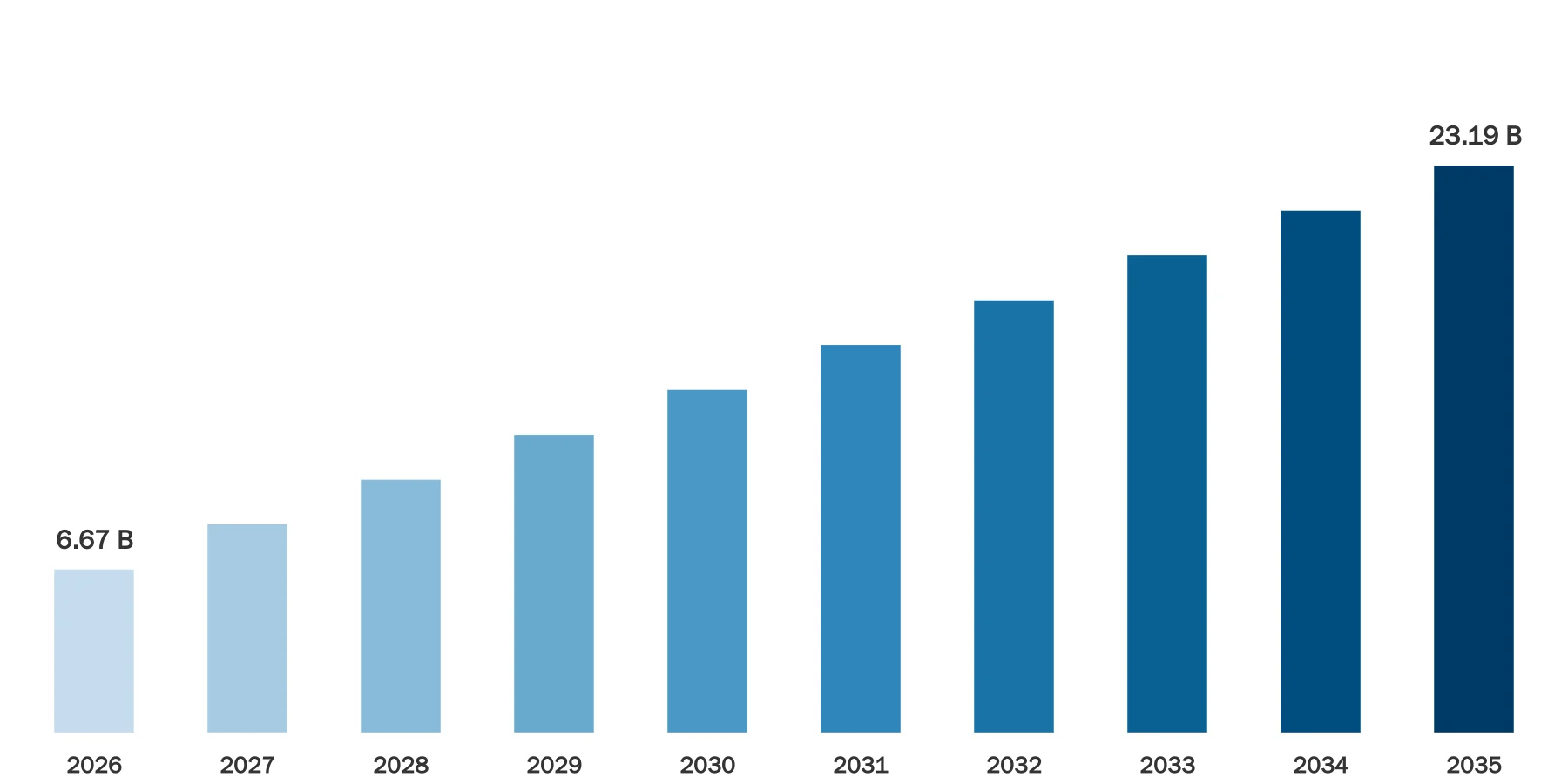
Source: Econ Market Research
Automotive 3D Printing technology builds objects layer by layer, allowing for intricate designs and customization. In this market, companies use 3D printers to manufacture car parts, prototypes, and even entire vehicles. The automotive 3D printing market has been rapidly growing due to its ability to reduce production time, costs, and material waste. It enables manufacturers to create complex shapes and lightweight components, enhancing vehicle performance and fuel efficiency. Moreover, 3D printing offers flexibility in design iterations, allowing for rapid prototyping and innovation. As a result, the automotive industry is increasingly adopting 3D printing technology to streamline production processes and stay competitive in the market. This trend is expected to continue driving the growth of the global automotive 3D printing market in the coming years.
Automotive 3D Printing Dynamics
The automotive sector remains innovative due to the progress made in 3D printing materials and procedures. The use of 3D printing in vehicle manufacturing is growing as a result of these developments, which allow producers to create strong, long-lasting parts at reduced prices. Secondly, the use of 3D printing technology is being propelled by the growing need for lightweight and fuel-efficient automobiles. Automakers can create intricate geometries that minimize weight without sacrificing strength by utilizing 3D printing, which enhances vehicle performance and fuel efficiency.
Another important factor propelling market expansion is the automobile industry',s increasing emphasis on environmental preservation and sustainability. Compared to conventional production techniques, 3D printing has the advantage of minimizing material waste, which is consistent with the industry',s sustainability objectives. Additionally, new applications for 3D printing are made possible by the move to electric and driverless vehicles. While manufacturers investigate novel designs and components for these cutting-edge technologies, 3D printing offers a versatile and effective manufacturing option.
However, challenges such as regulatory constraints and intellectual property concerns may hinder market growth. Regulatory standards for automotive parts produced through 3D printing need to be established to ensure safety and compliance. Moreover, protecting intellectual property rights in a digital manufacturing environment presents challenges related to design piracy and counterfeiting.
Automotive 3D Printing Drivers
Technological Advancements
The market for automotive 3D printing is significantly driven by ongoing technological breakthroughs in the field. Advancements in materials science, printing techniques, and software have expanded the potential of 3D printers, enabling more effective and high-quality manufacturing of intricate vehicle components. For instance, the automobile sector now has more uses due to the creation of metal alloys and high-performance polymers designed especially for 3D printing.
Furthermore, improvements in printing speed and accuracy allow for quicker production cycles and prototyping, which shortens the time it takes to bring new cars and components to market. Overall, these technological advancements drive adoption by automakers seeking to leverage 3D printing for agile manufacturing and product innovation.
Demand for Lightweight and Fuel-Efficient Vehicles
Another important factor propelling the automotive 3D printing market is the growing need for lightweight and fuel-efficient automobiles. With its ability to create intricate geometries and lattice structures that maximize weight without compromising strength, 3D printing is perfect for generating lightweight car parts, including interior trim, chassis parts, and engine parts.
In order to reduce emissions and increase fuel efficiency, lightweighting is essential. This is in line with worldwide trends toward environmental conservation and sustainability. Additionally, lighter parts improve the handling, acceleration, and range of electric vehicles, among other aspects of vehicle performance. With fuel efficiency and sustainability becoming top priorities for manufacturers, 3D printing will likely become more and more necessary in the car industry.
Automotive 3D Printing Restraints:
Regulatory Constraints
Standards and regulatory uncertainty are major barriers to the automobile 3D printing sector. The absence of uniform policies pertaining to the calibre, security, and functionality of 3D-printed car components poses obstacles to their broad implementation. A complex regulatory environment must be negotiated by automakers and 3D printing suppliers, which causes uncertainty and delays in product development and certification. Addressing safety concerns and fostering trust in the calibre of 3D-printed vehicle components require the establishment of extensive and precise regulatory frameworks that are suited to 3D printing technology.
Intellectual Property Concerns
Intellectual property (IP) concerns present another restraint to the automotive 3D printing market. The digital nature of 3D printing makes it susceptible to IP infringement, including unauthorized reproduction of patented designs and counterfeiting of automotive parts. Protecting proprietary designs and enforcing IP rights in a digital manufacturing environment is challenging, leading to concerns among automakers and original equipment manufacturers (OEMs) about the security of their intellectual property. Addressing these concerns requires the development of robust strategies for IP protection, including encryption technologies, digital rights management, and legal mechanisms for enforcing IP rights in the context of 3D printing.
Automotive 3D Printing Opportunities:
Customization and Personalization
Personalization and customization present a large opportunity for the vehicle 3D printing sector. With 3D printing, fully personalized car parts that fit specific needs and tastes can be produced. Automakers may now offer distinctive and differentiating products that appeal to a wide range of consumer interests thanks to 3D printing, from custom-designed exterior body components to personalized dashboard panels and interior trim. In addition to improving the driving experience overall, customization promotes customer happiness and brand loyalty. Automakers may use 3D printing technology to set themselves apart from the competition and obtain a competitive advantage as consumers want more customized goods and experiences.
Segment Overview
By Technology Type
The automotive 3D printing market encompasses various technology types that enable the Additive Manufacturing process. Selective Laser Sintering (SLS) utilizes a laser to sinter powdered material, such as polymer or metal, layer by layer to create 3D objects. Stereo Lithography (SLA) involves using a UV laser to solidify liquid resin into precise shapes based on digital designs. Digital Light Processing (DLP) operates similarly to SLA but uses a digital light projector to cure resin.
Electronic Beam Melting (EBM) employs an electron beam to melt and fuse metal powders, offering high precision and complex geometries. Selective Laser Melting (SLM) utilizes a high-power laser to melt and fuse metal powders together, producing strong and durable components. Fused Deposition Modeling (FDM) extrudes thermoplastic materials layer by layer, making it suitable for prototyping and producing functional parts.
By Application Type
Production and prototyping/R&,D are the two main application categories that the automotive 3D printing market caters to. Direct production line manufacturing of automobile components and end-use parts is accomplished through the use of 3D printing technology. Benefits from this strategy include shorter lead times, lower costs, and more design flexibility. 3D printing is used in research and development (R&,D) and prototyping to produce models, prototypes, and concept designs for testing and validation. Rapid customisation and iteration made possible by 3D printing shortens the time it takes to build a product and encourages creativity in vehicle design.
By Component Type
The automotive 3D printing market comprises three main component types: hardware, software, and services. Hardware includes 3D printers, scanners, and other equipment necessary for additive manufacturing processes. Software encompasses design and simulation tools, slicing software, and workflow management solutions that enable digital design and control of the 3D printing process. Services encompass consulting, training, maintenance, and support services provided by 3D printing companies to assist automotive manufacturers in adopting and optimizing additive manufacturing technologies.
By Material Type
Materials used in automotive 3D printing are categorized into three main types: metal, polymer, and ceramic. Metal materials such as titanium, aluminum, and stainless steel are commonly used for producing structural components and high-performance parts with excellent mechanical properties. Polymer materials such as ABS, PLA, and nylon offer versatility and cost-effectiveness for prototyping and producing non-structural components. Ceramic materials such as zirconia and alumina provide heat resistance and electrical insulation properties, making them suitable for specialized automotive applications such as engine components and electronic housings. Each material type offers unique properties and advantages for different automotive manufacturing needs.
Automotive 3D Printing Overview by Region
North America, particularly the United States, holds a significant share of the market, driven by the presence of leading automotive manufacturers, technological innovation hubs, and favourable government initiatives supporting additive manufacturing. Europe is another prominent region in the market, with countries like Germany and the United Kingdom leading in automotive 3D printing adoption.
The region benefits from strong investments in research and development, robust manufacturing infrastructure, and a growing emphasis on sustainability in the automotive sector. Additionally, Asia Pacific is experiencing rapid growth in the automotive 3D printing market, fuelled by increasing automotive production, rising investments in advanced manufacturing technologies, and government initiatives promoting indigenous innovation and digitalization.
Countries like China, Japan, and South Korea are key players in the region, leveraging 3D printing to enhance manufacturing capabilities and gain a competitive edge in the global automotive market. Emerging economies in Latin America and the Middle East &, Africa regions are also witnessing growing interest in automotive 3D printing, driven by expanding automotive industries, rising demand for customized vehicles, and efforts to reduce dependence on imported Automotive Components. However, challenges such as regulatory barriers, infrastructure limitations, and technological readiness may constrain market growth in these regions.
Automotive 3D Printing Market Competitive Landscape
Leading companies such as Stratasys Ltd., 3D Systems Corporation, and EOS GmbH are prominent players in the market, offering a wide range of 3D printing technologies, materials, and services tailored to the automotive industry. These companies focus on strategic partnerships, collaborations, and acquisitions to strengthen their market presence and enhance their technological capabilities. Additionally, multinational automotive manufacturers such as BMW, Volkswagen, and Ford are increasingly integrating 3D printing into their production processes to achieve cost savings, improve supply chain efficiency, and accelerate product development.
Moreover, emerging players and start-ups are entering the market with innovative solutions and disruptive business models, further intensifying competition. These companies leverage advancements in materials science, software algorithms, and automation technologies to address evolving customer demands and industry trends. As the automotive 3D printing market continues to evolve, competition is expected to intensify further, driving continuous innovation and differentiation among market players.
Automotive 3D Printing Market Leading Companies:
Hitachi Ltd.,
JE Pistons,
Federal-Mogul Corporation,
Capricorn Automotive,
Mahle GmbH,
Cheng Shing Piston,
Aisin-Seiki Co. Ltd.,
Day Piston,
Celina Aluminum Precision Technology,
Rheinmetall AG
Automotive 3D Printing Recent Developments
May 2022, Renishaw unveiled its latest line-up of 3D printing machinery, featuring the RenAM 500S Flex, a single-laser system, and the RenAM 500Q Flex, a four-laser system. These machines are equipped with simplified powder handling systems, ideal for various settings including research and development, pre-production, and bureau environments.
Automotive 3D Printing Report Segmentation
Automotive 3D Printing Market Report Scope & Segmentation
| Attributes | Details |
|---|---|
Market Size (Current) | US$ 6.67 Billion in 2026 |
Market Size (Forecast) | US$ 23.19 Billion in 2035 |
Growth Rate | CAGR of 14.79% from 2026 to 2035 |
Forecast Period | 2026 – 2035 |
Base Year | 2025 |
Historical Data Available | Yes |
Regional Scope | Global |
Segments Covered | By Technology
By Application
By Material
|
Frequently Asked Questions
Common questions about this report
The study period covers historical insights and forecast projections for the period 2026-2035.
About the Author
Market research expert with years of industry experience

Dipali Bhingare serves as the Market Research Director at Econ Market Research. With a focus on translating complex global economic shifts into actionable business intelligence, she oversees the strategic direction of comprehensive market studies. Her work empowers organizations to navigate volatile industries through data-driven forecasting and deep-dive competitive analysis.
Related Reports
Explore more market insights from the same category