

Anti-Drone Market
Anti-Drone Market Size, Share, Trends, Growth, and Industry Analysis, By Technology (Radar-based, Radio Frequency (RF) Detection, Electro-Optical/Infrared (EO/IR), Acoustic Sensors), By Application (Detection and Tracking, Interdiction), By Vertical (Military and Defense, Commercial, Homeland Security, Critical Infrastructure), Regional Analysis and Forecast Period 2026-2035
Anti-Drone Market Overview
As per Econ Market Research analysis, the Global Anti-Drone Market was valued at US$ 4.17 Billion in 2026 and is expected to reach US$ 40.75 Billion by 2035, registering a CAGR of 28.49% during the forecast period 2026–2035. The base year considered is 2025.
Anti-Drone Market Size 2025-2035 (USD Billion)

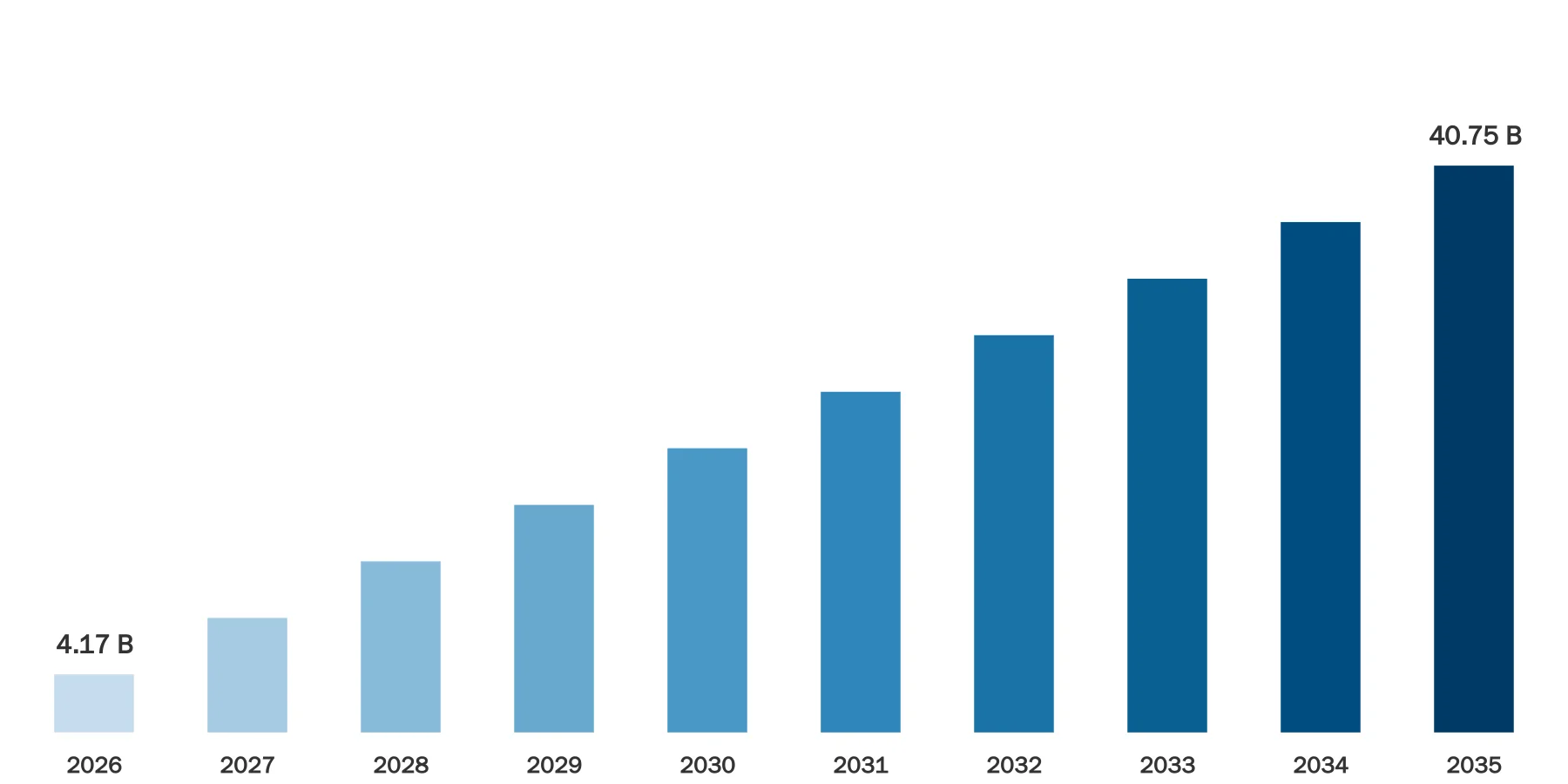
Source: Econ Market Research
A key sector has arisen in response to the increasing prevalence of unmanned aerial vehicles (UAVs) and the possibility of their misuse: the anti-drone business. Nowadays, drones are widely accessible for use in commercial, military, and recreational settings, bringing with them both potential and challenges. This market is centred on creating and implementing cutting-edge tools and techniques to identify, monitor, and control unapproved or rogue drone activity.
Radar, acoustic sensors, radio frequency (RF) monitoring, jamming systems, and other technologies are examples of anti-drone solutions that are used to protect sensitive locations like airports, public spaces, and government buildings. The growing number of cases of drones being utilized for illegal activities, including as smuggling, terrorism, and espionage, has highlighted the market',s importance. So, in order to safeguard their resources, security, and privacy, governments, operators of vital infrastructure, and private companies have made investments in anti-drone technologies. The anti-drone market is expected to grow as the drone landscape changes, propelled by developments in detection and countermeasure technologies. It is essential to preserving control, security, and safety in a world where drone usage is on the rise.
Market Dynamics
The market for anti-drone products is growing quickly as a result of security concerns and the widespread use of drones for numerous purposes. Governments, operators of key infrastructure, and private businesses are all making significant investments in anti-drone technologies. Technologies for detection and countermeasures have advanced significantly. Radar systems, Artificial Intelligence (AI), jamming devices, and radio frequency (RF) surveillance fall under this category.
The goal of innovations is to increase efficiency, precision, and the capacity to take down rogue drones. The regulatory landscape is quite important. The demand for anti-drone solutions has been impacted by the introduction of drone usage regulations and guidelines by governments across the globe. Adherence to these regulations serves as a catalyst for market expansion. Drones provide increasing risks as they become more widely available.
The need for anti-drone measures has grown, with reasons ranging from terrorist operations and espionage to the smuggling of goods. Investments in anti-drone technologies are coming from both the public and private sectors. Anti-drone devices are being installed in stadiums, military posts, airports, and other key infrastructure locations to improve security. There are many competitors in the fiercely competitive anti-drone sector, each providing a range of solutions. This rivalry lowers costs and stimulates innovation. Concerns about privacy have also surfaced in relation to anti-drone technology use. For the market, finding a balance between security and personal privacy is crucial.
Market Drivers
Increased Drone Proliferation
Unmanned aerial vehicles, or drones, are becoming more and more common in a variety of industries, including the military, business, and entertainment sectors. Drone technology has advanced, making these devices more widely available and reasonably priced. Consumer drone purchases for recreational purposes, such as aerial photography and filmmaking, have surged as a result of this accessibility.
The drone market is expanding due in part to the use of drones by commercial businesses for services including product delivery, agriculture, and monitoring. Drone use in the military for warfare, surveillance, and reconnaissance has increased significantly. Drone technology has seen significant research and development as a result of these uses. The sheer volume and variety of drones in the airspace have raised concerns related to safety, security, and privacy. Unauthorized drone flights, potential airspace violations, and misuse of drones for criminal or malicious activities have propelled the need for anti-drone measures.
Technological Advancements
By increasing the productivity and efficiency of many industries, technological innovations promote economic growth. Automation and robots, for example, have improved product quality, lowered prices, and raised production rates in the industrial industry. Technological developments in Telemedicine and medical equipment have enhanced patient care, diagnosis, and available treatments. In a similar vein, the digital revolution has completely changed how companies run, engage with clients, and store and process data, all of which have led to better decision-making and customer support. Innovation is stimulated by technological advancements as they open up new markets and opportunities. Blockchain, the Internet of Things, and artificial intelligence are examples of disruptive technologies that are completely changing sectors and generating new business models. These inventions can be leveraged by both startups and existing firms to achieve a competitive advantage. Technological developments are a major factor in societal and economic improvement since they present chances for expansion and creativity as well as solutions to urgent global problems. To be competitive and contribute to a better future, individuals and organizations must stay on the cutting edge of technological advancements.
Restraints
Balancing security with privacy concerns
Maintaining a careful balance between guaranteeing security and upholding individual privacy rights is necessary as drone proliferation develops and the necessity for security measures to mitigate possible threats grows. On the one hand, anti-drone technology is necessary to defend public safety, vital infrastructure, and against the illicit or espionage usage of drones. They are essential in averting situations that can jeopardise public safety and national security.
However, the application of anti-drone techniques, such jamming, geo-fencing, and even physical interdiction, may unintentionally violate the privacy of defenceless people. These technologies give rise to ethical and legal considerations since they have the potential to detect and disrupt not only hostile drones but also drones flown by law-abiding persons. This delicate balance necessitates the development of regulations and guidelines that strike a harmonious equilibrium between security imperatives and individual privacy rights. It requires the careful design and implementation of anti-drone systems that minimize collateral impacts on the privacy of citizens while effectively countering rogue drones.
High costs associated with anti-drone systems
Anti-drone systems can have high initial and recurring costs, which may put off potential customers and restrict industry expansion. The creation and application of cutting-edge detection and countermeasure technologies is one of the main contributing aspects. Specialized parts, including as radar, sensors, signal jamming apparatus, and software, are needed for these systems, and their production and upkeep can be costly.
Additionally, hiring qualified staff to run and maintain these systems as well as continuing maintenance and updates to keep up with the rapidly advancing field of drone technology raise the total cost. The demand for customization to meet the particular security requirements of various organizations and industries is another cost factor. The customization of anti-drone technologies for particular settings and the incorporation of these systems into pre-existing security infrastructure can result in increased expenses. Costs associated with legal and regulatory compliance might also be high.
Opportunities
Critical Infrastructure Protection
The field of technology and security offers a great opportunity with Critical Infrastructure Protection (CIP). The goal of CIP is to protect critical infrastructure and systems that are necessary for a country to function, like energy grids, water supply, transportation networks, and communication systems. There is an increasing need to safeguard vital assets against natural disasters, cyberattacks, and physical attacks as societies become increasingly reliant on technology and networked infrastructure.
The market is growing as a result of the expansion of critical infrastructure protection services and technology. Continuous technical innovation is necessary due to the dynamic threat scenario. This propels the creation of sophisticated security systems, robust communication networks, and artificial intelligence for danger identification, giving businesses the chance to develop cutting-edge solutions.
Counter-UAV Systems
Technological advancements in detection and mitigation, including as jamming, RF monitoring, and radar, present firms with opportunity to build more sophisticated and effective solutions that can keep up with the rapidly advancing capabilities of drones. The deployment of Counter-UAV measures is being mandated in some places by international governments through the implementation of rules and guidelines, which is propelling the adoption of these technologies. Counter-UAV systems find use in multiple domains, including as critical infrastructure protection, law enforcement, defence, and event security. Increased market penetration and revenue generation are made possible by this diversity. The global reach of the Counter-UAV industry presents prospects for enterprises to grow their business and cater to a wider clientele.
Segment Overview
By Technology
Based on technology, the global anti-drone market is divided into electronic systems, laser systems, kinetic systems. The kinetic systems category dominates the market with the largest revenue share in 2022. Kinetic anti-drone systems rely on physical force to neutralize unauthorized UAVs. This can involve the use of projectiles or other physical methods to intercept and disable drones. Kinetic systems are often employed in scenarios where the drone poses a serious threat and needs to be forcefully taken down. While effective, kinetic solutions may carry risks, particularly in densely populated or sensitive areas.
Electronic anti-drone systems primarily focus on detection, tracking, and mitigation through non-kinetic means. These systems utilize technologies such as radar, radio frequency (RF) monitoring, and acoustic sensors to detect and identify drones in their vicinity. Once a threat is detected, electronic systems can disrupt the drone's control signal or communication link, forcing it to return to its operator or land safely. This approach offers a non-destructive method of countering rogue drones, minimizing collateral damage.
Where laser-based anti-drone systems employ high-energy lasers to disable or disrupt a drone's functionality. They are capable of targeting and damaging a drone's critical components, such as its sensors or communication systems. Laser systems are known for their precision and can be used to incapacitate drones in a controlled manner. However, their effectiveness can be influenced by factors like weather conditions and drone materials.
By Platform Type
Based on the platform type, the global anti-drone market is categorized into ground-based, handheld, UAV-based. The UAV-based category leads the global anti-drone market with the largest revenue share in 2022. UAV-based anti-drone systems leverage drones to counter other drones. These UAVs are equipped with specialized detection and mitigation equipment, such as nets or countermeasure payloads, to intercept and neutralize rogue drones. They offer a dynamic and mobile response to drone threats and can be used for surveillance, tracking, and engagement.
UAV-based solutions are suitable for scenarios where a rapidly deployable and adaptable approach to counter-drone activities is required. Handheld anti-drone devices are portable and operated by personnel on the ground. These devices are typically used for localized anti-drone protection and are well-suited for law enforcement or security personnel. Handheld solutions may include RF detectors, jammers, or net guns that can be easily transported and deployed to counter drones in proximity. They provide a mobile and flexible approach to addressing drone threats in various environments, such as public gatherings or sensitive areas.
Ground-based anti-drone systems are stationary installations designed to detect, track, and mitigate drones in a specific area. These systems are commonly employed at critical infrastructure sites, such as airports, military bases, and public events. They often utilize radar, radiofrequency (RF) monitoring, and other sensor technologies to identify unauthorized drones within their coverage area. Ground-based systems can then employ non-kinetic methods, such as jamming or net capture, to neutralize the threat. They are ideal for scenarios where a persistent anti-drone presence is required to protect fixed assets and large areas.
By Application
Based on application, the global anti-drone market is segmented into detection and disruption. The detection segment dominates the anti-drone market. The detection segment of the anti-drone market focuses on technologies and systems designed to identify and locate unauthorized drones in the airspace. Detection solutions employ various sensors and technologies, including radar, radiofrequency (RF) monitoring, acoustic sensors, and optical sensors. These tools enable the early detection of drones, even at significant distances from the anti-drone system.
The gathered information is critical for assessing potential threats and initiating appropriate response measures. The disruption segment centers on technologies and methods used to mitigate or neutralize the detected drone threats. Disruption solutions encompass a range of countermeasure technologies, such as jamming, laser systems, or physical interceptors. These methods can interfere with a drone',s control signals or communication links, damage critical components, or even physically capture the drone to render it inoperative. Disruption measures are typically deployed when a drone is identified as a threat and needs to be neutralized to protect critical assets or public safety.
By End User
Based on end user, the global anti-drone market is divided into military and defense, commercial, homeland security. The homeland security category dominates the market with the largest revenue share in 2022. Homeland security applications of anti-drone technologies are geared toward the protection of public safety and critical infrastructure within a country',s borders. These solutions are used to defend airports, public events, government buildings, and other high-profile targets against threats from drones.
Detection systems, surveillance tools, and non-kinetic countermeasures are commonly used in homeland security to prevent drone-related incidents, including potential terrorist attacks or unauthorized drone flights in sensitive areas. In the military and defense sector, anti-drone solutions are primarily used to protect military installations, personnel, and assets against the potential threats posed by hostile drones. This segment encompasses technologies and systems designed for military applications, including surveillance, counter-UAV operations, and protection of sensitive defense facilities. It involves advanced anti-drone technologies, such as laser systems and kinetic interceptors, to ensure national security and military preparedness.
Where the commercial sector involves the use of anti-drone systems in various industries, including aviation, energy, telecommunications, agriculture, and construction, to safeguard critical infrastructure, operations, and airspace. Anti-drone solutions for commercial purposes are used to protect against unwanted drone incursions, security breaches, and potential disruptions. These solutions often employ a mix of detection and countermeasure technologies, like radar systems and electronic countermeasures, to ensure the safe and uninterrupted functioning of commercial operations.
Market Overview by Region
The global anti-drone market is categorized into North America, Europe, Asia-Pacific, and the Rest of the World. Asia-Pacific emerged as the leading region, capturing the largest market share in 2022. Some of the biggest and fastest-growing economies in the world, such as those of China, Japan, India, and South Korea, are found in the Asia-Pacific region. Manufacturing, technology, trade, and a growing middle class are the main drivers of this economic strength, which makes it a powerful force in international trade. The area is now a centre for technical research and innovation.
At the vanguard of cutting-edge advancements in fields like Biotechnology, robotics, and artificial intelligence are nations like China and Japan. This innovation also applies to the anti-drone sector, where cutting-edge solutions are always being created to counter new threats. The Asia-Pacific region',s large population offers substantial market opportunity for a number of businesses, including the anti-drone market. Asia-Pacific nations are important players in international relations and diplomacy. International relations are heavily influenced by countries like China, India, and Japan, which has an impact on the dynamics of security and stability in the region.
The region is strategically important due to its economic and geopolitical significance. It is home to important maritime lanes, such the South China maritime, which are used by a large amount of international trade. The emphasis on security and safety precautions, such as anti-drone technology, has increased as a result. There is enormous diversity in the cultures, languages, and customs of the Asia-Pacific area. This diversity encourages a rich flow of viewpoints, inventions, and ideas, which helps to create a dynamic atmosphere for new developments in technology and security measures.
Competitive Landscape
In the global anti-drone market, a few major players exert significant market dominance and have established a strong regional presence. These leading companies remain committed to continuous research and development endeavors and actively engage in strategic growth initiatives, including product development, launches, joint ventures, and partnerships. By pursuing these strategies, these companies aim to strengthen their market position, expand their customer base, and capture a substantial share of the market.
Key Players:
Lockheed Martin Corporation
DroneShield Ltd
Saab AB
Liteye Systems, Inc.
Detect, Inc.
Thales Group
Advanced Radar Technologies S.A.
Raytheon Technologies Corporation
Dedrone GmbH
Blighter Surveillance Systems Limited
Northrop Grumman Corporation
Israel Aerospace Industries Ltd
Rafael Advanced Defense Systems Ltd
Leonardo S.p.A
Recent Developments
In September 2023, India's First AI-Powered Anti-Drone System is Unveiled by a Hyderabadi Startup. Grene Robotics gave a live demonstration of the advanced full-spectrum drone security system capacity outside of Hyderabad.
In March 2023, Positive outcomes are seen on the Indo-Pak border with anti-drone jammers. The anti-drone jammer and spoofers that the Indian Army placed this year in the Jammu and Punjab region to counter drug, bomb, and weapon-carrying drones launched by terror groups based in Pakistan have yielded satisfactory test results.
Anti-Drone Market Report Scope & Segmentation
| Attributes | Details |
|---|---|
Market Size (Current) | US$ 4.17 Billion in 2026 |
Market Size (Forecast) | US$ 40.75 Billion in 2035 |
Growth Rate | CAGR of 28.49% from 2026 to 2035 |
Forecast Period | 2026 – 2035 |
Base Year | 2025 |
Historical Data Available | Yes |
Regional Scope | Global |
Segments Covered | By Technology
By Application
By Vertical
|
Frequently Asked Questions
Common questions about this report
The study period covers historical insights and forecast projections for the period 2026-2035.
About the Author
Market research expert with years of industry experience

Related Reports
Explore more market insights from the same category