

Aircraft Antenna Market
Aircraft Antenna Market Size, Share, Trends, Growth, and Industry Analysis, By Platform (Commercial Aviation, Military Aviation, Business andamp; General Aviation, Unmanned Aerial Vehicles (UAVs)), By Installation (Nose Mounted, Fuselage Mounted, Tail Mounted, Wing Mounted), By Application (Communication, Navigation andamp; Surveillance), Regional Analysis and Forecast Period 2026-2035
Market Overview
As per Econ Market Research analysis, the Global Aircraft Antenna Market was valued at US$ 0.3 Billion in 2026 and is expected to reach US$ 0.64 Billion by 2035, registering a CAGR of 16.57% during the forecast period 2026–2035. The base year considered is 2025.
Aircraft Antenna Market Size 2025-2035 (USD Billion)

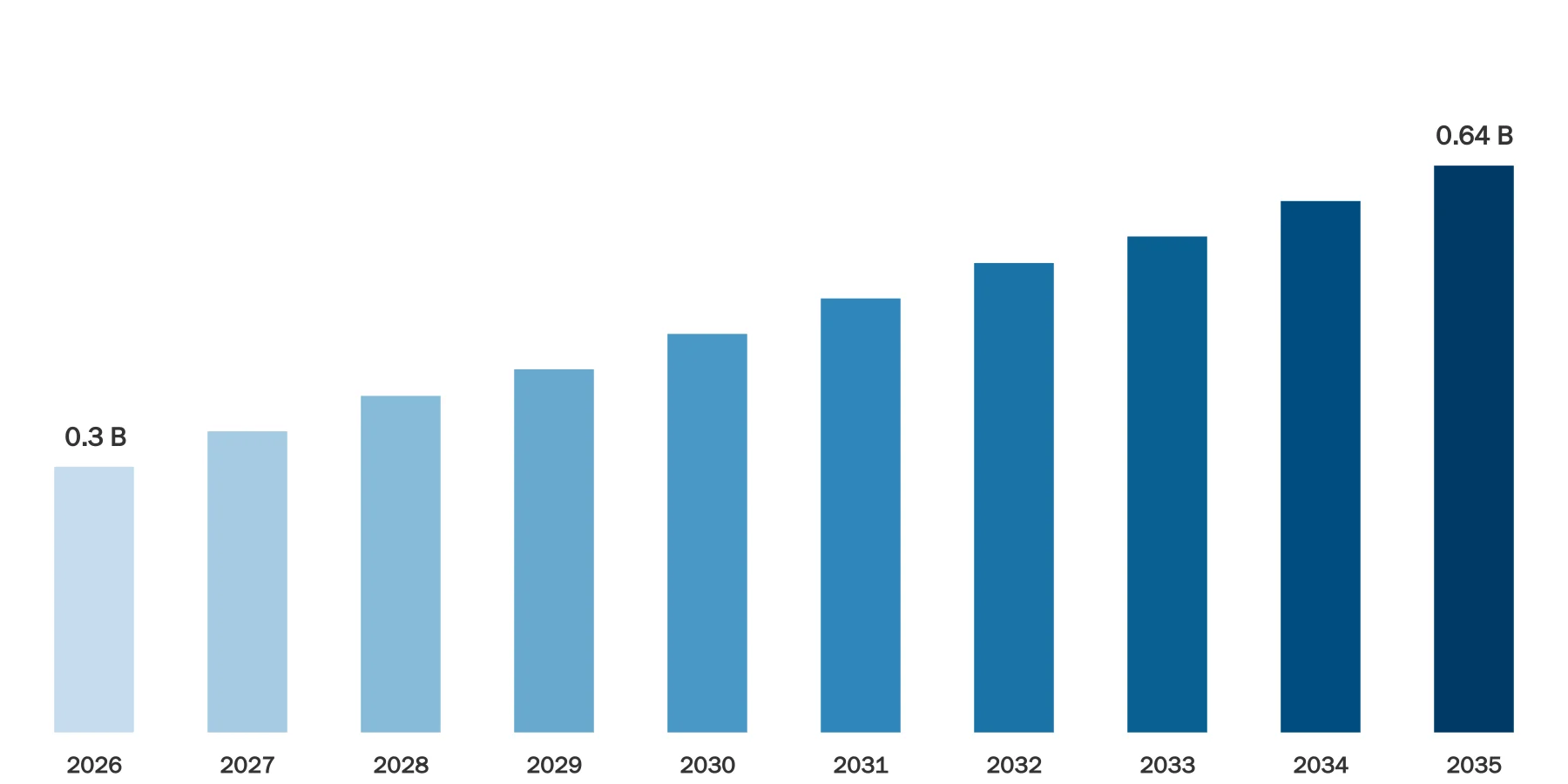
Source: Econ Market Research
The manufacture and installation of antennas for in-flight communication, navigation, and surveillance systems is included in the aviation antenna market. For a variety of applications, including satellite communication, weather radar, voice and data transmission, and collision avoidance systems, these antennas are essential to dependable connectivity. The market for aircraft antennas is growing due to technological advancements and the increasing need for in-flight connectivity. This market offers creative solutions to improve safety, maximize operational efficiency, and improve aircraft communication capabilities for the commercial and military aviation sectors.
Aircraft Antenna Dynamics
Growth in in-flight connection, improvements in satellite communication technology, and an increasing focus on aircraft safety and navigation systems are some of the reasons driving the dynamics of the aircraft antenna market. Further factors that expand the market include the military aircraft fleet',s growth, the commercial aviation industry',s expansion, and the introduction of new aircraft platforms. Additional factors driving market expansion are the incorporation of lightweight designs and cutting-edge materials to enhance antenna performance and fuel efficiency. Nonetheless, obstacles like strict legal requirements and expensive installation costs could obstruct market expansion and need ongoing innovation and adjustment to changing industry norms.
Aircraft Antenna Drivers
Rising Demand for In-Flight Connectivity
Passengers', growing reliance on digital devices and their need for constant access to internet services while flying are driving increased demand for in-flight connectivity. As passengers want to be connected for social, business, and entertainment purposes, airlines are spending more money on cutting-edge antenna systems to provide Wi-Fi onboard. Strong and dependable in-flight connectivity solutions are in high demand as a result of this trend, which indicates a shift towards improving the passenger experience and satisfying changing consumer expectations.
Advancements in Satellite Communication Technology
The growth of low earth orbit (LEO) constellations and high-throughput satellites, among other developments in satellite communication technology, is pushing the need for more competent and efficient aircraft antennas. These developments provide increased bandwidth, decreased latency, and better coverage, allowing airlines to provide customers with better in-flight connectivity and communication capabilities. These innovations stimulate the adoption of complex antenna systems and demonstrate the industry',s dedication to providing state-of-the-art inflight amenities. They can give flawless connectivity even in isolated places.
Restraints:
The market for airplane antennas is severely constrained by high installation costs, which place a financial strain on airlines and operators. Due to the intricate difficulty of integrating cutting-edge antenna systems with current aircraft structures, significant labor, equipment, and downtime costs are incurred. The requirement for specific training and certification drives up installation expenses even more. These financial obstacles might prevent certain businesses from expanding or modernizing existing antenna systems, which would impede industry innovation and market growth.
Limited Spectrum Allocation
The development and application of new antenna technology is limited by the limited radio frequency spectrum available for aircraft communication and navigation. This constraint can make it difficult to allocate bandwidth and optimize communication effectiveness, especially as demand for in-flight connectivity increases. The problem is made worse by regulatory limitations and competition for spectrum, which make it more difficult for the sector to adapt to changing connectivity needs and prevent the development of novel antenna solutions.
Opportunities:
Expansion of Unmanned Aerial Vehicle (UAV) Market
There is a rising need for specific antenna solutions made for these platforms as UAVs are used for a wider range of tasks like mapping, delivery, surveillance, and reconnaissance. Antennas designed specifically for unmanned aerial vehicles (UAVs) have the potential to improve unmanned aircraft operations in a variety of industries, including as infrastructure inspection, defense, agricultural, and more. These antennas can also improve communication, navigation, and data transfer capabilities.
Integration with Advanced Avionics Systems
Antennas that smoothly interact with advanced avionics platforms like GPS and ADS-B (Automatic Dependent Surveillance-Broadcast) are becoming more and more necessary as aviation technology advances. Antennas designed with these systems in mind can improve situational awareness, navigation accuracy, and airplane safety. Manufacturers are able to meet the changing needs of the aviation sector and take advantage of new market demands by providing dependable and high-performance antenna solutions that interface easily with updated avionics.
Segment Overview
By Frequency Band
Based on frequency band, the global aircraft antenna market is divided into Ka/Ku/K band, VHF band, UHF band, HF band, X band, C band, and others. The X band category dominates the market with the largest revenue share in 2023. Weather radar systems, which provide high-resolution pictures for precise weather monitoring and avoidance, are the main applications for X Band antennas. Air traffic management, weather monitoring, and surveillance are just a few of the radar and communication uses for C Band antennas.
In addition to being used for military purposes such as secure communication and surveillance, ultra-high frequency bands are also used for line-of-sight communication between satellites, ground stations, and airplanes. High frequency bands are utilized for long-distance communication, especially over far locations and oceans where other bands might not be able to reach. Air traffic control and emergency communication are two further uses for them.
By Application
Based on the application, the global aircraft antenna market is categorized into communication, surveillance, and navigation. The communication category leads the global aircraft antenna market with the largest revenue share in 2023. Information sharing between the aircraft and other external entities, including as satellites, ground stations, and other aircraft, is made easier by communication antennae. They make it possible for pilots to speak with air traffic control, passengers to stay connected while flying, and aircraft to exchange vital information with ground-based systems. They also enable voice communication, data transmission, and internet connectivity. In addition to recognizing, tracking, and spotting other aircraft, surveillance antennas keep an eye out for any possible threats in the nearby airspace. The position, direction, and altitude of the aircraft with respect to the surface of the Earth and other reference points are all determined with the use of navigation antennas.
By Platform
Based on the platform, the global aircraft antenna market is segmented into commercial aviation, military aviation, Business Jet and general aviation, unmanned aerial vehicles (UAV), and Electric Vehicle takeoff and landing. The commercial aviation segment dominates the aircraft antenna market. Airlines and passenger aircraft that carry people and goods on scheduled or private flights are considered to be part of the commercial aviation industry.
In addition to giving passengers with in-flight connectivity services, the primary goals of antennas in this industry are to assure safe and effective operations through dependable communication, navigation, and surveillance capabilities. All military aircraft used by the armed forces for transport, reconnaissance, combat, and other defense-related operations are included in the category of military aviation. Drones, or unmanned aerial vehicles, or UAVs, are aircraft that are flown without a human pilot present and are utilized for a variety of tasks such as aerial photography, agriculture, delivery services, and surveillance.
By End User
Based on end users, the global aircraft antenna market is divided into OEM and aftermarket. The OEM category dominates the market with the largest revenue share in 2023. The term OEM describes the market sector in which manufacturers directly supply antennas as a component of the original aircraft production process. In the OEM market, antennas are built into airplanes as part of the production process, either as required equipment by the manufacturer or as an add-on that airlines or operators select. The sale and installation of antennas following the delivery of the aircraft to the customer and its introduction into operation constitute the aftermarket portion of the aircraft antenna market.
Aircraft Antenna Overview by Region
The global aircraft antenna market is categorized into North America, Europe, Asia-Pacific, and the Rest of the World. North America emerged as the leading region, capturing the largest market share in 2023. Much of the global aerospace industry is based in this region, including major manufacturers of aircraft, providers of avionics, and producers of antennas.
Furthermore, the development of innovative antenna technology is supported by a strong infrastructure in North America that promotes aviation innovation, research, and development. The adoption of modern antenna systems has also been accelerated by the region',s high demand for in-flight connection, which is fueled by tech-savvy travelers and the existence of multiple carriers.
Numerous causes are responsible for this expansion, such as the region',s growing aviation industry, an increase in air travel, and a rise in the demand for connectivity services. Investments in commercial and military aviation are being driven by the rapid economic development of nations like China and India, which is increasing demand for sophisticated antenna systems. Further driving up demand for airplane antennas in the Asia-Pacific area are the entry of low-cost airlines and the debut of new aircraft models outfitted with cutting-edge communication and navigation systems.
Aircraft Antenna Competitive Landscape
In the global aircraft antenna market, a few major players exert significant market dominance and have established a strong regional presence. These leading companies remain committed to continuous research and development endeavors and actively engage in strategic growth initiatives, including product development, launches, joint ventures, and partnerships. By pursuing these strategies, these companies aim to strengthen their market position, expand their customer base, and capture a substantial share of the market.
Aircraft Antenna Leading Companies:
McMurdo Limited
Sensor Systems Inc.
The Boeing Company
RAMI Aviation.
Antcom Corporation
Azimut Benetti Group
TECOM Group
Harris Corporation
Honeywell International Inc.
Cobham plc, and various others.
Aircraft Antenna Recent Developments
In April 2023, Next Generation Aircraft Antennas are Driven by Advances in Satellite Connectivity. non-geosynchronous orbit (NGSO) systems in low Earth orbit (LEO), medium Earth orbit (MEO), and high Earth orbit (HEO) are the satellites that are increasingly enabling this connectivity.
In August 2022, Heico purchases Sensor Systems, an aircraft antenna company Heico paid cash and about 575,000 HEICO Class A ordinary shares to buy Sensor Systems, a company that makes aircraft antennas. HEICO (HEI) declared that it does not anticipate any significant employee turnover among Sensor',s approximately 200 employees as a result of the transaction.
In February 2022, For its 5G airplane antenna, Gogo Business Aviation has been granted FAA Supplemental Type Certification (STC) and Parts Manufacturer Approval (PMA).
Aircraft Antenna Market Report Segmentation
Aircraft Antenna Market Report Scope & Segmentation
| Attributes | Details |
|---|---|
Market Size (Current) | US$ 0.3 Billion in 2026 |
Market Size (Forecast) | US$ 0.64 Billion in 2035 |
Growth Rate | CAGR of 16.57% from 2026 to 2035 |
Forecast Period | 2026 – 2035 |
Base Year | 2025 |
Historical Data Available | Yes |
Regional Scope | Global |
Segments Covered | By Platform
By Installation
By Application
|
Frequently Asked Questions
Common questions about this report
The study period covers historical insights and forecast projections for the period 2026-2035.
About the Author
Market research expert with years of industry experience

Related Reports
Explore more market insights from the same category