

Air Taxi eVTOL Market
Air Taxi eVTOL Market Size, Share, Trends, Growth, and Industry Analysis, By Propulsion Type (Electric, Hybrid, Hydrogen-Electric), By Range (Short Range, Long Range), By Mode of Operation (Piloted, Autonomous, Semi-Autonomous), By Application (Passenger Transport, Cargo Transport, Air Ambulance, Military), By End User (Commercial Operators, Government & Defense, Private Users), Regional Analysis and Forecast Period 2026-2035
Air Taxi eVTOL Market Overview
As per Econ Market Research analysis, the Global Air Taxi eVTOL Market was recorded at US$ 2.18 Billion in 2026 and is projected to expand to US$ 12.4 Billion by 2035, registering a CAGR of 21.3% over the forecast period. The base year used is 2025.
Air Taxi eVTOL Market Size 2025-2035 (USD Billion)

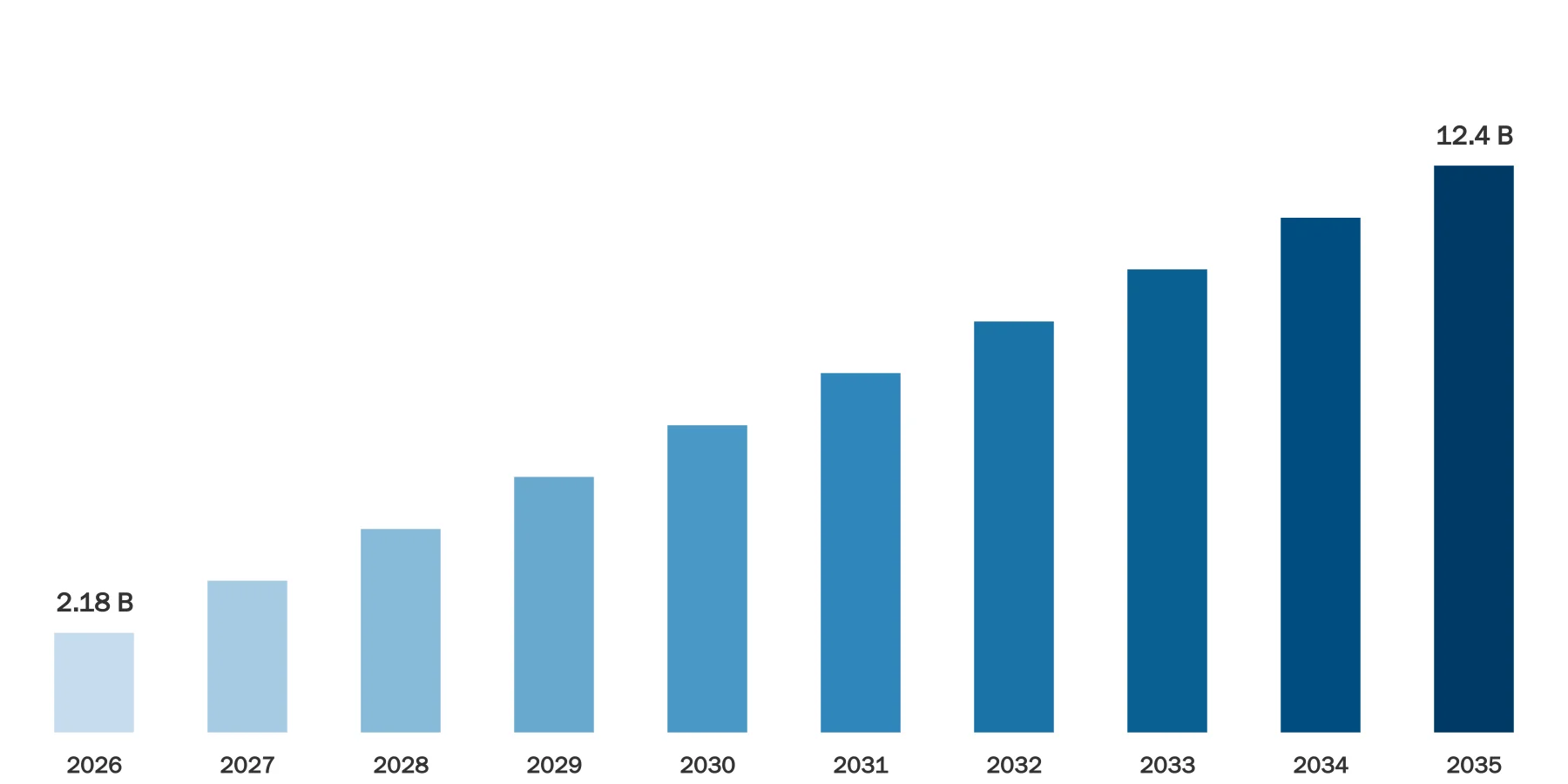
Source: Econ Market Research
The global Air Taxi (eVTOL) Market is expanding rapidly with more than 400 electric vertical take-off and landing aircraft programs under development across 50 countries in 2025. Over 1,200 prototype and pre-production eVTOL aircraft have completed test flights worldwide, while more than 650 vertiport projects are under planning or construction stages. Battery energy density in commercial-grade aviation batteries crossed 300 Wh/kg in several pilot projects during 2024, enabling flight ranges above 240 km for selected platforms. More than 80 aviation regulators are actively drafting certification frameworks for urban air mobility systems. The Air Taxi (eVTOL) Market Report highlights increasing adoption of zero-emission mobility solutions, autonomous aviation technologies, and urban congestion reduction initiatives.
The USA Air Taxi (eVTOL) Market accounts for nearly 38% of global testing activities, supported by more than 45 active eVTOL developers and over 70 vertiport infrastructure proposals across states including California, Texas, and Florida. The Federal Aviation Administration finalized powered-lift operational regulations in 2024, accelerating certification activities for at least 8 major manufacturers. More than 50,000 cumulative flight-test miles have already been completed by leading American eVTOL companies. The U.S. Department of Transportation launched pilot integration programs covering 26 states in 2026, supporting commercial urban air mobility corridors. The Air Taxi (eVTOL) Market Analysis for the United States shows growing demand for airport shuttle operations, emergency medical transport, and premium urban commuting services.
The European Air Taxi (eVTOL) Market represents approximately 27% of global urban air mobility development projects, with Germany, France, and the United Kingdom leading regulatory and manufacturing activities. Europe hosts more than 120 urban air mobility pilot initiatives and over 90 vertiport planning programs. The European Union Aviation Safety Agency introduced Special Condition VTOL certification guidelines that currently influence over 20 aircraft programs. Germany alone accounts for more than 25% of Europe’s eVTOL engineering workforce. Paris and Rome are among the first cities planning operational air taxi routes before 2027, while London continues expanding advanced air mobility corridor studies across 6 metropolitan zones. The Air Taxi (eVTOL) Industry Analysis indicates strong institutional support for sustainable aviation mobility.
Air Taxi (eVTOL) Market Latest Trends
The Air Taxi (eVTOL) Market Trends indicate rapid movement toward autonomous flight systems, lightweight composite structures, and advanced battery technologies. More than 70% of newly unveiled eVTOL aircraft in 2025 feature distributed electric propulsion systems with 6 to 18 rotors. Autonomous flight software testing exceeded 150,000 simulated operational hours globally by early 2026. Urban mobility corridors under development increased from 110 in 2023 to more than 210 in 2025. Over 40 airports worldwide are integrating vertiport concepts into expansion plans.
Hydrogen-electric propulsion is becoming a notable trend, with at least 18 manufacturers testing hybrid hydrogen systems capable of ranges exceeding 400 km. Artificial Intelligence-based air traffic management systems are also emerging, with 30 smart-city programs integrating digital flight corridor mapping technologies. More than 60% of eVTOL prototypes now include fly-by-wire systems and triple-redundancy flight controls for safety enhancement.
Noise reduction remains a critical trend in the Air Taxi (eVTOL) Industry Report, with manufacturers targeting acoustic signatures below 65 dB at 100 meters. Several aircraft demonstrated noise levels 30% lower than conventional helicopters during urban testing. Lightweight carbon-fiber structures now account for nearly 45% of average airframe composition in leading platforms. Additionally, battery charging technologies capable of achieving 80% recharge within 20 minutes are under deployment in over 35 pilot facilities globally.
Air Taxi (eVTOL) Market Dynamics
The Air Taxi (eVTOL) Market Outlook is shaped by increasing urban congestion, advancements in electric propulsion systems, supportive aviation regulations, and rising investments in sustainable transportation infrastructure. More than 55% of megacities globally experience average traffic delays exceeding 90 minutes daily, increasing interest in urban aerial mobility solutions. Governments in over 25 countries have introduced advanced air mobility roadmaps. The market also benefits from improvements in lithium-ion battery efficiency, digital air traffic management systems, and autonomous flight technologies. However, infrastructure limitations, certification complexity, and public safety concerns continue influencing commercialization timelines in multiple regions.
DRIVER
Increasing Urban Congestion and Sustainable Mobility Demand
Urban traffic congestion continues driving the Air Taxi (eVTOL) Market Growth, with over 4.4 billion people currently living in urban areas worldwide. In cities such as Los Angeles, London, Mumbai, and São Paulo, commuters spend between 80 and 150 hours annually in traffic congestion. More than 65% of urban planners surveyed in 2025 identified advanced air mobility as a strategic transportation priority. eVTOL aircraft produce significantly lower operational emissions compared to conventional helicopters, while electric propulsion systems reduce mechanical complexity by nearly 35%. More than 300 city-level mobility feasibility studies have already been completed globally. Increasing airport-to-city travel demand is also accelerating deployment plans, especially for routes under 50 km where air taxis can reduce travel time by up to 70%.
RESTRAINT
Limited Charging and Vertiport Infrastructure
Infrastructure limitations remain a major restraint for the Air Taxi (eVTOL) Market Forecast. More than 75% of urban regions currently lack certified vertiport infrastructure capable of supporting commercial eVTOL operations. A standard urban vertiport requires approximately 20,000 to 40,000 square feet of operational space along with high-capacity charging systems exceeding 1 MW power output. Battery charging cycles for aviation-grade batteries still average between 20 and 45 minutes under commercial conditions. Less than 15 cities worldwide currently possess integrated advanced air mobility traffic management trials. Additionally, urban zoning restrictions and rooftop structural limitations affect deployment timelines. Certification procedures for charging systems, passenger handling infrastructure, and emergency response integration continue creating operational delays across North America and Europe.
OPPORTUNITY
Expansion of Autonomous Flight Technologies
Autonomous aviation systems present major opportunities in the Air Taxi (eVTOL) Market Opportunities landscape. More than 40 eVTOL manufacturers are developing autonomous or semi-autonomous operational capabilities. Autonomous systems can reduce pilot-related operating requirements by nearly 50% while increasing fleet scalability. AI-driven flight management software now processes over 1 million simulated urban flight scenarios annually for safety validation. Remote supervision systems capable of monitoring multiple aircraft simultaneously are under testing in at least 12 countries. Autonomous eVTOL platforms are expected to improve fleet utilization rates by over 30% in high-density urban corridors. Several regulators are already studying remote pilot oversight frameworks for passenger and cargo air taxi services, enabling broader operational flexibility and lower operational complexity.
CHALLENGES
Certification Complexity and Safety Validation
Certification remains one of the largest challenges in the Air Taxi (eVTOL) Market Research Report. More than 20 leading manufacturers are undergoing complex certification procedures involving thousands of flight-test parameters. Aircraft safety validation requires extensive testing of propulsion systems, battery containment, software redundancy, and emergency landing capabilities. Some eVTOL certification programs involve over 10,000 documentation submissions and more than 5,000 hours of engineering validation. Regulators require compliance with both helicopter and fixed-wing aircraft operational standards due to powered-lift configurations. Public acceptance also remains a challenge, as surveys conducted in 2025 showed that only 48% of urban consumers expressed confidence in autonomous passenger air taxis. Weather resilience, cybersecurity, and battery thermal management continue creating additional technical barriers.
SWOT Analysis
Strengths
eVTOL aircraft can reduce urban travel times by 50% to 80% on routes under 100 km.
More than 400 active eVTOL development programs are operating globally in 2025.
Electric propulsion systems reduce moving mechanical components by nearly 35% compared to helicopters.
Noise emissions in several aircraft prototypes remain below 65 dB, nearly 30% lower than traditional rotorcraft.
Over 650 vertiport development projects are currently under planning or implementation worldwide.
Weaknesses
Commercial aviation batteries still provide average operational ranges between 100 km and 300 km for most aircraft.
Certification timelines often exceed 5 to 8 years due to aviation safety requirements.
More than 70% of urban regions lack dedicated vertiport infrastructure.
High dependency on lithium, nickel, and cobalt creates battery supply-chain vulnerabilities.
Payload limitations restrict most aircraft to 2 to 6 passengers.
Opportunities
More than 210 urban air mobility corridors are under development globally.
Autonomous flight technologies could reduce operational labor requirements by up to 50%.
Air ambulance applications can reduce emergency response times by 40% in congested cities.
Hydrogen-electric systems are targeting ranges above 400 km in pilot projects.
Smart-city initiatives in over 35 countries are integrating aerial mobility infrastructure plans.
Threats
Regulatory delays continue affecting more than 20 major certification programs.
Public safety concerns remain significant, with less than 50% urban passenger confidence in autonomous operations.
Battery thermal runaway risks require extensive containment testing.
Cybersecurity vulnerabilities in AI-based navigation systems remain unresolved.
Conventional helicopter operators and ground ride-sharing networks increase competitive pressure.
Segmentation Analysis
The Air Taxi (eVTOL) Market Size is segmented by propulsion type, range, mode of operation, application, and end user. Electric propulsion currently dominates due to lower emissions and reduced maintenance complexity. Short-range operations below 200 km account for the majority of urban air mobility trials. Piloted aircraft remain commercially dominant because aviation authorities continue prioritizing human oversight. Passenger transport leads applications with more than 60% share of ongoing deployment projects. Commercial operators represent the largest end-user segment due to increasing investments in urban mobility networks, airport shuttle systems, and premium transportation services across metropolitan areas.
By Propulsion Type
Electric propulsion accounts for approximately 68% of the Air Taxi (eVTOL) Market Share due to increasing battery advancements and urban sustainability initiatives. More than 280 fully electric eVTOL prototypes are currently under active testing globally. These systems generally support flight ranges between 100 km and 250 km with cruise speeds exceeding 240 km/h. Electric aircraft maintenance requirements are estimated to be 25% lower than turbine-powered helicopters because of fewer moving parts.
Hybrid propulsion systems represent nearly 22% of market activity, particularly for regional air mobility routes requiring ranges above 300 km. Hybrid systems integrate electric motors with fuel-powered generators to improve endurance and operational flexibility. More than 40 hybrid eVTOL programs are in development stages globally.
Hydrogen-electric propulsion holds nearly 10% market participation but is expanding steadily. Hydrogen fuel cells can potentially support flight ranges beyond 400 km while reducing battery weight constraints by nearly 35%. At least 18 hydrogen-electric prototypes entered demonstration phases during 2024 and 2025. Infrastructure development for hydrogen storage and refueling remains limited in fewer than 30 operational aviation facilities worldwide.
By Range
Short-range eVTOL aircraft dominate the Air Taxi (eVTOL) Industry Analysis with nearly 72% market share, primarily serving urban routes under 100 km. Most current aircraft prototypes are optimized for airport shuttles, intra-city transport, and suburban mobility. Cruise speeds in this category generally range between 160 km/h and 320 km/h. More than 180 pilot projects worldwide focus specifically on urban short-range air taxi operations.
Long-range eVTOL aircraft account for approximately 28% of development programs and are designed for regional connectivity between cities. Several long-range platforms target operational ranges exceeding 300 km with payload capacities for 4 to 8 passengers. Hybrid-electric and hydrogen-electric propulsion technologies are increasingly associated with this segment. Long-range aircraft also require enhanced battery cooling systems and larger rotor configurations, increasing aircraft complexity by nearly 20%. Regional air mobility demand is rising strongly in geographically dispersed areas such as Australia, Canada, and the Middle East, where ground transportation travel times often exceed 4 hours.
By Mode of Operation
Piloted eVTOL aircraft currently account for nearly 64% of the Air Taxi (eVTOL) Market Share because aviation regulators continue prioritizing certified human flight oversight. More than 70 active flight-test campaigns globally involve onboard pilots during demonstration operations. Piloted systems remain critical for early commercial adoption and public acceptance.
Semi-autonomous aircraft represent approximately 24% of market activity. These systems utilize AI-supported navigation, automated stabilization, and collision avoidance technologies while maintaining pilot supervision. More than 90 manufacturers are integrating semi-autonomous flight control systems into development programs.
Fully autonomous eVTOL aircraft hold nearly 12% market share but demonstrate strong long-term potential. Autonomous systems can reduce operational staffing requirements and improve scalability in dense urban corridors. Several developers have completed over 100,000 simulated autonomous flight hours. Remote supervision platforms capable of monitoring 3 to 5 aircraft simultaneously are also under testing. However, autonomous certification standards remain under development in most aviation jurisdictions.
By Application
Passenger transport dominates the Air Taxi (eVTOL) Market Insights with approximately 61% market share. Airport transfers, premium urban mobility, and intercity shuttle services are primary deployment targets. More than 150 planned commercial routes globally focus on passenger transportation. Average passenger capacity currently ranges between 2 and 6 individuals per aircraft.
Cargo transport represents nearly 19% market share, driven by demand for rapid logistics and last-mile delivery. Cargo-focused eVTOL systems often support payload capacities between 150 kg and 500 kg. More than 60 cargo air mobility pilot projects were active globally during 2025.
Air ambulance applications account for approximately 11% of the market. Emergency medical eVTOL platforms can reduce urban emergency response times by nearly 40% during peak congestion periods. Several aircraft are specifically designed with medical equipment integration and patient support systems.
Military applications contribute around 9% market share. Defense organizations in over 15 countries are evaluating eVTOL systems for reconnaissance, troop transport, and logistics operations. Military prototypes generally feature enhanced endurance, tactical autonomy, and ruggedized airframes.
By End User
Commercial operators account for nearly 67% of the Air Taxi (eVTOL) Market Growth due to increasing interest in urban mobility services, tourism transport, and airport connectivity. More than 120 commercial partnerships involving airlines, mobility providers, and aircraft developers were announced globally by 2025.
Government and defense organizations represent approximately 23% market share. Public agencies are supporting emergency response trials, infrastructure planning, and military mobility programs. Several governments allocated dedicated advanced air mobility testing zones across metropolitan regions.
Private users account for around 10% of the market. Personal eVTOL ownership remains limited due to certification complexity and infrastructure availability. However, recreational and executive mobility applications are increasing in high-income urban centers. More than 15 companies are developing lightweight personal eVTOL aircraft with operational ranges between 20 km and 100 km.
Regional Analysis
The Air Taxi (eVTOL) Market Forecast demonstrates strong regional variation driven by regulatory frameworks, infrastructure investment, urban congestion levels, and aviation innovation ecosystems. North America currently leads development and testing activities, while Europe focuses heavily on certification and sustainability integration. Asia-Pacific is emerging rapidly through smart-city mobility programs and manufacturing expansion. The Middle East & Africa region is emphasizing premium mobility corridors, tourism applications, and strategic smart-city deployment initiatives.
North America
North America holds approximately 39% of the global Air Taxi (eVTOL) Market Share.
The United States accounts for more than 80 active advanced air mobility pilot programs.
Over 70 vertiport proposals are under development across major metropolitan regions.
California, Texas, and Florida remain primary eVTOL testing hubs.
More than 50,000 cumulative test-flight miles have been completed by U.S.-based manufacturers.
The FAA finalized powered-lift operational rules in 2024, accelerating certification pathways for multiple companies.
North America hosts over 45 active eVTOL manufacturers and technology developers.
Canada is supporting regional mobility projects targeting remote-area transportation routes exceeding 200 km.
Autonomous cargo transport testing increased by nearly 35% across North America during 2025.
More than 25 airports in the region are studying integrated vertiport systems for airport shuttle services.
Several operators are planning commercial launches before 2027 in New York, Los Angeles, Miami, and Dallas.
Europe
Europe accounts for nearly 27% of the global Air Taxi (eVTOL) Industry Report.
Germany leads the regional market with more than 30 active urban air mobility initiatives.
France continues developing Olympic-linked urban air mobility infrastructure projects.
More than 90 vertiport concepts are under evaluation across European cities.
The European Union Aviation Safety Agency currently supports certification programs for over 20 eVTOL developers.
Urban mobility corridors are being studied in Paris, Rome, Munich, and London.
More than 40% of European eVTOL projects emphasize zero-emission sustainability targets.
The United Kingdom is advancing autonomous flight corridor trials across 6 urban regions.
Europe also leads in lightweight composite material integration, accounting for nearly 35% of advanced eVTOL material research activities globally.
Battery recycling initiatives are increasing rapidly, with over 15 aviation battery recovery programs launched across Europe during 2024 and 2025.
Several regional airlines are collaborating with eVTOL developers to support airport shuttle and regional commuter services.
Asia-Pacific
Asia-Pacific represents approximately 24% of the Air Taxi (eVTOL) Market Size.
China leads regional deployment with more than 100 urban air mobility pilot zones.
Japan, South Korea, Singapore, and India are actively developing smart-city aviation corridors.
China became one of the first countries to issue eVTOL-related certification approvals for commercial testing programs.
More than 45 Asian cities are evaluating vertiport integration projects.
India is emerging as a manufacturing and infrastructure hub with several domestic eVTOL initiatives.
South Korea allocated multiple advanced mobility testing corridors under smart transportation programs.
Japan continues integrating eVTOL systems into tourism and regional island connectivity plans.
Battery manufacturing facilities in China, South Korea, and Japan account for over 70% of global aviation battery supply-chain capacity.
Singapore supports highly digitized urban traffic management trials integrating AI-based aerial mobility systems.
Regional governments continue funding advanced air mobility initiatives linked to smart-city transportation modernization.
Middle East & Africa
The Middle East & Africa region holds nearly 10% of the Air Taxi (eVTOL) Market Opportunities landscape.
The UAE leads regional development with planned urban air taxi routes connecting airports and business districts.
Dubai and Abu Dhabi are developing vertiport infrastructure integrated into smart-city mobility plans.
Saudi Arabia is incorporating advanced air mobility concepts into multiple giga-city projects.
More than 15 vertiport proposals are under consideration across the Gulf region.
The UAE aviation authority introduced streamlined certification pathways for restricted operational deployment.
African adoption remains at early stages but includes medical logistics and humanitarian transportation applications.
Several tourism-focused eVTOL projects are emerging in South Africa, Morocco, and Kenya.
Long-distance regional transport demand supports interest in hybrid and hydrogen-electric aircraft across desert and remote terrains.
Government-backed smart infrastructure programs continue driving urban mobility investment throughout Gulf Cooperation Council countries.

Competitive Landscape
The Air Taxi (eVTOL) Market Competitive Landscape remains highly fragmented with more than 400 active aircraft concepts globally. Approximately 25 manufacturers currently lead advanced certification and commercial deployment activities. Major competition focuses on battery performance, certification timelines, autonomous systems, noise reduction, and vertiport integration capabilities. Several companies have completed over 1,000 test flights individually, while others remain in prototype phases.
Strategic partnerships between aircraft developers, airlines, automotive manufacturers, and infrastructure companies continue increasing. More than 120 collaboration agreements were announced globally between 2023 and 2025. Leading companies are targeting aircraft cruise speeds between 240 km/h and 320 km/h with passenger capacities ranging from 4 to 6 seats.
Manufacturers are also competing on operational range capabilities, with hydrogen-electric prototypes targeting more than 400 km flight endurance. Flight redundancy systems now commonly include triple or quadruple backup architectures. Several developers are integrating AI-powered Predictive Maintenance systems capable of reducing maintenance downtime by nearly 20%.
The competitive environment also includes heavy investment in autonomous flight software and air traffic integration technologies. Certification progress remains a key differentiator, with only a limited number of manufacturers advancing toward final operational approvals in North America, Europe, and the Middle East.
List of Top Air Taxi (eVTOL) Companies
Joby Aviation
Archer Aviation
Lilium
Volocopter
EHang
Vertical Aerospace
Beta Technologies
Wisk Aero
AutoFlight
Airbus
Leading Companies by Market Share
Joby Aviation
Joby Aviation remains among the leading players in the Air Taxi (eVTOL) Market Share landscape with more than 50,000 cumulative flight-test miles completed. The company operates aircraft with 6 rotors, 4 passenger seats, and cruise speeds above 320 km/h. Joby continues expanding operational partnerships in the United States and the Middle East.
EHang
EHang maintains strong market positioning through autonomous passenger aircraft development and early certification progress in China. The company completed thousands of autonomous demonstration flights and expanded pilot operations across multiple Asian urban centers. EHang aircraft are primarily designed for short-range urban mobility and tourism applications.
Market Investment Outlook
The Air Taxi (eVTOL) Market Investment Outlook remains highly active with global advanced air mobility investments exceeding billions of dollars across aircraft development, infrastructure, and software systems since 2018. More than 250 venture capital and institutional funding rounds were recorded between 2023 and 2025. Governments in over 20 countries launched dedicated advanced air mobility innovation programs.
Infrastructure investment is accelerating rapidly, with more than 650 vertiport proposals currently under planning or development worldwide. Airport operators are increasingly integrating eVTOL charging systems and rooftop landing facilities into modernization strategies. Smart-city transportation projects in Asia-Pacific and the Middle East continue allocating significant resources toward aerial mobility infrastructure.
Battery technology investment also remains critical, with aviation-grade battery density targets exceeding 350 Wh/kg under several research initiatives. Hydrogen-electric propulsion systems are attracting increased attention for long-range mobility applications. Autonomous traffic management software development expanded significantly during 2025, with AI-supported aerial corridor systems under testing in over 15 countries.
The Air Taxi (eVTOL) Market Opportunities also include cargo logistics, emergency response services, and tourism mobility. Several defense agencies are investing in tactical eVTOL systems for reconnaissance and rapid logistics missions. Strategic partnerships between airlines, automotive manufacturers, and aerospace developers continue increasing across North America, Europe, and Asia-Pacific.
New Product Development
New product development in the Air Taxi (eVTOL) Market Analysis is increasingly focused on battery efficiency, autonomous flight systems, and lightweight aircraft architecture. More than 70 newly introduced aircraft models between 2023 and 2025 incorporated distributed electric propulsion systems with multiple redundant motors. Cruise speeds in new-generation prototypes range from 240 km/h to 320 km/h.
Several manufacturers introduced hybrid-electric and hydrogen-electric aircraft concepts capable of exceeding 400 km operational ranges. Advanced carbon-fiber Composite Materials now account for nearly 45% of structural weight reduction strategies in leading designs. Battery thermal management systems improved significantly, with several aircraft capable of maintaining stable performance under temperatures exceeding 45°C.
Autonomous navigation technologies are another major innovation area. AI-supported obstacle detection systems can now process environmental data within milliseconds, improving operational safety in dense urban environments. Manufacturers also introduced modular cabin systems supporting rapid reconfiguration between passenger, cargo, and medical applications.
Noise reduction technologies continue advancing, with several aircraft recording acoustic signatures below 65 dB during urban demonstrations. Quick-charge battery systems capable of reaching 80% capacity within 20 minutes are also under pilot deployment. Digital twin simulation platforms are increasingly used for predictive maintenance and operational optimization across prototype fleets.
Recent Developments
In 2024, the FAA finalized powered-lift operational rules supporting commercial eVTOL integration into U.S. airspace systems and pilot certification pathways.
In 2025, Joby Aviation began testing its first production-model eVTOL aircraft after surpassing 50,000 cumulative flight-test miles.
In 2025, Vertical Aerospace expanded collaboration with Honeywell for certification-focused flight systems integration targeting more than 150 aircraft deliveries.
In 2025, Sarla Aviation announced a 500-acre manufacturing campus project in India dedicated to eVTOL production and urban mobility deployment planning.
In 2024, Wisk Aero achieved a significant FAA certification milestone for autonomous air taxi operations involving remote supervisory control systems.
Report Coverage of Air Taxi (eVTOL) Market
The Air Taxi (eVTOL) Market Research Report provides comprehensive analysis across propulsion technologies, operational models, infrastructure development, certification progress, and regional deployment strategies. The report evaluates more than 400 active eVTOL programs operating across North America, Europe, Asia-Pacific, and the Middle East & Africa. It includes segmentation analysis covering propulsion type, range, mode of operation, application, and end-user categories.
The report examines more than 650 vertiport development projects and over 210 planned urban mobility corridors globally. Detailed assessment of battery technologies, hydrogen-electric systems, autonomous flight software, and AI-based traffic management platforms is included. The report also evaluates certification frameworks established by major aviation authorities and operational readiness across multiple commercial launch programs.
Competitive benchmarking covers aircraft speed, passenger capacity, operational range, rotor configurations, and safety redundancy systems. The Air Taxi (eVTOL) Industry Analysis further examines strategic partnerships, pilot programs, airport integration projects, and smart-city transportation initiatives.
Regional analysis includes detailed assessment of infrastructure expansion, manufacturing capabilities, regulatory support, and urban congestion trends influencing demand. The report additionally reviews cargo transport, air ambulance, tourism, and defense applications shaping future advanced air mobility deployment strategies.
Air Taxi eVTOL Market Report Scope & Segmentation
| Attributes | Details |
|---|---|
Market Size (Current) | US$ 2.18 Billion in 2026 |
Market Size (Forecast) | US$ 12.4 Billion in 2035 |
Growth Rate | CAGR of 21.3% from 2026 to 2035 |
Forecast Period | 2026 – 2035 |
Base Year | 2025 |
Historical Data Available | Yes |
Regional Scope | Global |
Segments Covered | By Propulsion Type
By Range
By Mode of Operation
By Application
By End User
|
Frequently Asked Questions
Common questions about this report
The study period covers historical insights and forecast projections for the period 2026-2035.
About the Author
Market research expert with years of industry experience

Related Reports
Explore more market insights from the same category