

AI Code Tools Market
AI Code Tools Market Size, Share, Trends, Growth, and Industry Analysis, By Offering (Tools/Platforms, Services (Consulting, Integration, Training)), By Deployment (Cloud-based, On-Premise), By Application (Code Generation, Debugging andamp; Optimization, Testing andamp; Automation, Data Science andamp; ML), Regional Analysis and Forecast Period 2026-2035
AI Code Tools Market Overview
As per Econ Market Research analysis, the Global AI Code Tools Market was recorded at US$ 18.62 Billion in 2026 and is projected to expand to US$ 122.14 Billion by 2035, registering a CAGR of 23.24% over the forecast period. The base year used is 2025.
AI Code Tools Market Size 2025-2035 (USD Billion)

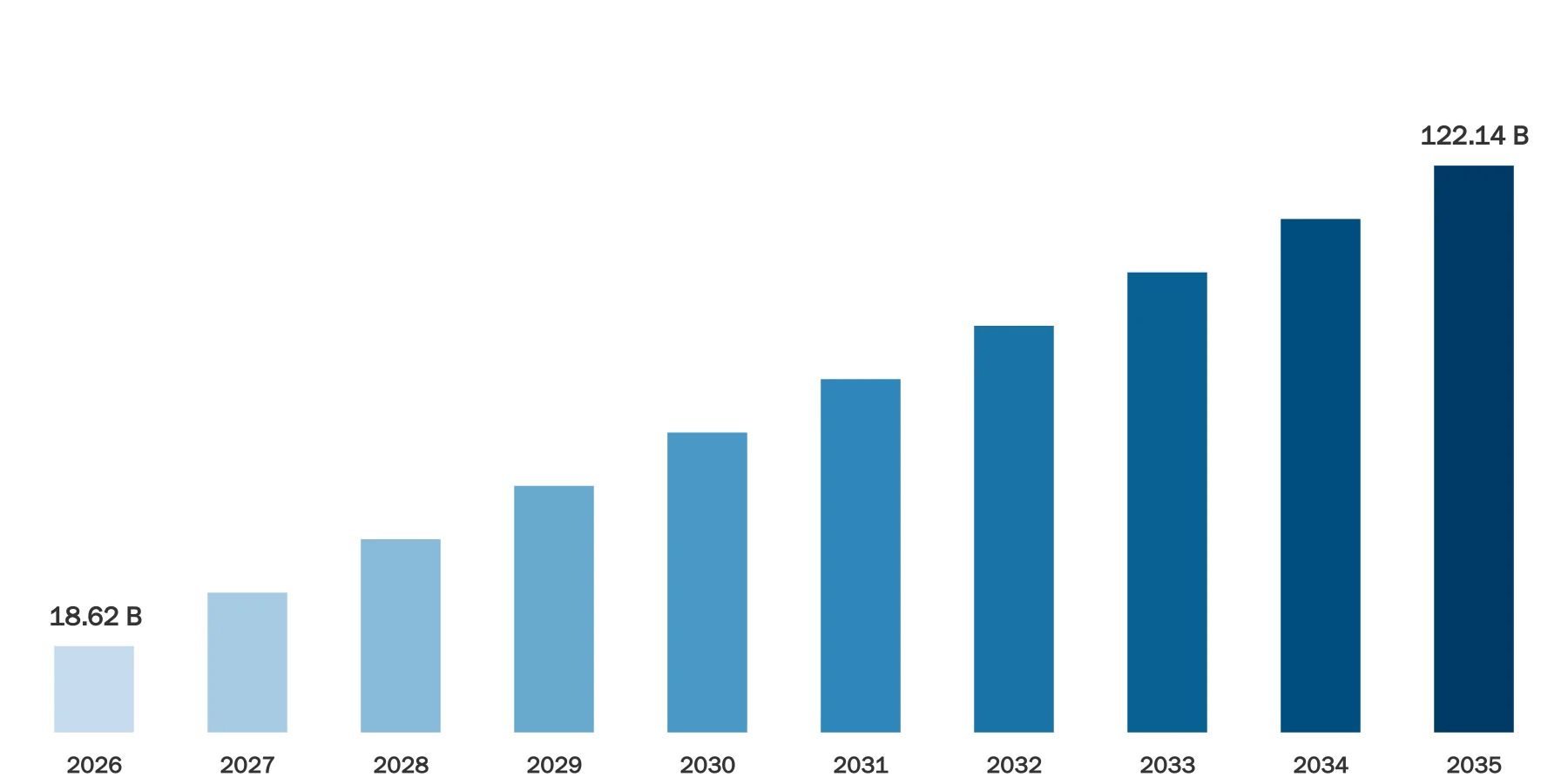
Source: Econ Market Research
AI Code tools increase productivity through the automation of repetitive tasks, suggesting code snippets, and error detection. For example, when the complexity of software development increases, AI code tools help programmers save time and reduce the likelihood of mistakes, making coding more efficient and effective.
The demand for AI code tools has recently risen very rapidly with the increase in software development in all segments, including technology, finance, and healthcare. Companies are increasingly adopting the latest trends to maintain their positions in the fast world of digital evolution and enhance their competitive edge. Hence, the market is growing substantially with innovations in machine learning and natural language processing. It is also bolstered by the growing attention to the practice of DevOps as well as to agile development methodology, both highly orientated towards speed and efficiency.
Dynamic Insights
The primary driver is the need for more automation in the process of software development. In the quest for more efficiency, AI code tools are helping to facilitate development through increased accuracy, minimal errors, and increased productivity. The recent rise in sophistication of software applications makes them require more robust tools to cope with the coding challenges involved.
An increasingly critical dynamic is that of the fast pace by which AI technologies are marching forward and more specifically towards the spheres of machine learning and natural language processing. With these advancements, tooling like AI code enables one to generate high accuracy in code suggestions and optimization accompanied by error detection that would be unworkable in the hands of any developer, further fuelled by growing remote work and distributed teams. Growth is unfortunately hindered by data privacy concerns and the call for constant updates to adhere to changes in evolving programming languages and frameworks.
Drivers Insights
Increasing Demand for Automation in Software Development
As organizations strive to be more efficient and less costly, the demand for automation tools in software development is on the rise. AI code tools automate repetitive tasks such as code generation, error detection, and debugging so that developers can focus on the more complex and creative aspects of their work. This not only accelerates the development process but also reduces human errors, ensuring better quality. AI code tools integration into agile and DevOps workflows is becoming the need of the businesses from multiple industries, and this is driving growth in the market.
Advancements in AI Technologies
Continuous advancements in Artificial Intelligence, particularly in machine learning and natural language processing, significantly enhance the capabilities of AI code tools. These technologies allow tools to understand code context, provide accurate suggestions, and learn from user behaviour over time. As AI code tools become more sophisticated, they can adapt to different programming languages and frameworks, offering tailored solutions for developers. This evolution not only improves user experience but also increases reliance on AI code tools, thereby fuelling market expansion.
Restraints Insights
Data Privacy and Security Concerns
Integration of AI code tools into software development has also raised significant concerns in regard to data privacy and security. Many of these tools request access to sensitive code repositories and proprietary data, increasing the risks of data breaches and intellectual property theft in organizations. This can cause companies to shy away from using AI code tools in fear of the associated risks. Strict data protection and regulation will therefore have to be upheld to overcome such apprehensions and enable growth.
Rapidly Evolving Technology Landscape
In rapid technological changes, AI code tools come under pressure. New programming languages, frameworks, and coding practices become the order of the day regularly. The providers of these AI tools need to be up to date with the changing scenes on a daily basis in terms of making constant updates and adaptations regarding the changes happening daily. This can be hard on effectiveness and affects user satisfaction as well as market share, putting a strain on companies that are involved in the AI code tools market.
Opportunities Insights
Growth of Remote Work and Collaborative Development
The shift towards remote work has created a strong demand for collaborative development tools that facilitate seamless coding among distributed teams. AI code tools that support real-time collaboration, code reviews, and version control can capture significant market share by addressing the needs of modern development teams. By enhancing communication and workflow efficiency, these tools present a valuable opportunity for growth in the AI code tools market.
Segment Analysis
By Type
The type segment includes various AI code tools designed to assist developers throughout the coding process. Code generators automate the creation of code based on predefined templates or specifications, enhancing productivity and consistency. Code review tools facilitate the examination of code quality, enabling teams to catch issues early in the development cycle.
Debugging tools help identify and fix bugs in code, improving overall software reliability. Code completion tools provide real-time suggestions and auto-completions, speeding up coding tasks and reducing the likelihood of syntax errors. Integrated Development Environments (IDEs) combine multiple functionalities, including code editing, compiling, and debugging, into one platform, creating a seamless development experience.
By Application
In terms of application, the AI code tools are in use across different domains having unique coding requirements. Under Web Development, they smooth out the process of development of interactive and responsive web sites with features specially intended for front-end and back-end developers. AI is used in Mobile Application developing for the creation of easily accessible applications for both platforms of iOS and Android devices. Game development uses AI code tools to create complex tasks for coding, ensuring the game is optimized and a more immersive experience.
Enterprise applications make use of the tool in order to build robust systems for exact business needs, hence increasing productivity and collaboration. Data science and analytics process and analyse large amounts of data using AI code tools, which further helps in decision-making that relies on data. Diversified applications underscore that code tools for AI apply flexibility to the different kinds of needs of developers through varied industries.
By Deployment Model
The deployment model classifies two: cloud-based versus on-premises solution. The use of tools based on the cloud increases flexibility for the developer with respect to their place because the developers are free to access and work together via an internet connection from wherever they are located. There is often automated updating as well as scalable solutions while cost-effectiveness provides scalability for any kind of size of organizations.
However, more control is offered by on-premises deployment in keeping the company',s data as well as its level of security. Organizations that follow strict compliance might prefer this kind of deployment model. Companies also get a chance to standardize their environment as it suits the requirements while considering data privacy. These AI Code Tools market preferences between these models differ in keeping with varying preferences and operative strategies.
By End User
The end-user segment includes SMEs, large enterprises, and individual developers. With AI code tools, SMEs are increasingly adopting the technology to streamline their development processes and enhance competitiveness through cost-effective solutions that increase productivity.
Large enterprises have more complex development needs, which they use these tools to manage large teams and projects efficiently, ensuring high-quality outputs and faster time-to-market. Individual developers are also taking up a big share of this market, they will use AI code tools in order to develop their skills in coding as well as increase their productivity, specifically on personal projects or freelance work.
Regional Analysis
North America dominates the market primarily due to strong technology infrastructure, high concentrations of software development companies, and an early adopter base of AI technologies. Major tech giants and a good venture capital ecosystem propel innovation and investment in AI code tools. In addition, rising demands for automation and efficiency in the software development practice of the diverse industries enhance market growth in this region.
Europe, too, is growing remarkably in the market, not only through government initiatives promoting digital transformation and innovation but also because of the significant increase in start-ups and mature companies investing in AI code tools to improve the processes of software development. Germany, the UK, and France are leading this race. The other regions of the Asia-Pacific countries are in high speed to their potential market where mainly the market grows faster as people and the inhabitants like China, India, and Japan which is developing new technology digitally.
Strong expansions are backed up through greater developers as well as massive demands on advanced technological demand for software development. Regions of Latin America and Middle East and Africa are also slowly adopting AI code tools because of increasing interest in digital solutions and a growing need to improve the efficiency of developing software.
Competitive Landscape
Major players in the space like Microsoft, Google, and IBM are utilizing their deep pockets and superior technological prowess towards creating professional-grade AI code tools for thousands of developers. For instance, Visual Studio from Microsoft is developing AI capabilities that make it more efficient to write codes. The cloud-based services of Google have AI capabilities to assist developers. Giant established players enjoy brand value, committed customer base and adequate funds to pump in research and development for product.
Beyond the big players above, start-ups and speciality firms are mushrooming, offering new views as well as specialized solutions on the market. Firms like GitHub, which happens to be owned by Microsoft, has been able to gain momentum through user-friendliness in interface and personalization. Similarly, new entrants like JetBrains, Tabnine, etc have been finding their niche positions with novel solutions for ensuring accuracy as well as agility in coding. Innovations in technology are equally accelerating the competition and the need for companies to change and innovate constantly. The dynamic environment encourages collaboration and partnerships, urging companies to integrate AI tools into the already existing development framework.
List of Key Players:
OpenAI
Google LLC
Amazon Web Services, Inc.
AdaCore
Microsoft
Replit, Inc.
Meta
Sourcegraph, Inc.
Salesforce, Inc.
International Business Machines Corporation
Recent Developments:
Oct 2023, BackboneAI, a leader in AI solutions for product data in B2B eCommerce and supply chain management, has announced the public release of its innovative self-service tools that leverage generative AI technology. These tools are designed to generate large volumes of high-quality images and text content specifically for product data aimed at industrial and automotive sectors. This launch follows a successful 12-month pilot program with several Fortune 500 clients. The platform was developed using data from more than 500 industrial and automotive companies across over 50 countries.
June 2024, Runway, a company focused on developing generative AI tools for film and image content creators, has introduced Gen-3 Alpha. This latest AI model is capable of generating video clips from text descriptions and still images. According to Runway, the new model represents a significant advancement in both generation speed and fidelity compared to their previous flagship video model, Gen-2. Additionally, it offers enhanced control over the structure, style, and motion of the videos it produces.
Global AI Code Tools Report Segmentation
AI Code Tools Market Report Scope & Segmentation
| Attributes | Details |
|---|---|
Market Size (Current) | US$ 18.62 Billion in 2026 |
Market Size (Forecast) | US$ 122.14 Billion in 2035 |
Growth Rate | CAGR of 23.24% from 2026 to 2035 |
Forecast Period | 2026 – 2035 |
Base Year | 2025 |
Historical Data Available | Yes |
Regional Scope | Global |
Segments Covered | By Offering
By Deployment
By Application
|
Frequently Asked Questions
Common questions about this report
The study period covers historical insights and forecast projections for the period 2026-2035.
About the Author
Market research expert with years of industry experience

Related Reports
Explore more market insights from the same category