

Agricultural Lubricants Market
Agricultural Lubricants Market Size, Share, Trends, Growth, and Industry Analysis, By Product Type (Engine Oil, Transmission Fluids, Hydraulic Fluids, Greases), By Category (Mineral Oil-based, Synthetic, Bio-based), By Application (Engines, Gear andamp; Transmission, Hydraulics, Greasing), Regional Analysis and Forecast Period 2026-2035
Market Overview
As per Econ Market Research analysis, the Global Agricultural Lubricants Market generated revenue of US$ 7.57 Billion in 2026 and is forecast to achieve US$ 10.78 Billion by 2035, at a CAGR of 4% during the study period 2026–2035. The base year considered is 2025.
Agricultural Lubricants Market Size 2025-2035 (USD Billion)

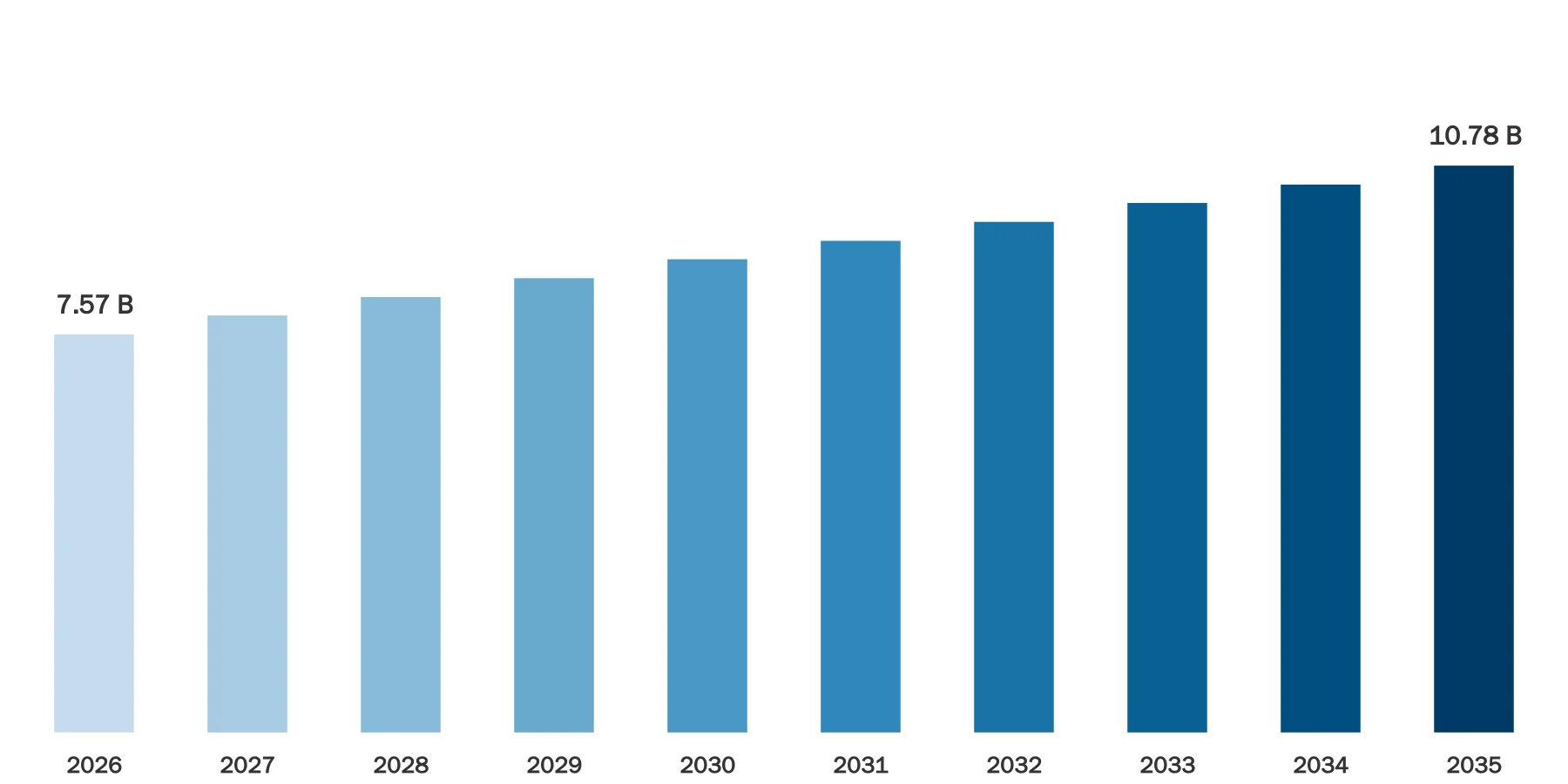
Source: Econ Market Research
The global agricultural lubricants market plays a crucial role in supporting the efficiency and longevity of farm machinery, thereby contributing to the overall productivity of the agricultural sector. These lubricants are specifically formulated to address the unique demands of agricultural equipment, such as tractors, combines, and other farm machinery, which often operate in challenging environments. The market is driven by the increasing mechanization of agriculture, as farmers worldwide adopt advanced machinery to enhance operational efficiency.
The expanding world population is one of the main factors driving the market, as it is creating a demand for more food to be produced. In addition to working hard to meet this demand, farmers also need high-performance, dependable lubricants to make sure that agricultural machinery runs smoothly and lasts a long time. Furthermore, the need for specialised lubricants that can endure the harsh conditions of precision equipment is increased by the trend towards Smart Agriculture and precision farming.
Agricultural Lubricants Dynamics
A multitude of varied factors interact to shape the dynamics of the global market for agricultural lubricants. Global farming practices are becoming more and more mechanised, which is one of the main drivers. The increasing sophistication and necessity of agricultural machinery and equipment in contemporary farming has led to a growing need for high-performance lubricants to maintain the machinery',s longevity and optimal performance. Furthermore, the need for increased agricultural productivity is fuelled by the world',s expanding population and the ensuing demand for food, which is pushing the adoption of sophisticated farming methods that significantly rely on lubricated machinery.
Environmental regulations and sustainability concerns also play a pivotal role in shaping the market dynamics. There is a noticeable shift towards eco-friendly and bio-based lubricants in the agricultural sector to minimize the environmental impact of agricultural activities. This shift is driven by both regulatory pressures and a heightened awareness among farmers about the importance of sustainable practices. Additionally, the volatility in crude oil prices significantly influences the pricing and availability of petroleum-based lubricants, impacting the overall market dynamics.
Agricultural Lubricants Drivers
Increasing Trend of Mechanization Trend
The market for agricultural lubricants is significantly influenced by the growing trend of agricultural mechanisation. The need for specialised lubricants is growing as farmers around the world adopt cutting-edge machinery and equipment to improve operational efficiency. These lubricants are essential to the efficient operation of many pieces of agricultural equipment, such as irrigation systems, harvesters, and tractors. The need for more efficiency, economy, and timely farm operations is driving the trend towards mechanisation, which supports the market for agricultural lubricants', steady expansion.
Sustainability and Regulatory Compliance
The market for eco-friendly lubricants is expanding as a result of growing environmental concerns and strict agricultural regulations. The use of bio-based and environmentally friendly lubricants is becoming more prevalent as governments and environmental agencies place more stringent regulations on the use of lubricants in the agricultural industry. In response, producers are creating lubricants that have a smaller environmental effect, encouraging environmentally friendly agricultural methods. This change is in line with the larger global movement towards sustainable agriculture, which is driving the market for agricultural lubricants upward.
Restraints:
Fluctuating Crude Oil Prices
Since many lubricants are derived from petroleum-based sources, the market for agricultural lubricants is vulnerable to fluctuations in the price of crude oil. Price and availability uncertainty arises from the direct impact of oil price fluctuations on lubricant production costs. This presents a challenge for the agricultural industry',s manufacturers and end users, as they must manage cost variations that may have an impact on overall operating expenses. Creating plans to lessen the effects of erratic crude oil prices becomes essential for players in the market for agricultural lubricants.
Opportunities:
Precision Agriculture Integration
The integration of precision agriculture technologies presents a significant opportunity for the agricultural lubricants market. Precision agriculture relies on advanced equipment, sensors, and Data Analytics to optimize farming practices. Lubricants tailored to the specific needs of precision farming equipment, such as GPS-guided tractors and automated machinery, can enhance overall efficiency and performance. The increasing adoption of precision agriculture creates a niche market for specialized lubricants, offering a growth avenue for manufacturers attuned to the evolving technological landscape in agriculture.
Segment Overview
By Product Type
The agricultural lubricants market is diversified across various product types, each playing a crucial role in ensuring the efficient operation and longevity of agricultural machinery. Engine oil, a key component, lubricates internal combustion engines, preventing wear and corrosion. Transmission fluids facilitate smooth power transmission within machinery, optimizing performance. Hydraulic Fluids are integral to hydraulic systems, ensuring proper functioning of equipment like tractors and loaders. Greases, with their semi-solid consistency, provide long-lasting lubrication to components subjected to heavy loads and extreme conditions.
Other product types encompass a range of specialized lubricants catering to specific needs, such as gear oils and chain lubricants. The dynamic interplay of these product types addresses the diverse lubrication requirements across various agricultural applications, reflecting the industry',s commitment to providing comprehensive solutions for the evolving needs of modern farming practices.
By Type
The differentiation of agricultural lubricants by type is a pivotal aspect, influencing performance, environmental impact, and suitability for diverse applications. Mineral oil-based lubricants, derived from crude oil, are traditional and widely used, offering cost-effectiveness and general-purpose lubrication. Synthetic oil-based lubricants, synthesized chemically, provide enhanced performance under extreme conditions, exhibiting superior temperature stability and resistance to oxidation. Bio-based lubricants, sourced from renewable materials like vegetable oils, emerge as an environmentally friendly alternative, aligning with sustainability goals. This categorization reflects the industry',s response to evolving consumer preferences, regulatory pressures, and the quest for lubricants tailored to specific operational demands.
The diverse landscape of mineral oil-based, synthetic oil-based, and bio-based lubricants caters to the varied needs of farmers and equipment manufacturers, ensuring a comprehensive range of options to optimize machinery performance while addressing environmental concerns. As the market continues to evolve, the strategic positioning of these lubricant types becomes paramount, balancing performance attributes, cost considerations, and the broader sustainability agenda driving innovation in the agricultural lubricants sector.
Agricultural Lubricants Overview by Region
North America, with its highly mechanized and technologically advanced agriculture sector, is a significant market for agricultural lubricants. The region',s emphasis on precision farming and the adoption of cutting-edge machinery contribute to a robust demand for high-performance lubricants. In Europe, stringent environmental regulations drive the adoption of bio-based lubricants, aligning with the continent',s sustainability goals. The Asia-Pacific region, characterized by a large and diverse agricultural landscape, experiences growing demand for lubricants due to increasing mechanization in countries like China and India.
The Middle East and Africa, with their unique agricultural challenges and emerging economies, present both opportunities and challenges for market players. The regional analysis allows stakeholders to tailor their strategies based on specific market characteristics, regulatory environments, and the level of agricultural modernization, ultimately facilitating a more targeted and effective approach to cater to the varied needs of farmers and equipment users worldwide. As the global agricultural lubricants market continues to evolve, understanding regional intricacies becomes paramount for industry participants to capitalize on emerging opportunities and navigate regional challenges successfully.
Agricultural Lubricants market competitive landscape
The competitive landscape of the global agricultural lubricants market is characterized by a mix of established multinational corporations, regional players, and emerging entrants, all vying for market share in a dynamic and evolving industry. Major players such as ExxonMobil, Shell, and Chevron dominate the market with extensive product portfolios that cater to the diverse lubrication needs of modern agriculture. These industry giants leverage their global reach, technological expertise, and research capabilities to offer a comprehensive range of mineral oil-based, synthetic oil-based, and bio-based lubricants. Regional players often carve out niches by focusing on specific agricultural practices prevalent in their respective areas, addressing the unique demands of local farming communities.
The market',s competitive intensity is fuelled by ongoing research and development efforts to introduce innovative lubricants that enhance machinery efficiency, comply with stringent environmental regulations, and align with the growing trend of sustainability in agriculture. Bio-based lubricants, in particular, have garnered attention as companies seek to capitalize on the increasing demand for environmentally friendly solutions. Partnerships and collaborations between lubricant manufacturers and agricultural machinery producers further shape the competitive landscape, as joint ventures enable the development of lubricants tailored to the specifications of advanced farming equipment.
Shell plc
Fuchs Petrolub SE
Exxon Mobil Corporation
TotalEnergies SE
BP p.l.c.
Chevron Corporation
Phillips 66
Petro-Canada Lubricants Inc.
Schaeffer Manufacturing Co.
Royal Mfg Co LP
Agricultural Lubricants Recent Developments
October 2023, Valvoline Cummins Private Limited, a renowned global lubricant manufacturer with a rich heritage of 150 years in pioneering cutting-edge lubricant technologies, has introduced an exclusive product to the industry: Valvoline All Fleet Turbo Plus (Haulage Expert). This innovative offering is designed specifically for heavy usage scenarios involving high horsepower tractors on roads and other agricultural allied operations.
Global Agricultural Lubricants Report Segmentation
Agricultural Lubricants Market Report Scope & Segmentation
| Attributes | Details |
|---|---|
Market Size (Current) | US$ 7.57 Billion in 2026 |
Market Size (Forecast) | US$ 10.78 Billion in 2035 |
Growth Rate | CAGR of 4% from 2026 to 2035 |
Forecast Period | 2026 – 2035 |
Base Year | 2025 |
Historical Data Available | Yes |
Regional Scope | Global |
Segments Covered | By Product Type
By Category
By Application
|
Frequently Asked Questions
Common questions about this report
The study period covers historical insights and forecast projections for the period 2026-2035.
About the Author
Market research expert with years of industry experience

Dipali Bhingare serves as the Market Research Director at Econ Market Research. With a focus on translating complex global economic shifts into actionable business intelligence, she oversees the strategic direction of comprehensive market studies. Her work empowers organizations to navigate volatile industries through data-driven forecasting and deep-dive competitive analysis.
Related Reports
Explore more market insights from the same category