


Top Companies in the Data Security Posture Management Industry
The top data security posture management companies are compared through their platforms, security capabilities, regional presence, and emerging industry trends.
Introduction
Overview of the Global Data Security Posture Management Industry
The global Data Security Posture Management (DSPM) industry has developed into an important segment of enterprise cybersecurity, addressing the challenges of discovering, classifying, monitoring, and protecting sensitive information across distributed digital environments. In 2026, organizations increasingly operate across 3 major public cloud ecosystems—Amazon Web Services, Microsoft Azure, and Google Cloud—alongside private infrastructure, software-as-a-service applications, and enterprise artificial intelligence systems. DSPM solutions provide visibility into structured and unstructured information, identify excessive access permissions, assess data exposure, and support continuous compliance monitoring. Financial institutions, healthcare organizations, government agencies, manufacturers, and technology companies represent important enterprise customer groups.
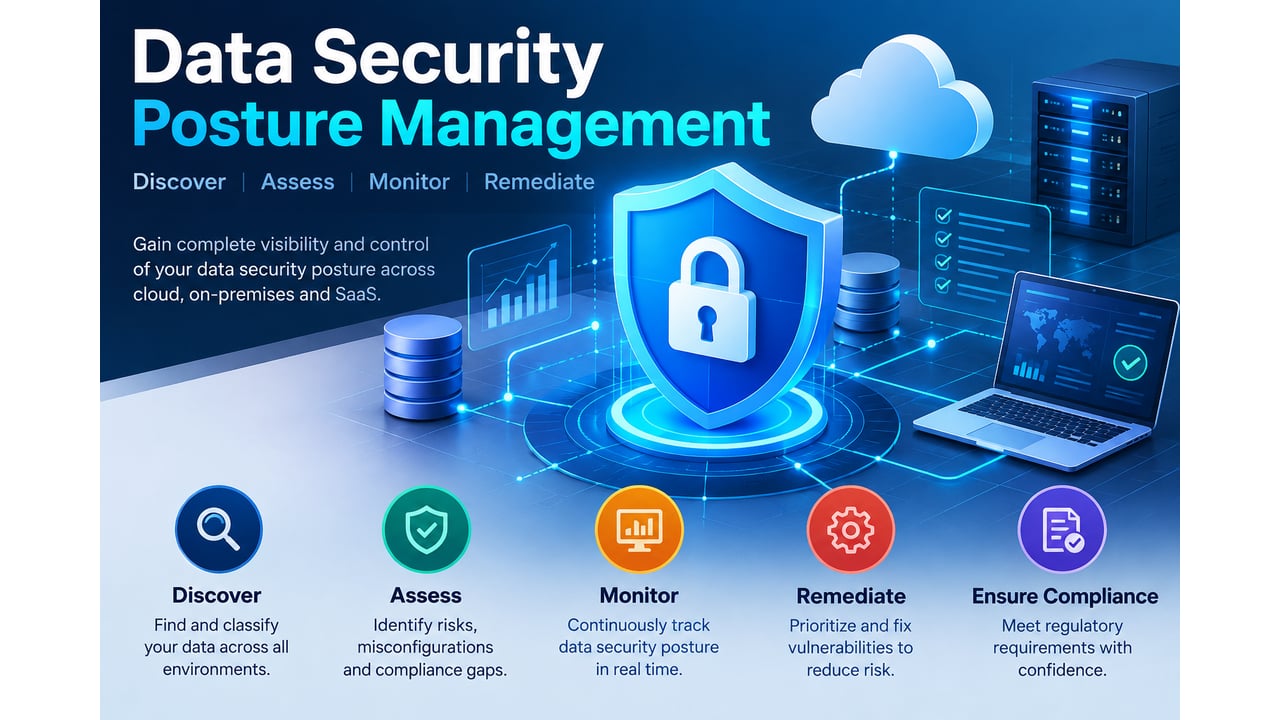
The industry's operational importance is reflected in the 2026 Data Threat Report, which surveyed 3,120 security and IT professionals globally. The findings indicated that 61% of respondents reported attackers targeting their AI applications, while only 47% of sensitive cloud data was encrypted. These findings demonstrate the security gaps that data-centric protection technologies are designed to address, although they do not represent direct DSPM deployment rates. Modern platforms extend beyond traditional cloud security posture management by connecting data sensitivity, identity permissions, storage configurations, and access activity. Competition involves specialist DSPM developers, established cybersecurity companies, cloud technology providers, and enterprise data protection vendors.
Market Evolution and Growth Drivers
Data Security Posture Management evolved from traditional data discovery, database monitoring, and data loss prevention technologies as enterprise information became distributed across cloud infrastructure and SaaS applications. The introduction of increasingly sophisticated classification tools during the early 2020s enabled security teams to identify sensitive records without relying exclusively on manually configured rules. By 2025, commercial DSPM offerings increasingly combined automated discovery, access governance, contextual risk assessment, and remediation workflows. The expansion of generative AI introduced additional security requirements involving training datasets, retrieval-augmented generation systems, confidential documents, and autonomous applications that retrieve business information.
Regulatory developments have also accelerated demand for data visibility and governance capabilities. The European Union's Digital Operational Resilience Act became applicable on January 17, 2025, while additional PCI DSS version 4 requirements became effective on March 31, 2025. The European Union's NIS2 Directive introduced cybersecurity risk-management requirements across 18 critical sectors, further increasing the importance of systematic data protection. Meanwhile, the 2026 global data security survey identified rapid AI ecosystem changes as a leading concern for 70% of surveyed organizations. These developments encourage enterprises to replace periodic security assessments with continuous monitoring and risk-based remediation.
Top 5 Latest Trends in the Data Security Posture Management Industry
The following 5 developments are shaping the capabilities, competitive positioning, and adoption priorities of Data Security Posture Management technology providers in 2026:
AI-powered sensitive data discovery and contextual classification
Integration of DSPM with generative AI and autonomous agent security
Unified multicloud data visibility and shadow data detection
Identity-centric data access governance and automated remediation
Convergence of DSPM, data detection and response, and regulatory compliance
Trend 1: AI-Powered Sensitive Data Discovery and Contextual Classification
Artificial intelligence is changing how DSPM systems identify and categorize sensitive information across enterprise environments. Traditional classification approaches relied heavily on regular expressions, dictionaries, and predefined information patterns. Since 2024, vendors have increasingly introduced machine learning and contextual classification technologies capable of recognizing financial records, personal information, intellectual property, medical documents, and enterprise-specific confidential information. These technologies evaluate content alongside surrounding metadata, ownership, storage location, and access relationships to improve the quality of security findings.
In 2026, contextual classification has become particularly important for organizations managing petabyte-scale repositories and heterogeneous data formats. Cyera describes AI-native classification capabilities that extend across structured and unstructured datasets, while Sentra supports continuous discovery and classification across cloud services and enterprise data platforms. Such systems help distinguish genuinely sensitive information from harmless records containing similar text patterns. Their operational value depends on measurable classification accuracy, scanning coverage, false-positive rates, and the speed at which newly created records enter the security inventory.
Trend 2: Integration of DSPM With Generative AI and Autonomous Agent Security
Generative AI has introduced new data exposure pathways involving enterprise copilots, large language models, retrieval-augmented generation pipelines, and autonomous software agents. Traditional controls focused on employee accounts and application permissions, whereas AI-enabled applications may retrieve information through service identities, search indexes, APIs, and integrated knowledge repositories. During 2025 and 2026, DSPM technology providers expanded their capabilities to determine which sensitive records AI systems could access and whether those permissions aligned with approved business requirements.
The 2026 Data Threat Report found that 61% of surveyed organizations reported attacks targeting their AI applications. Microsoft expanded its Purview DSPM capabilities to address AI applications and agents, with its updated unified DSPM experience becoming generally available in May 2026. Other specialist vendors introduced controls for AI-related data discovery, identity mapping, and policy enforcement. These capabilities are particularly relevant to financial services, healthcare, legal services, and research organizations where AI-generated responses can inadvertently expose regulated or proprietary information.
Trend 3: Unified Multicloud Data Visibility and Shadow Data Detection
Enterprise data commonly moves between production databases, development environments, analytics platforms, file repositories, and cloud storage services. Copies created for testing, backup, or analytics can become unmanaged shadow data when they fall outside established security inventories. By 2026, DSPM platforms increasingly support discovery across AWS, Azure, Google Cloud, on-premises databases, and SaaS applications. The challenge extends beyond locating information because security teams must establish data ownership, determine sensitivity, identify replication paths, and assess whether each copy remains necessary.
Modern DSPM solutions use agentless scanning, cloud metadata, contextual classification, and policy-based assessments to identify exposed repositories without requiring conventional endpoint agents on every workload. Rubrik, IBM, and Palo Alto Networks offer data discovery capabilities that address multiple cloud environments. The distinction between cloud infrastructure security and data security remains important: a correctly configured storage service can still contain sensitive records accessible through excessive permissions. Unified discovery therefore improves the foundation for data minimization, access reviews, and compliance evidence collection.
Trend 4: Identity-Centric Data Access Governance and Automated Remediation
The expansion of human and non-human identities has increased the complexity of controlling access to sensitive enterprise information. Service accounts, cloud roles, third-party applications, automated workloads, and AI agents can possess permissions that exceed their operational requirements. In 2026, security teams increasingly need visibility into both direct permissions and inherited access through groups, roles, sharing links, and cloud identity policies. DSPM platforms are responding by combining identity relationship analysis with sensitive data classification and exposure assessments.
The 2026 global data security survey found that 52% of respondents identified identity and access management as their most pressing security discipline. Varonis provides access intelligence and automated permission remediation, while Palo Alto Networks incorporates data access governance into Cortex Cloud. These capabilities enable security teams to prioritize situations where privileged identities can access sensitive repositories that are unnecessarily exposed. Automated remediation can remove public links, revoke excessive permissions, adjust policies, or initiate approval workflows. Effective implementation requires safeguards, impact assessment, and audit trails to prevent legitimate business processes from being interrupted.
Trend 5: Convergence of DSPM, Data Detection and Response, and Regulatory Compliance
Data Security Posture Management is increasingly integrating with technologies responsible for detecting suspicious activity, preventing information leakage, and supporting regulatory compliance. Traditional DSPM solutions emphasized the identification of existing exposure, whereas data detection and response technologies monitor how information is accessed and transferred. Combining these approaches helps enterprises establish both the security condition of a dataset and whether its usage indicates an active threat. By 2025, vendors were integrating posture management, access governance, activity monitoring, and automated response within broader data security platforms.
The convergence accelerated through corporate acquisitions and platform expansion. Rubrik integrated DSPM capabilities into Rubrik Security Cloud in 2025, while Veeam completed its acquisition of Securiti AI in December 2025, bringing data discovery, privacy governance, and resilience technologies into the same corporate portfolio. Regulatory developments reinforce this direction because the 2025 PCI DSS requirements and expanding European cybersecurity obligations increase demand for continuous control validation. The commercial advantage of integration is the ability to connect discovery, investigation, remediation, and reporting rather than managing these activities through disconnected security systems.
Top 10 Companies in the Data Security Posture Management Industry
The following 10 companies are selected based on their active DSPM capabilities, technical specialization, enterprise security offerings, geographic presence, and contributions to data protection technology. They are presented as an industry overview rather than a ranking by market share or commercial performance.
1. Microsoft Corporation
Company Overview: Founded in 1975, Microsoft has developed an extensive enterprise technology ecosystem spanning productivity software, cloud computing, identity management, security operations, and artificial intelligence. Its established presence in enterprise IT provides an operational foundation for integrating data security controls across Microsoft 365, Azure, and connected third-party environments.
Headquarters: Redmond, Washington, United States.
Core Data Security Posture Management Expertise: Microsoft specializes in data discovery, information classification, sensitivity labeling, access governance, and monitoring of sensitive information used by AI applications. Its approach connects data security findings with identity controls, organizational policies, and established enterprise workflows.
Major Products and Services: Microsoft Purview Data Security Posture Management provides centralized discovery, risk assessment, reporting, and remediation workflows. The updated DSPM experience became generally available in May 2026, expanding support for traditional applications, AI agents, and integrated third-party services. Complementary capabilities include Microsoft Purview Information Protection, Data Loss Prevention, Insider Risk Management, and Microsoft Security Copilot.
2. Google LLC
Company Overview: Google was founded in 1998 and operates cloud computing, artificial intelligence, data analytics, and enterprise technology services internationally. Its position in DSPM expanded through the completion of its acquisition of Wiz on March 11, 2026. Wiz continues to operate under its established brand within Google Cloud, providing multicloud security capabilities that extend beyond Google's native infrastructure.
Headquarters: Mountain View, California, United States.
Core Data Security Posture Management Expertise: Google's DSPM capabilities focus on understanding sensitive data exposure alongside cloud infrastructure configurations, workload identities, attack paths, and security vulnerabilities. Wiz contributes graph-based contextual analysis and agentless discovery to this portfolio.
Major Products and Services: Wiz DSPM continuously discovers and classifies sensitive information across infrastructure-as-a-service, platform-as-a-service, databases, application environments, and AI workloads. Its security graph helps organizations identify connections between vulnerable resources and critical datasets. Google Cloud's broader security portfolio supports threat investigation, cloud posture assessment, and security operations across multicloud environments.
3. Palo Alto Networks, Inc.
Company Overview: Incorporated in 2005, Palo Alto Networks develops enterprise cybersecurity technologies covering network security, cloud protection, identity-related threats, and security operations. Its Santa Clara headquarters includes a campus with 4 buildings totaling over 630,000 square feet, supporting engineering, product development, and corporate operations.
Headquarters: Santa Clara, California, United States.
Core Data Security Posture Management Expertise: The company combines sensitive data discovery, contextual classification, cloud identity analysis, and real-time security detection. Its DSPM technology evaluates whether cloud data is exposed through misconfigurations, excessive privileges, or potentially exploitable access pathways.
Major Products and Services: Cortex Cloud provides Data Security Posture Management alongside cloud security posture management, cloud infrastructure entitlement management, and AI security posture management. The platform supports hundreds of built-in data classifiers and evaluates access relationships across cloud resources. The company's 2026 architecture guidance emphasizes correlating data, infrastructure, application, and identity signals to prioritize remediation according to actual exposure.
4. International Business Machines Corporation
Company Overview: IBM traces its corporate history to 1911 and maintains operations across enterprise software, infrastructure, consulting, and advanced computing. Its long-established presence in regulated industries provides experience addressing complex data protection requirements involving financial information, healthcare records, government systems, and hybrid technology environments.
Headquarters: Armonk, New York, United States.
Core Data Security Posture Management Expertise: IBM focuses on discovering sensitive data, mapping access permissions, monitoring cloud repositories, and evaluating security policy violations. Its capabilities combine database security experience with cloud-native discovery and posture analysis.
Major Products and Services: IBM Guardium DSPM, available through IBM Guardium Data Security Center, discovers and classifies shadow data across AWS, Azure, Google Cloud, and supported SaaS applications. It also evaluates sensitive information exposed through collaboration platforms, file-sharing services, and development tools. IBM offers a 14-day DSPM trial and supports compliance-related assessments associated with GDPR, HIPAA, PCI DSS, and other applicable security obligations.
5. Rubrik, Inc.
Company Overview: Rubrik was incorporated in December 2013 and adopted its current corporate name in October 2014. The company develops cloud-oriented data security, cyber recovery, and resilience technologies for enterprise environments. Its progression into DSPM includes capabilities originating from Laminar, which Rubrik acquired in 2023.
Headquarters: Palo Alto, California, United States.
Core Data Security Posture Management Expertise: Rubrik focuses on connecting sensitive data discovery with access governance, security policy monitoring, threat detection, and cyber recovery. This combination helps organizations understand which datasets require protection and how those datasets relate to operational recovery requirements.
Major Products and Services: Rubrik Security Cloud incorporates Data Security Posture Management across cloud, SaaS, and on-premises environments. Its capabilities include data classification, identity inventory, exposure analysis, risk remediation guidance, and suspicious activity monitoring. In 2025, Rubrik expanded integration between DSPM and its broader security platform, supporting centralized management of sensitive data risks and Microsoft 365 information protection.
6. Veeam Software
Company Overview: Founded in 2006, Veeam provides enterprise data resilience, backup, recovery, and security technologies. The company reported over 550,000 customers globally in 2025 and expanded its workforce to over 6,600 employees across more than 60 countries. Its DSPM capabilities expanded substantially following its completed acquisition of Securiti AI in December 2025.
Headquarters: Seattle, Washington, United States.
Core Data Security Posture Management Expertise: Veeam combines data resilience with sensitive data intelligence, classification, privacy governance, and access risk assessment. The acquisition of Securiti AI introduced specialized technologies designed to provide consistent visibility across cloud, SaaS, enterprise applications, and backup environments.
Major Products and Services: Veeam's portfolio includes technologies originating from Securiti AI's Data Command Center, providing data discovery, DSPM, privacy controls, and AI governance capabilities. These complement Veeam's established backup and cyber recovery solutions. The combined approach supports the operational objective of identifying, securing, governing, and recovering information through connected data security processes.
7. Cyera
Company Overview: Established in 2021, Cyera specializes in data security technologies built for modern cloud and AI environments. The company maintains headquarters operations in New York and Tel Aviv, alongside additional international offices. Its technical development emphasizes agentless deployment, machine learning, and enterprise data intelligence.
Headquarters: New York, United States, with co-headquarters operations in Tel Aviv, Israel.
Core Data Security Posture Management Expertise: Cyera focuses on identifying sensitive and proprietary information, mapping data ownership and access, and prioritizing exposure according to business context. Its platform is designed to support data environments extending into hundreds of petabytes.
Major Products and Services: Cyera DSPM provides continuous data discovery, AI-driven classification, contextual risk prioritization, and automated remediation. The broader portfolio includes data loss prevention, identity security, and AI-focused protection technologies. A company-sponsored study published in September 2026 reported improvements in sensitive data discovery and reductions in security incidents among assessed customers; these findings should be interpreted as study-specific results rather than universal performance guarantees.
8. Sentra
Company Overview: Founded in 2021, Sentra develops cloud-native data security and AI data governance technologies. The company operates from New York and Tel Aviv, serving enterprises managing sensitive information across cloud infrastructure, SaaS services, and analytics platforms. Its product development emphasizes continuous data intelligence and governance for large-scale environments.
Headquarters: New York, United States, with co-headquarters operations in Tel Aviv, Israel.
Core Data Security Posture Management Expertise: Sentra specializes in automated data discovery, contextual classification, access governance, and protection of sensitive datasets used by AI applications. Its architecture is designed to assess enterprise data without transferring complete sensitive datasets outside customer-controlled environments.
Major Products and Services: The Sentra Data Security Platform combines DSPM, Data Access Governance, Data Detection and Response, and AI data readiness capabilities. Its integrations support AWS, Azure, Google Cloud, Snowflake, Databricks, and other enterprise data services. Sentra also addresses shadow data, excessive permissions, unauthorized access, and risky data duplication through connected detection and remediation workflows.
9. BigID
Company Overview: Founded in 2016, BigID develops enterprise software for data discovery, security, privacy management, governance, and AI risk reduction. Its platform supports organizations operating complex data environments involving structured databases, file repositories, SaaS services, legacy infrastructure, and cloud applications.
Headquarters: New York, United States.
Core Data Security Posture Management Expertise: BigID specializes in identity-aware data discovery, contextual classification, privacy-related information mapping, and automated risk remediation. Its approach connects information sensitivity with business ownership, access privileges, data lifecycle requirements, and AI usage patterns.
Major Products and Services: BigID's DSPM platform provides sensitive data discovery, exposure assessment, access intelligence, policy enforcement, data retention management, and automated remediation. The company also offers capabilities for AI security posture management and agentic AI governance. Its published classification portfolio includes over 1,500 classifiers, allowing enterprises to identify diverse categories of personal, proprietary, and regulated information.
10. Varonis Systems, Inc.
Company Overview: Varonis commenced operations in 2005 and specializes in protecting enterprise data across cloud, SaaS, and on-premises environments. The company reports over 2,400 employees and 14 global offices, supporting enterprise security operations and technology development across international markets.
Headquarters: Miami, Florida, United States.
Core Data Security Posture Management Expertise: Varonis focuses on identifying sensitive information, evaluating access relationships, monitoring unusual data activity, and automatically reducing security exposure. Its technology examines permissions, sharing links, identity relationships, and behavioral patterns to determine how confidential information could be accessed or misused.
Major Products and Services: The Varonis Data Security Platform combines DSPM, data discovery, classification, automated remediation, and data detection and response. It also provides managed detection and response coverage operating 24 hours per day, 7 days per week. In May 2026, Varonis announced general availability of Varonis Atlas, expanding its security capabilities across AI assets, applications, models, and autonomous agents.
Regional Outlook
North America
North America represents an established environment for enterprise Data Security Posture Management adoption, supported by cloud infrastructure development, cybersecurity research, technology investment, and regulatory oversight. The United States is home to the global headquarters of the 10 companies profiled in this article, although their engineering and business operations are distributed internationally. Major demand sectors include banking, healthcare, insurance, government, retail, technology, and professional services. These industries routinely operate across cloud and on-premises environments, creating requirements for sensitive data discovery, access monitoring, and continuous security policy enforcement.
The United States' regulatory environment supports adoption through industry-specific requirements and state-level privacy legislation. HIPAA establishes obligations concerning protected health information, while the California Consumer Privacy Act and subsequent amendments strengthen privacy rights and organizational accountability. PCI DSS version 4.0.1 includes additional security requirements that became effective on March 31, 2025, influencing how organizations identify and protect payment-related information. Data Security Posture Management can support these responsibilities by discovering regulated datasets and providing evidence about storage locations, permissions, and protection controls, although deployment alone does not establish regulatory compliance.
Canada represents another important market, particularly among financial institutions, healthcare providers, telecommunications companies, and public-sector organizations. The Personal Information Protection and Electronic Documents Act, introduced in 2000, establishes privacy obligations for covered commercial activities, while provincial requirements create additional compliance considerations. Mexico's expanding digital services, manufacturing operations, and cross-border business activities create demand for enterprise data protection. Across the 3 countries, customers require solutions that accommodate different legal frameworks, data residency expectations, and levels of internal cybersecurity expertise.
Regional opportunities include security automation for AI applications, cloud identity governance, and unified monitoring across large distributed organizations. However, organizations must address integration complexity, workforce shortages, and the challenge of protecting older systems alongside new cloud applications.
Europe
Europe's Data Security Posture Management industry is shaped by comprehensive privacy legislation, cybersecurity requirements, and established enterprise demand for auditable security controls. The European Union comprises 27 member states, creating a large but legally complex environment for organizations operating across national boundaries. The General Data Protection Regulation became applicable in May 2018 and remains an important driver of data discovery, classification, access management, and privacy governance. Enterprises need to identify personal information, understand its processing activities, and evaluate whether access and retention practices align with applicable requirements.
European cybersecurity regulations have expanded beyond traditional privacy governance. The NIS2 Directive covers 18 critical sectors, including energy, healthcare, transport, and public administration. Member states were required to transpose the directive by October 17, 2024, although implementation progress has varied. The Digital Operational Resilience Act became applicable in January 2025, creating additional operational resilience and ICT risk-management obligations for covered financial entities. These developments increase the practical importance of continuous data risk identification and documented remediation processes.
Germany, France, the Netherlands, and the Nordic countries have developed technology-intensive business environments where DSPM can support manufacturing, financial services, research, and public infrastructure. The United Kingdom represents a separate regulatory environment following its departure from the European Union, while retaining substantial demand for enterprise data protection. Italy and Spain provide opportunities across banking, manufacturing, tourism, and digital public services. In each country, data residency, third-party access, and cloud governance requirements influence deployment decisions.
The European AI Act introduced progressively applicable obligations, with certain enforcement provisions applying from August 2, 2026. Although DSPM does not independently satisfy AI Act requirements, its data discovery and access intelligence capabilities can support AI governance programs. Regional challenges include multilingual classification requirements, differing national implementation arrangements, and the complexity of maintaining consistent controls across multiple jurisdictions.
Asia-Pacific
Asia-Pacific presents diverse opportunities for Data Security Posture Management providers because enterprise technology maturity, cybersecurity legislation, and cloud adoption differ substantially between countries. China, Japan, India, South Korea, Australia, Singapore, and Taiwan support substantial industrial, financial, telecommunications, and technology activity. Enterprise information is increasingly distributed among domestic infrastructure, international cloud services, SaaS platforms, and AI applications. These conditions create demand for accurate data discovery, classification, and access governance across environments that may be subject to different processing and localization rules.
China's Personal Information Protection Law took effect in 2021, establishing requirements governing personal information processing. Japan's amended Act on the Protection of Personal Information introduced important requirements in 2022. India enacted its Digital Personal Data Protection Act in 2023 and notified implementing rules in November 2025, with different provisions subject to phased commencement. These developments create opportunities for data inventories, privacy-related classification, retention governance, and identification of sensitive information exposed through unauthorized access.
Singapore serves as a regional hub for financial technology, cloud services, and international enterprise operations. Its Personal Data Protection Act requires notification of qualifying data breaches to the regulator within 3 calendar days after determining that a breach is notifiable. Australia maintains an established privacy and cybersecurity regulatory environment, while South Korea has detailed personal information protection requirements. Taiwan's semiconductor ecosystem also creates demand for protecting research, manufacturing, and intellectual property data.
India's enterprise technology services, financial institutions, and digital infrastructure create opportunities for DSPM vendors serving domestic and international customers. Japan and South Korea offer specialized applications involving industrial data, electronics research, and enterprise AI. Southeast Asian markets require security platforms that can accommodate different cloud availability, local regulations, and language requirements. Regional barriers include inconsistent cybersecurity resources, fragmented enterprise infrastructure, cross-border transfer restrictions, and shortages of skilled security personnel.
Middle East & Africa
The Middle East and Africa represent developing opportunities for Data Security Posture Management, supported by national digital transformation initiatives, cloud infrastructure expansion, financial technology adoption, and stronger privacy regulation. The Gulf Cooperation Council comprises 6 countries: Saudi Arabia, the United Arab Emirates, Qatar, Kuwait, Bahrain, and Oman. These economies are advancing digital government services, healthcare information systems, financial technology, telecommunications, and data-intensive infrastructure. Such initiatives increase the importance of discovering sensitive information, monitoring identity permissions, and maintaining appropriate data protection controls.
Saudi Arabia's Personal Data Protection Law became effective on September 14, 2023, with a general compliance grace period extending to September 14, 2024. The United Arab Emirates introduced its federal Personal Data Protection Law through Federal Decree-Law No. 45 of 2021. These frameworks have encouraged organizations to examine personal data handling, processing responsibilities, and cross-border information management. DSPM platforms can support this work by identifying regulated datasets and highlighting inappropriate access or storage configurations.
Israel contributes specialized cybersecurity research and software engineering expertise, including development activities associated with global DSPM vendors. Qatar and other Gulf countries provide opportunities in banking, energy, transportation, and government technology systems. South Africa's Protection of Personal Information Act reached its principal enforcement stage in July 2021, strengthening the importance of accountable information processing. Nigeria enacted its Data Protection Act in 2023, while Kenya introduced its Data Protection Act in 2019. These developments provide a legal foundation for enterprise investment in data visibility and protection technologies.
Opportunities across African markets include protecting mobile financial services, healthcare databases, telecommunications platforms, and public digital services. Egypt, Kenya, Nigeria, and South Africa are relevant markets for cloud adoption and managed cybersecurity offerings. Important barriers include uneven connectivity, limited specialist workforce availability, legacy system integration, and differences in regulatory implementation. Managed DSPM services and regional technology partnerships may help organizations adopt advanced protection capabilities without maintaining large internal security teams.
Future Opportunities in the Data Security Posture Management Industry
The future of the Data Security Posture Management industry will increasingly depend on its ability to protect information accessed by AI applications, distributed identities, and automated enterprise processes. During 2026, DSPM providers have expanded their focus beyond cloud storage discovery to include AI models, enterprise knowledge bases, autonomous agents, and data processing pipelines. This creates opportunities for integrating data classification with AI security posture management, identity governance, and real-time policy enforcement. Potential improvements include better recognition of proprietary documents, more accurate identification of unusual data access, and stronger controls governing which information an AI system can retrieve.
Product innovation will also focus on automated remediation and operational efficiency. Platforms that identify thousands of security findings must distinguish critical exposures from low-risk configuration issues. The 2026 global security survey found that 52% of respondents viewed identity and access management as their most pressing security discipline. This creates a practical opportunity for DSPM providers to connect sensitive data risk with permissions, service accounts, and non-human identities. Future product development is likely to emphasize configurable automated controls, approval workflows, and measurable reductions in excessive access rather than discovery alone.
Regulatory developments provide another source of demand. European AI governance obligations continue to enter application in stages, including provisions scheduled for December 2027 and August 2028. Organizations developing regulated AI applications will need reliable inventories of sensitive data and evidence demonstrating appropriate governance. DSPM vendors can contribute classification records, access histories, remediation evidence, and data relationship information to broader compliance programs. Partnerships between security software providers, cloud operators, privacy technology developers, and consulting firms can extend these capabilities into complex enterprise environments.
Small and medium-sized enterprises represent an opportunity for simplified DSPM deployment models. Organizations with fewer internal security specialists may benefit from managed services, cloud-native subscriptions, and automated discovery with minimal infrastructure requirements. Technology providers can also differentiate through secure scanning architectures, reduced unnecessary data movement, efficient processing of unchanged datasets, and support for regional information residency requirements. These features may reduce infrastructure overhead and unnecessary computational work, although actual environmental benefits require workload-specific measurement.
Over the longer term, the strongest opportunities for top companies in the Data Security Posture Management industry involve combining 3 operational priorities: reliable data intelligence, controlled access, and actionable risk reduction. Successful products will need to maintain these capabilities across cloud services, on-premises infrastructure, AI applications, and emerging technologies without introducing new security vulnerabilities through their own privileged access.
Conclusion
The global Data Security Posture Management industry has become an increasingly important component of enterprise cybersecurity as organizations expand their use of cloud infrastructure, SaaS platforms, and artificial intelligence. The 2026 global data security survey involving 3,120 respondents demonstrates why continuous data visibility and access governance are important operational concerns. The industry's 5 major trends—AI-driven classification, AI application security, multicloud discovery, identity-aware governance, and integration with detection and compliance technologies—reflect a transition from static security assessments toward continuous data protection.
The 10 companies examined in this article represent different approaches to the same objective. Microsoft, Google, Palo Alto Networks, IBM, Rubrik, and Veeam combine DSPM with wider enterprise technology platforms, while Cyera, Sentra, BigID, and Varonis contribute specialized data discovery, classification, access intelligence, and security automation capabilities. Their products differ in architecture, supported environments, governance depth, and remediation methods, making technical evaluation essential for enterprise adoption.
Regional conditions will continue to influence demand. North America offers established enterprise infrastructure, Europe emphasizes comprehensive privacy and regulatory controls, Asia-Pacific combines industrial digitization with diverse national data protection requirements, and the Middle East and Africa present opportunities associated with expanding digital services. Future competition among top companies in the Data Security Posture Management industry will depend on classification accuracy, integration capabilities, secure automation, AI governance, and demonstrable reductions in sensitive data exposure.
As the industry advances beyond 2026, DSPM's strategic value will increasingly be measured by its ability to provide continuous, accurate, and actionable control over enterprise information. Organizations adopting these technologies will benefit most when discovery, access governance, security operations, and compliance responsibilities operate together within a clearly defined data protection strategy.