


Top Companies in the Correspondence Management System
The top correspondence management system companies in 2026, latest industry trends, regional outlook, key solutions, and future opportunities.
Introduction
Overview of the Global Correspondence Management System Industry
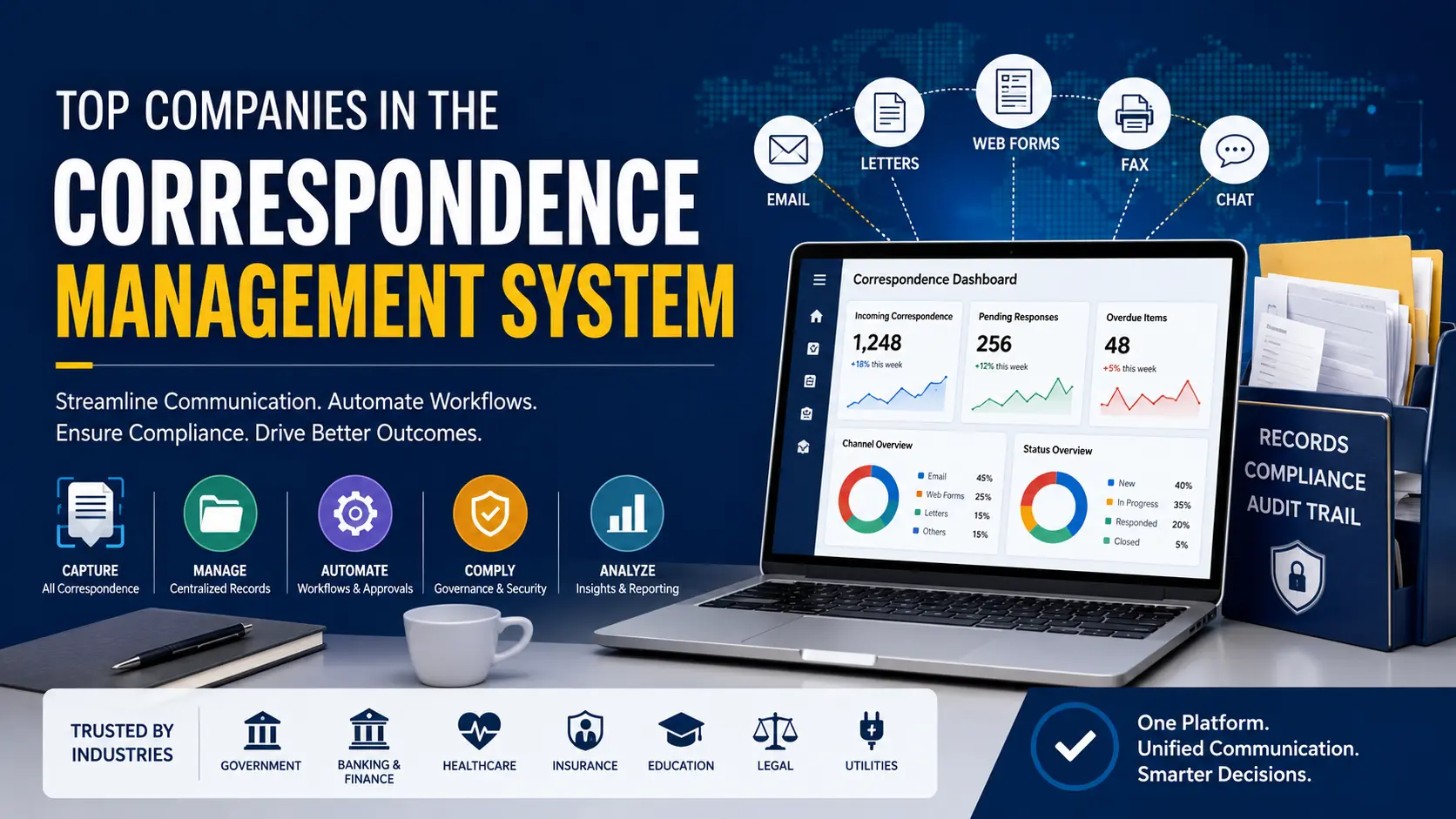
The global correspondence management system industry has become an essential component of enterprise information governance in 2026. A modern correspondence management system captures, classifies, routes, tracks, retrieves, and archives communications received through email, physical letters, web forms, fax, mobile applications, and digital service portals. Organizations commonly use these platforms to maintain 1 centralized record for every incoming and outgoing communication while supporting version control, approval histories, digital signatures, retention policies, and audit trails. With an estimated 70% to 90% of enterprise information existing in unstructured formats, businesses and public authorities are prioritizing technologies capable of converting disconnected communications into searchable, governed, and actionable digital records.
Correspondence management system adoption is particularly strong among government departments, banks, insurers, healthcare providers, utilities, legal organizations, and enterprises operating across more than 1 jurisdiction. These institutions can process thousands or millions of letters, complaints, claims, applications, notices, invoices, and regulatory communications every year. Unlike basic document storage, an enterprise correspondence management system assigns reference numbers, identifies responsible employees, tracks deadlines, escalates overdue responses, and preserves each action within a complete audit history. The resulting environment provides 24-hour access to authorized teams while reducing dependence on paper files, shared inboxes, manual registers, and uncontrolled spreadsheets.
Market Evolution and Growth Drivers
The correspondence management system market has evolved through at least 4 major technology stages: paper-based registries, electronic document repositories, workflow-enabled content platforms, and AI-supported correspondence automation. Early systems primarily scanned letters and stored digital copies. Current solutions can apply optical character recognition, natural language processing, automated classification, entity extraction, sentiment detection, translation, and generative AI to communications containing dozens or hundreds of pages. This evolution is being accelerated by hybrid work, digital government programs, cloud migration, citizen-service modernization, cybersecurity requirements, and stricter regulatory expectations regarding retention, privacy, accessibility, and response times.
Several measurable operational challenges are driving investment in correspondence management software. A single organization may operate 10 or more communication channels, maintain 5 different content repositories, and rely on multiple departments to approve 1 final response. Without centralized workflow controls, correspondence can be duplicated, assigned incorrectly, answered late, or stored without the required metadata. Digital platforms address these risks by establishing defined service-level targets, automated reminders, role-based permissions, and 1 authoritative record. Organizations are also demanding deployment flexibility, including public cloud, private cloud, hybrid infrastructure, and on-premises environments, because government and regulated-sector customers frequently maintain different residency and security requirements across 2 or more countries.
Top 5 Latest Trends in the Correspondence Management System
Trend 1: AI-Powered Classification and Intelligent Data Extraction
Artificial intelligence is one of the most influential correspondence management system trends in 2026. Traditional platforms depended on employees to read every message, select a document type, enter metadata, and assign the communication to the correct department. AI-enabled solutions can now examine 1 incoming email or scanned letter, identify its subject, recognize names and account numbers, determine urgency, and recommend the appropriate workflow. Some systems combine optical character recognition with machine learning and generative AI to process both structured fields and unstructured narratives. This capability is particularly valuable when organizations receive correspondence in 10 or more document formats or languages.
The practical value of AI extends beyond faster indexing. Intelligent models can identify duplicate submissions, summarize a 20-page attachment, extract 15 required data fields, detect missing information, and generate an initial response for employee review. Human approval remains important for legal, regulatory, medical, financial, or public-sector communication, but automation can reduce repetitive work at the first 3 stages of intake: capture, classification, and assignment. Newer platforms also support prompt-based retrieval, enabling authorized users to ask questions about stored documents instead of relying exclusively on exact file names or metadata values. AI-enabled content platforms introduced during 2025 and 2026 increasingly combine correspondence automation, enterprise search, records governance, and process orchestration within 1 environment.
Trend 2: Omnichannel Correspondence Consolidation
Organizations are moving from email-focused correspondence management toward true omnichannel communication control. A customer or citizen may begin a request through 1 web form, provide supporting evidence by email, call a service center after 2 days, and submit an additional document through a mobile application. Without an integrated correspondence management system, these interactions may appear as 4 unrelated cases. Omnichannel platforms consolidate letters, emails, forms, portal submissions, scanned records, fax documents, text-based messages, and contact-center notes into a unified case or correspondence record.
This consolidation allows employees to review the complete communication history before responding. It also helps prevent inconsistent answers from 2 different departments and reduces the likelihood that a complaint, claim, or regulatory request will be processed more than once. Advanced platforms can assign 1 unique reference number, apply channel-specific acknowledgment templates, and calculate response deadlines from the initial submission date. Government-focused correspondence applications additionally support constituent letters, policy documents, stakeholder collaboration, automated routing, and notification workflows across multiple departments. As digital service delivery expands, organizations increasingly evaluate vendors according to the number of channels, languages, file formats, and integration methods supported by a single correspondence platform.
Trend 3: Cloud-Native and Hybrid Deployment Models
Cloud adoption is reshaping correspondence management system architecture in 2026, but the transition is not limited to public cloud deployment. Large organizations often require 3 choices: software-as-a-service, private cloud, and hybrid deployment. A cloud-native correspondence management system can support distributed teams, rapid capacity expansion, remote access, continuous feature releases, and standardized disaster recovery. However, regulated organizations may still keep highly sensitive records within a national data center while using cloud services for workflow automation, collaboration, analytics, or external communication.
Hybrid correspondence management has therefore become a significant product requirement. A ministry may operate correspondence workflows in 1 private environment, preserve historical records in an existing repository, and connect both systems to a cloud-based portal. Banks and healthcare providers may use separate data zones for personal information, public documents, and operational communications. Vendors are responding with containerized services, application programming interfaces, cloud connectors, encryption controls, and configurable retention policies. The most competitive platforms can connect to 5 or more enterprise applications while maintaining consistent classification, permissions, and audit rules across environments. This flexibility helps organizations modernize gradually rather than attempting to replace every legacy system within 1 implementation cycle.
Trend 4: Low-Code Workflow Configuration and Process Automation
Low-code technology is allowing business teams to configure correspondence workflows with less dependence on traditional software development. A correspondence management process may contain 10 or more steps, including registration, validation, department assignment, technical review, legal approval, executive authorization, dispatch, acknowledgment, closure, and archival. In older environments, changing 1 approval stage could require custom programming and extended testing. Low-code platforms provide visual process designers, reusable rules, drag-and-drop forms, configurable dashboards, and prebuilt integration components.
This approach is particularly useful for government authorities and diversified enterprises because each department may operate different response deadlines, templates, classification schemes, and approval structures. Administrators can create separate workflows for complaints, legislative questions, legal notices, customer requests, and internal memoranda while retaining 1 common governance framework. Some public-sector suites also combine correspondence management with office notes, committee administration, meeting management, freedom-of-information processing, court-case tracking, and knowledge management. A configurable low-code foundation allows organizations to introduce 3 or 4 priority processes first and expand the system over time without rebuilding the core platform.
Trend 5: Security, Records Governance, and Regulatory Traceability
Security and regulatory traceability are becoming central purchasing criteria for correspondence management solutions. Business correspondence may contain identity details, financial records, health information, legal evidence, government decisions, or commercially sensitive attachments. Organizations consequently require several layers of protection, including role-based access control, encryption, multi-factor authentication, segregation of duties, immutable audit trails, retention schedules, legal holds, version history, and controlled disposal. A modern platform should record who opened, edited, approved, downloaded, forwarded, or deleted 1 correspondence item.
Records governance is also shifting from manual filing decisions to policy-based automation. Systems can classify communications at intake, apply a predefined retention category, transfer completed correspondence into a records repository, and prevent deletion until the required period has expired. Full-text, metadata, and faceted search features help authorized users retrieve records during audits, investigations, litigation, or information requests. Enterprise content platforms increasingly embed governance across the complete information lifecycle rather than treating archival as a separate final step. This model supports both faster daily operations and stronger evidence that 100% of controlled communications followed approved procedures.
Top 10 Companies in the Correspondence Management System
1. OpenText
Company overview: OpenText is a major enterprise information management provider with decades of experience in content services, document management, records governance, workflow automation, archiving, and secure information exchange. Its platforms are designed for large organizations managing millions of business records across multiple departments and regulatory jurisdictions.
Headquarters: Waterloo, Ontario, Canada.
Core Correspondence Management System expertise: The company specializes in enterprise document capture, information lifecycle management, automated classification, secure collaboration, records retention, full-text search, metadata management, workflow integration, and controlled access. Its technology can support both incoming and outgoing correspondence across 1 centralized content environment.
Major products and services: Key offerings include OpenText Content Management, Extended ECM capabilities, Documentum-related content services, records management, intelligent capture, archiving, government content solutions, workflow automation, cloud services, and professional implementation support. Recent platform releases have introduced additional AI-assisted workflows, usability improvements, governance capabilities, and performance enhancements.
2. Microsoft
Company overview: Microsoft provides a broad productivity, collaboration, cloud, security, and business-application ecosystem used by organizations of nearly every size. Its correspondence management capabilities are commonly created by combining several Microsoft 365 and Power Platform services rather than deploying only 1 dedicated application.
Headquarters: Redmond, Washington, United States.
Core Correspondence Management System expertise: Microsoft’s principal strengths include document collaboration, workflow automation, email integration, records governance, enterprise search, AI-assisted document processing, identity management, analytics, and low-code application development. Organizations can configure departmental correspondence registers, approval workflows, response tracking, dashboards, and secure digital archives.
Major products and services: Important offerings include SharePoint, Microsoft 365, Power Automate, Power Apps, Teams, Outlook, Microsoft Purview, Azure AI services, and content-processing capabilities associated with Microsoft Syntex. These tools can be integrated to support 1 correspondence lifecycle covering capture, review, approval, dispatch, retention, and reporting.
3. IBM
Company overview: IBM is a global enterprise technology company with more than 100 years of experience in software, infrastructure, consulting, automation, artificial intelligence, and hybrid cloud environments. Its solutions are frequently used by governments, banks, insurers, healthcare organizations, and other highly regulated institutions.
Headquarters: Armonk, New York, United States.
Core Correspondence Management System expertise: IBM contributes content management, process automation, document capture, enterprise search, AI services, case management, governance, systems integration, and hybrid cloud architecture. These capabilities can support high-volume correspondence environments in which 1 communication must pass through several validation, approval, and compliance stages.
Major products and services: Relevant offerings include IBM FileNet Content Manager, IBM Business Automation Workflow, IBM Datacap, watsonx technologies, cloud infrastructure, consulting, integration services, and automation software. IBM’s enterprise approach is particularly suitable for organizations that require correspondence workflows to connect with core banking, insurance, government, or case-management systems.
4. Salesforce
Company overview: Salesforce is a leading customer relationship management and cloud application provider. Its public-sector and service-oriented products allow organizations to manage correspondence alongside customer, citizen, case, and stakeholder data within 1 connected platform.
Headquarters: San Francisco, California, United States.
Core Correspondence Management System expertise: Salesforce supports omnichannel intake, case creation, request routing, task assignment, notifications, stakeholder collaboration, service-level tracking, response generation, and communication history management. Its data model is valuable when correspondence must remain connected to 1 customer, household, business, constituent, or public-service case.
Major products and services: Relevant products include Salesforce Government Cloud, Public Sector Solutions, Service Cloud, Experience Cloud, Flow automation, document-generation capabilities, analytics, AI services, and its dedicated Correspondence Management application. The application supports incoming letters, filtering, sorting, response preparation, policy-document generation, automated notifications, and collaboration among multiple stakeholders.
5. Appian
Company overview: Appian is an enterprise process automation and low-code software provider with more than 25 years of experience in mission-critical workflows. Its platform is used in government agencies and large enterprises where correspondence processes must integrate people, data, documents, systems, and business rules.
Headquarters: McLean, Virginia, United States.
Core Correspondence Management System expertise: Appian specializes in low-code workflow design, case management, AI-supported process automation, document handling, task orchestration, deadline monitoring, records integration, and configurable user experiences. It can support correspondence teams processing letters, inquiries, legislative requests, complaints, and policy-related communications.
Major products and services: Its principal offering is the Appian Platform, supplemented by process mining, robotic process automation, data fabric capabilities, AI services, case management, and public-sector correspondence solutions. Organizations can configure 1 end-to-end application that captures correspondence, routes assignments, coordinates reviews, produces responses, and measures processing performance.
6. Hyland
Company overview: Hyland is an enterprise content services and process management provider serving organizations across government, healthcare, financial services, insurance, education, and other information-intensive sectors. The company offers at least 5 recognized document-management products and maintains a strong position in operational content management.
Headquarters: Westlake, Ohio, United States.
Core Correspondence Management System expertise: Hyland focuses on document capture, content governance, workflow automation, intelligent extraction, system integration, enterprise search, case management, and information lifecycle control. These capabilities help organizations centralize changing business documents and ensure employees access the correct version when handling 1 correspondence case.
Major products and services: Major offerings include OnBase, Alfresco, Nuxeo, intelligent capture, content federation, workflow solutions, enterprise search, and industry-specific automation. In 2026, Hyland also introduced AI-powered intelligent correspondence capabilities for healthcare revenue-cycle documents such as emails, faxes, and lockbox files.
7. Newgen Software
Company overview: Newgen Software is an enterprise automation and content management provider with strong expertise in banking, insurance, government, healthcare, shared services, and other document-intensive environments. Its platforms have supported implementations containing more than 15 billion documents, 550 million policy records, 2,000 branches, and 25,000 users.
Headquarters: New Delhi, India.
Core Correspondence Management System expertise: Newgen specializes in document capture, electronic files, office notes, incoming and outgoing correspondence, records governance, workflow automation, low-code development, AI-based indexing, approval routing, auditability, and granular access control.
Major products and services: Major offerings include NewgenONE, enterprise document management, process automation, contextual content services, intelligent capture, email archival, records orchestration, digital workplace management, and e-government office automation. The company’s government solutions support file and correspondence management, legislative questions, information requests, committee processes, and administrative approvals.
8. Fabasoft
Company overview: Fabasoft is an Austrian enterprise software company with a history in digital government, cloud content management, electronic records, technical documentation, contract management, and AI-supported enterprise search. The company has been listed on the Frankfurt Stock Exchange since 1999.
Headquarters: Linz, Austria.
Core Correspondence Management System expertise: Fabasoft provides structured correspondence directories, electronic files, document classification, workflow control, secure collaboration, records management, digital government processes, technical records, and AI-supported information retrieval.
Major products and services: Key offerings include Fabasoft eGov-Suite, Fabasoft Approve, Fabasoft Contracts, Fabasoft Cloud, technical records management, quality management, and Mindbreeze-powered AI functionality. Fabasoft Approve includes a dedicated correspondence management application area, while Austrian federal ministries have used electronic file-management technology since 2004.
9. M-Files
Company overview: M-Files is an information management company recognized for its metadata-driven approach to document control. Instead of organizing every file only through folder structures, the platform allows employees to locate information by client, project, date, document type, status, owner, or other business context.
Headquarters: Austin, Texas, United States, with substantial Finnish operational roots.
Core Correspondence Management System expertise: M-Files supports metadata-based classification, automated workflows, version control, access permissions, duplicate detection, document relationships, records governance, enterprise search, and integration with productivity and customer-management platforms.
Major products and services: Its product portfolio includes the M-Files document management platform, workflow automation, intelligent metadata services, information governance, collaboration tools, integrations, and cloud or hybrid deployment options. The system can warn users when 1 document may have been stored twice by evaluating names and associated project data, helping correspondence teams reduce duplicate records.
10. DocuWare
Company overview: DocuWare provides document management and workflow automation software for organizations seeking to replace paper-based processes and fragmented digital storage. Its platform is used for document capture, indexing, approval workflows, archiving, search, and mobile information access.
Headquarters: Germering, Germany, with significant operations in the United States.
Core Correspondence Management System expertise: DocuWare supports incoming-document capture, email storage, optical character recognition, indexing, workflow routing, electronic forms, task management, controlled access, audit histories, and secure digital archiving.
Major products and services: Major offerings include DocuWare Cloud, on-premises document management, Intelligent Indexing, Workflow Manager, Forms, Connect to Outlook, scanning applications, mobile access, and preconfigured business solutions. Its cloud and workflow capabilities make it suitable for organizations processing correspondence through 2 or more office locations without maintaining a large internal software-development team.
Regional Outlook
North America
North America remains one of the most mature regions for correspondence management system adoption in 2026. The United States and Canada contain large numbers of federal, state, provincial, and municipal agencies, as well as banks, insurers, healthcare networks, universities, utilities, and legal organizations that manage high volumes of regulated communications. A single government department may receive correspondence through 5 or more channels and require responses from policy, legal, communications, and operational teams. Platforms that provide constituent correspondence, case routing, document generation, records retention, accessibility, and audit reporting are therefore highly relevant.
The region also benefits from the presence of major vendors headquartered in the United States and Canada, including OpenText, Microsoft, IBM, Salesforce, Appian, Hyland, and M-Files. Buyers increasingly request cloud authorization, zero-trust access, encryption, configurable retention, AI-based classification, and integration with existing enterprise platforms. North American healthcare organizations are adopting intelligent correspondence solutions to process emails, faxes, financial documents, and patient-related records, while public agencies use workflow applications to coordinate letters and policy responses. Procurement decisions commonly involve 3 considerations: compliance, interoperability, and implementation speed.
Artificial intelligence is expected to influence the next phase of North American adoption, particularly for summarization, content extraction, response recommendations, translation, and semantic search. However, regulated organizations are maintaining human review for high-impact decisions. Successful deployments typically combine automated processing with 1 accountable employee who validates sensitive responses before dispatch. Vendors that demonstrate transparent AI governance, detailed auditability, configurable data residency, and support for both cloud and legacy repositories are likely to remain competitive.
Europe
Europe represents a highly governance-focused correspondence management system market because organizations must manage communications across more than 40 countries, multiple legal frameworks, and 20-plus widely used languages. Data protection, digital sovereignty, records retention, accessibility, and public-sector transparency strongly influence product selection. European institutions frequently require correspondence platforms that can operate in national or regional data centers, apply configurable retention schedules, maintain detailed processing histories, and restrict access according to employee roles.
The region has a long history of electronic government and records management. Austrian federal ministries, for example, have managed and edited electronic files through a government-focused digital environment since 2004. This 20-year operational history demonstrates that correspondence management is not merely a recent cloud trend; it is an established administrative capability that is now being enhanced with AI, mobile access, digital signatures, and cross-agency collaboration. European vendors such as Fabasoft and DocuWare compete alongside global enterprise content providers.
Multilingual communication is another major regional requirement. One correspondence case may contain a letter in 1 language, attachments in a 2nd language, and a response that must be issued in a 3rd language. AI-supported classification and translation can assist employees, but organizations must validate accuracy when legal rights, public benefits, financial obligations, or regulatory decisions are involved. Demand is also rising for sovereign cloud environments, metadata standards, secure electronic signatures, and interoperability with public registries. Vendors that combine strong privacy controls with low-code workflow flexibility are well positioned for European projects.
Asia-Pacific
Asia-Pacific is an important expansion region for correspondence management systems because it contains more than 4 billion people, rapidly growing digital-service ecosystems, large government structures, and major banking, insurance, telecommunications, manufacturing, and healthcare sectors. Countries such as India, China, Japan, South Korea, Singapore, Australia, Indonesia, Malaysia, and the Philippines are modernizing administrative and customer-service workflows at different speeds. Many organizations are replacing physical registers and departmental spreadsheets with centralized electronic file and correspondence platforms.
India is particularly significant because central, state, and local government agencies process large volumes of applications, notices, legislative questions, court-related documents, public grievances, and interdepartmental correspondence. Electronic office programs can provide real-time file tracking, digital signatures, remote access, and visibility into the number of days a document has remained at each approval stage. In 1 documented implementation approach, employees received 2 days of system training before a development authority transitioned toward paperless workflow and online file monitoring.
Asia-Pacific demand is also influenced by mobile-first service delivery. Citizens and customers increasingly expect to submit requests through 24-hour portals and receive digital status updates without visiting an office. Vendors must therefore support mobile interfaces, multilingual content, local data residency, scalable infrastructure, and integration with national identity or payment systems. Large implementations can contain thousands of users and billions of documents, making performance, indexing accuracy, and disaster recovery essential. Regional providers such as Newgen compete effectively because they combine correspondence management, records control, workflow automation, government processes, and low-code development within 1 platform.
Middle East & Africa
The Middle East and Africa region is adopting correspondence management systems as governments, financial institutions, energy companies, healthcare providers, and infrastructure organizations modernize administrative operations. Gulf countries are investing heavily in digital government, smart-city services, national development programs, and paperless administration. These initiatives require secure platforms for managing letters, directives, approvals, contracts, complaints, permits, regulatory communications, and records across 2 or more languages.
Arabic and English correspondence support is especially important in Gulf markets. Systems must manage right-to-left text, bilingual templates, multilingual metadata, electronic signatures, organizational hierarchies, and formal approval chains. A financial authority in Oman implemented an electronic document and records management environment that included separate capabilities for document management, records management, and correspondence management. The project focused on centralized information access, stronger security, controlled retention, and lower exposure to unauthorized document use or data loss.
African markets present diverse opportunities across more than 50 countries. Some large enterprises require sophisticated enterprise content platforms, while smaller authorities may initially prioritize 3 capabilities: correspondence registration, workflow tracking, and searchable archiving. Cloud deployment can reduce infrastructure barriers, but connectivity, data sovereignty, implementation skills, and budget predictability remain important considerations. Vendors offering modular deployment, local language support, mobile access, offline functionality, training, and regional implementation partners can address these requirements more effectively than standardized global packages.
Future Opportunities in the Correspondence Management System
Future opportunities in the correspondence management system market will center on intelligent automation, cross-platform orchestration, digital public services, and trustworthy AI. Over the next 5 to 10 years, organizations will expect platforms to understand correspondence rather than simply store it. A system may automatically identify 20 document types, extract 30 metadata fields, connect each message with an existing case, recommend a responsible department, calculate a response deadline, and prepare a draft acknowledgment within seconds.
Generative AI will create significant opportunities in correspondence summarization, response drafting, knowledge retrieval, translation, and policy comparison. An employee reviewing a 50-page submission may receive a 1-page summary, a list of missing documents, and links to relevant internal policies. However, vendors must provide citation-based answers, permission-aware retrieval, model monitoring, data isolation, and human approval controls. Organizations will be reluctant to automate final decisions when 1 incorrect response could create legal, financial, medical, or reputational consequences.
Another opportunity involves communication analytics. Correspondence platforms contain valuable information about recurring complaints, service failures, customer sentiment, policy confusion, processing delays, and emerging risks. Dashboards can reveal that 40% of complaints concern 1 service category or that 2 departments regularly exceed response targets. These insights allow organizations to address the underlying problem rather than repeatedly processing similar letters.
Integration will remain equally important. Buyers will favor correspondence management solutions that connect with customer relationship management, enterprise resource planning, identity systems, email, digital signatures, payment platforms, records repositories, and analytics tools through standardized APIs. Low-code configuration will enable organizations to launch 1 priority workflow and expand into 5 additional departments after proving the operating model. Vendors that combine security, AI, governance, interoperability, and user-friendly process design will capture the strongest long-term opportunities.
Conclusion
The correspondence management system industry has progressed from basic document registration to intelligent, omnichannel process management. In 2026, organizations require more than 1 electronic archive. They need platforms that capture communications from multiple channels, identify their meaning, route them to the correct teams, track deadlines, support collaboration, generate controlled responses, preserve complete audit histories, and apply retention policies throughout the information lifecycle.
The top companies in the correspondence management system landscape include OpenText, Microsoft, IBM, Salesforce, Appian, Hyland, Newgen Software, Fabasoft, M-Files, and DocuWare. Each vendor brings a different combination of enterprise content management, workflow automation, low-code development, artificial intelligence, records governance, cloud services, and sector-specific expertise. The most appropriate provider depends on at least 5 factors: correspondence volume, regulatory requirements, existing technology, deployment preferences, and workflow complexity.
Organizations evaluating a correspondence management system should conduct structured assessments rather than selecting a product solely by feature count. A practical evaluation should include 3 real correspondence processes, representative document samples, integration requirements, security controls, and measurable response targets. The strongest implementation will be the one that improves user experience while maintaining accountability, privacy, accuracy, and regulatory evidence. As AI and digital-service channels continue to expand, correspondence management systems will become an increasingly important foundation for trusted communication between enterprises, governments, employees, customers, and citizens.