


Point-of-Care Diagnostics Companies Advancing Rapid Testing
The point-of-care diagnostics industry is transforming rapid testing through molecular platforms, connected devices, portable analyzers, and home-based solution
Introduction
Overview of the Global Point-of-Care Diagnostics Industry
The global point-of-care diagnostics industry supplies testing systems that produce clinically actionable results beside or close to the patient rather than relying exclusively on centralized laboratories. Current platforms cover glucose, blood gases, electrolytes, cardiac markers, infectious diseases, coagulation, pregnancy, traumatic brain injury, hemoglobin, HbA1c, creatinine and lactate. Test completion ranges from approximately 60 seconds for critical-care blood analysis to 15–20 minutes for multiplex respiratory and immunoassay systems. Point-of-care devices operate in hospitals, physician offices, pharmacies, ambulances, urgent-care centers, correctional facilities, community programs and homes. Cepheid’s molecular systems operate in over 180 countries, while bioMérieux serves over 160 countries and Abbott maintains operations in over 160 countries, demonstrating the industry’s global operating scale.
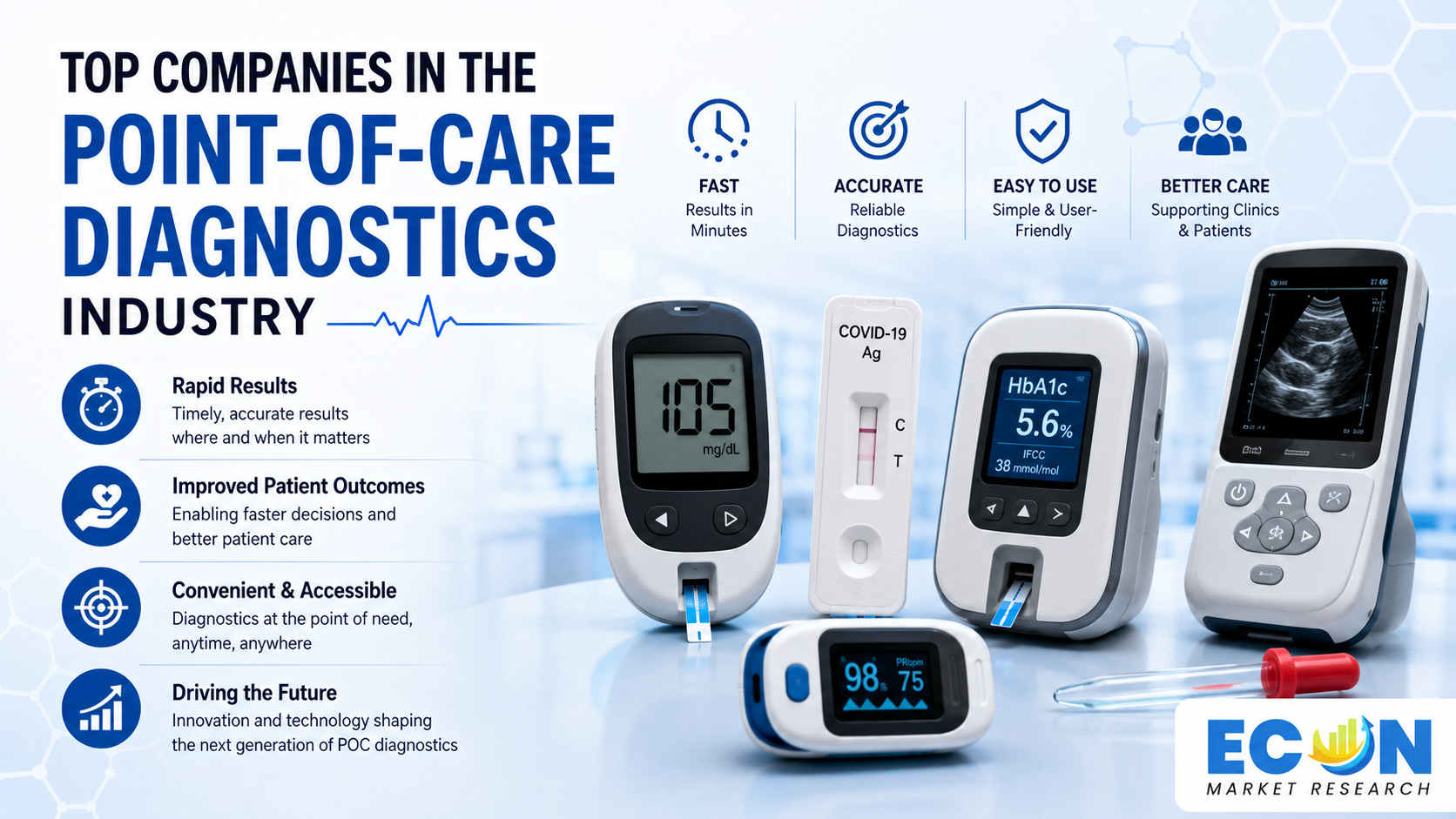
The industry combines single-use lateral-flow tests, handheld electrochemical meters, cartridge-based molecular systems, compact immunoassay analyzers and connected critical-care instruments. WHO’s Essential Diagnostics List, first published in 2018, supports national prioritization of essential in-vitro tests, while the United States regulates testing complexity through the Clinical Laboratory Improvement Amendments. Point-of-care products may receive CLIA-waived status when their operating steps and error risks are suitable for decentralized settings. Product penetration is strongest in glucose monitoring and infectious-disease screening, but adoption is expanding in molecular testing, women’s health, sepsis evaluation and neurological assessment. Competitive differentiation increasingly depends on turnaround time, multiplexing capacity, connectivity, sample volume, portability and regulatory coverage rather than test speed alone.
Market Evolution and Growth Drivers
Point-of-care diagnostics evolved from visually interpreted strips into digitally connected systems capable of automated sample preparation, amplification, quality control and result transmission. The commercial shift accelerated after the 2020 pandemic demonstrated the operational value of testing outside central laboratories. Current molecular platforms can detect 5–15 respiratory targets in approximately 15 minutes, while the Roche cobas liat system produces PCR results within 20 minutes. In 2024, the FDA permitted marketing of the first point-of-care hepatitis C RNA test, allowing fingerstick testing and results in about 1 hour at qualifying CLIA-waived sites. This development extended decentralized testing from antibody screening to confirmation of active viral infection during a single patient encounter.
Growth is also being driven by ageing populations, chronic-disease monitoring, antimicrobial stewardship and shortages of laboratory personnel. Digital connectivity enables healthcare organizations to manage hundreds of devices, operators, quality-control records and patient results from a central platform. Regulatory requirements are becoming more structured: Regulation (EU) 2017/746 has governed in-vitro diagnostic devices across the European Union since 2022, and 4 EUDAMED modules became mandatory on May 28, 2026. Artificial intelligence is beginning to support workflow monitoring, risk identification and interpretation, although validated assays and human clinical oversight remain essential. Future adoption will therefore depend on combining decentralized access with laboratory-grade governance, cybersecurity and operator competency.
Top 5 Latest Trends in the Point-of-Care Diagnostics Industry
Multiplex molecular testing during a single visit
Connected point-of-care device ecosystems
Expansion of home and self-testing
Portable testing for critical and emergency care
Decentralized diagnostics for underserved populations
Trend 1: Multiplex Molecular Testing During a Single Visit
Multiplex molecular testing allows one specimen and cartridge to identify multiple pathogens during the same clinical encounter. The BIOFIRE SPOTFIRE respiratory and sore-throat platforms offer 5-target and 15-target configurations with results in approximately 15 minutes. By September 2025, bioMérieux had installed over 5,500 SPOTFIRE instruments, following the placement of over 900 additional units during the third quarter alone. Roche expanded the cobas liat assay menu beyond respiratory infections through 2025 clearances for point-of-care testing of sexually transmitted infections. These systems became commercially important because influenza, respiratory syncytial virus, SARS-CoV-2 and bacterial pharyngitis can present with overlapping symptoms, while treatment and isolation requirements differ. Multiplex testing therefore reduces sequential test ordering and supports treatment decisions before the patient leaves.
Trend 2: Connected Point-of-Care Device Ecosystems
Connectivity has become a core requirement as hospitals deploy point-of-care analyzers across emergency departments, intensive-care units, operating rooms and outpatient sites. Modern middleware can manage patient results, quality-control records, operator certifications, analyzer configurations and laboratory-information-system interfaces from 1 environment. EKF Link provides centralized management across compatible analyzers, while Abbott’s RALS portfolio and Roche’s digital solutions support oversight of distributed testing. Cepheid systems are available in 4-, 16-, 48- and 80-module configurations, creating different connectivity requirements for small clinics and high-throughput facilities. Connected infrastructure reduces manual transcription and allows administrators to identify failed controls or expired operator credentials, but it also introduces cybersecurity, software-validation and interoperability responsibilities that were less important for visually interpreted tests.
Trend 3: Expansion of Home and Self-Testing
Home diagnostics shifted from pregnancy and glucose testing toward infectious-disease screening and digitally supported self-care after 2020. OraSure’s oral-fluid HIV self-test provides results in 20 minutes and is approved in the United States for individuals aged 17 years and older. The platform detects antibodies to HIV-1 and HIV-2 without requiring a blood sample, although users must understand that infections acquired within the preceding 3 months may not be detected. At-home tests improve privacy and access, while pharmacy and telehealth channels can connect users with confirmatory testing and treatment. Product developers are now designing clearer instructions, smartphone-assisted interpretation and multilingual support because home users do not receive the operator training available in hospitals. The expansion creates new opportunities, but false reassurance, incorrect timing and weak linkage to care remain operational concerns.
Trend 4: Portable Testing for Critical and Emergency Care
Portable blood-analysis systems are moving laboratory information directly into emergency and critical-care workflows. Siemens Healthineers’ RAPIDPoint 500e produces blood-gas, electrolyte, metabolite and co-oximetry results in approximately 60 seconds, while its measurement cartridge operates for 28 days. Abbott’s handheld i-STAT platform supports blood gases, chemistries, electrolytes, coagulation, cardiac markers, pregnancy and traumatic-brain-injury assessment depending on the installed cartridge. Nova Biomedical’s Stat Profile Prime Plus can measure over 20 analytes and supports micro-capillary sampling for patients where repeated blood collection is undesirable. These capabilities matter in trauma, neonatal care, intensive care and ambulances because a 30–60-minute laboratory delay can affect ventilation, transfusion, electrolyte correction and surgical decisions. Product competition increasingly focuses on smaller sample volumes and resistance to medication-related interference.
Trend 5: Decentralized Diagnostics for Underserved Populations
The Top Companies in the Point-of-Care Diagnostics Industry are expanding systems designed for locations without advanced laboratory infrastructure. WHO describes near-point-of-care nucleic acid amplification tests for tuberculosis that can produce results in less than 1 hour, use sputum or tongue swabs and operate on battery-powered instruments. Cepheid reports over 20,000 GeneXpert systems installed across high-burden developing countries through its global-access activities. In 2025, WHO also prequalified the first bundled set of 3 rapid diagnostic tests capable of detecting HIV, hepatitis B and syphilis during maternal-health screening. Decentralized testing can reduce patient travel and loss to follow-up, but sustainable deployment requires cartridge availability, temperature-resistant supply chains, maintenance personnel, external quality assessment and reliable reporting into national surveillance systems.
Top 10 Companies in the Point-of-Care Diagnostics Industry
The following companies are not presented as a strict ranking. They were selected according to their point-of-care product capabilities, technical expertise, regulatory portfolio, geographic reach, deployment scale, manufacturing resources and relevance to decentralized clinical testing.
1. Abbott
Company Overview: Abbott’s operating history dates to 1888, and the company employs approximately 122,000 people across over 160 countries. Headquarters: Abbott Park, Illinois, United States. Core Point-of-Care Diagnostics Expertise: Abbott develops handheld blood-analysis systems, rapid infectious-disease assays, glucose technologies and connected data-management solutions for hospitals, clinics and community settings. Major Products and Services: The i-STAT Alinity platform uses single-use cartridges for blood gases, electrolytes, chemistries, coagulation, cardiac markers, pregnancy and neurological biomarkers. The i-STAT traumatic-brain-injury cartridge measures 2 brain-specific biomarkers in whole blood to support assessment of suspected mild brain injury. Abbott’s rapid diagnostic portfolio also includes antigen, antibody and molecular tests used in infectious-disease and cardiometabolic programs. Its broad instrument and cartridge menu allows healthcare providers to standardize different testing requirements within one supplier relationship.
2. Roche
Company Overview: Roche was founded in Basel in 1896 and operates across over 100 countries with a workforce exceeding 100,000 employees. Headquarters: Basel, Switzerland. Core Point-of-Care Diagnostics Expertise: Roche combines molecular PCR systems, cardiac testing, coagulation monitoring, blood-glucose technologies and digital device connectivity. Major Products and Services: The cobas liat system automates nucleic-acid extraction, amplification, detection and interpretation within a compact analyzer, producing results in 20 minutes or less. Its menu covers respiratory infections, strep throat, sexually transmitted infections and other pathogens depending on country authorization. Roche received FDA clearance and CLIA-waived status in January 2025 for cobas liat assays addressing selected sexually transmitted infections. The company’s digital infrastructure connects decentralized instruments with electronic records and centralized oversight, supporting standardized quality management across multiple clinical sites.
3. Siemens Healthineers
Company Overview: Siemens Healthineers reported approximately 74,000 employees in fiscal 2025, with operations in over 180 countries and direct representation in over 70. Headquarters: Erlangen, Germany. Core Point-of-Care Diagnostics Expertise: The company specializes in critical-care blood analysis, diabetes testing, cardiac markers and connected point-of-care data management. Major Products and Services: RAPIDPoint 500e provides blood-gas, electrolyte, glucose, lactate, bilirubin and co-oximetry testing in approximately 60 seconds. Its 28-day measurement cartridge incorporates a sensor module and sample probe, while integrated barcode scanning reduces patient-identification errors. The epoc Blood Analysis System uses a wireless handheld workflow and small blood samples for bedside testing. Siemens also develops RAPIDComm software for managing instruments, users and results across hospital networks, giving laboratory administrators visibility over decentralized testing activity.
4. Cepheid
Company Overview: Cepheid was founded in 1996, listed publicly in 2000 and became part of Danaher in 2016. Its systems operate in over 180 countries. Headquarters: Sunnyvale, California, United States. Core Point-of-Care Diagnostics Expertise: Cepheid develops cartridge-based sample-to-answer PCR systems that automate extraction, amplification and detection for infectious diseases and oncology applications. Major Products and Services: The GeneXpert family includes modular configurations with 4, 16, 48 or 80 analytical modules. Its Xpert menu addresses tuberculosis, respiratory infections, sexually transmitted infections, healthcare-associated infections and other conditions. More than 20,000 GeneXpert systems have been installed in high-burden developing countries, where the technology supports national tuberculosis algorithms. Self-contained cartridges reduce manual processing requirements, making sophisticated molecular testing possible in district hospitals and smaller laboratories with limited specialist staffing.
5. bioMérieux
Company Overview: bioMérieux was created in 1963, maintains a direct presence in approximately 45 countries and serves over 160 countries through its distributor network. The company reported over 15,000 employees in 2025. Headquarters: Marcy-l’Étoile, France. Core Point-of-Care Diagnostics Expertise: bioMérieux applies multiplex molecular biology to syndromic infectious-disease testing near the patient. Major Products and Services: The BIOFIRE SPOTFIRE system delivers multiplex respiratory and sore-throat results in approximately 15 minutes. Its Mini configuration can detect 5 common viral or bacterial causes using nasopharyngeal, throat or anterior-nasal specimens, depending on the selected menu. By September 2025, the installed base had exceeded 5,500 instruments. bioMérieux also acquired SpinChip in 2025 to add compact immunoassay technology, supporting expansion from molecular infectious-disease testing into additional point-of-care clinical applications.
6. QuidelOrtho
Company Overview: QuidelOrtho was created in 2022 through the combination of Quidel Corporation and Ortho Clinical Diagnostics, bringing together over 120 years of collective diagnostic experience. Headquarters: San Diego, California, United States. Core Point-of-Care Diagnostics Expertise: The company develops fluorescent immunoassays, visually read rapid tests, cardiac assays, toxicology products and compact molecular platforms. Major Products and Services: Sofia analyzers produce automated immunoassay results in 3–15 minutes with approximately 1 minute of hands-on time. The portfolio supports respiratory pathogens, strep throat and other infectious-disease applications. QuidelOrtho also offers QuickVue lateral-flow tests, Triage cardiac and toxicology products and Savanna real-time PCR instruments in eligible markets. Its support infrastructure reaches over 130 countries, helping physician offices, urgent-care sites and hospital networks standardize point-of-care testing, operator training and instrument service.
7. Becton, Dickinson and Company
Company Overview: BD was founded in 1897 and has over 70,000 employees, with commercial activity in virtually every country. Headquarters: Franklin Lakes, New Jersey, United States. Core Point-of-Care Diagnostics Expertise: BD develops digitally interpreted rapid antigen systems, specimen-collection products and infectious-disease diagnostics for hospitals, clinics, pharmacies and home environments. Major Products and Services: The BD Veritor Plus System provides instrument-read rapid testing for respiratory infections, including a SARS-CoV-2 antigen assay introduced in 2020 with results in approximately 15 minutes. Digital interpretation helps reduce variation associated with visually read lateral-flow strips. BD also developed a smartphone-interpreted at-home test in 2021, reflecting the company’s movement toward consumer-connected diagnostics. Its manufacturing scale, collection-device portfolio and laboratory relationships give BD an integrated role spanning specimen acquisition, rapid analysis and confirmatory workflows.
8. Nova Biomedical
Company Overview: Nova Biomedical was incorporated in 1976 and employed over 1,500 people before its combination with Advanced Instruments under the Nova Biomedical brand. Headquarters: Waltham, Massachusetts, United States. Core Point-of-Care Diagnostics Expertise: Nova develops whole-blood biosensor systems for glucose, ketones, lactate, creatinine, hemoglobin and critical-care testing. Major Products and Services: StatStrip Glucose was evaluated through a program involving 1,698 critically ill patients, over 257 clinical conditions and over 8,000 medications before receiving broad FDA clearance for hospital use. The Stat Profile Prime Plus platform can measure over 20 analytes and supports capillary sampling. Nova serves 120 countries through direct organizations in 16 countries and distributors in over 100, with manufacturing in the United States, United Kingdom and Taiwan. These capabilities support hospitals, ambulances, sports medicine and outpatient care.
9. EKF Diagnostics
Company Overview: EKF’s diagnostic operations originated in Germany in 1990, and the current group manufactures in the United States and Germany while distributing products to over 120 countries. Headquarters: Cardiff, United Kingdom. Core Point-of-Care Diagnostics Expertise: EKF concentrates on compact hematology, diabetes, lactate and ketone systems suited to blood banks, physician offices, sports medicine and remote screening. Major Products and Services: Hemo Control delivers hemoglobin results in 25 seconds with a reported coefficient of variation below 2% and calculates hematocrit from the same test. Quo-Test provides HbA1c results in approximately 4 minutes, while DiaSpect Tm supports handheld hemoglobin testing. EKF Link middleware centralizes patient results, operator status, quality-control data and device configuration, allowing smaller analyzers to participate in structured hospital connectivity programs.
10. OraSure Technologies
Company Overview: OraSure Technologies traces its history to 1987 and developed from an early-stage company in Bethlehem, Pennsylvania, into a specialist in oral-fluid and rapid infectious-disease diagnostics. Headquarters: Bethlehem, Pennsylvania, United States. Core Point-of-Care Diagnostics Expertise: OraSure develops rapid antibody and antigen tests designed for clinics, community programs, public-health campaigns and self-testing. Major Products and Services: OraQuick ADVANCE detects antibodies to HIV-1 and HIV-2 from oral fluid, fingerstick blood, venous blood or plasma and produces results in 20 minutes. OraQuick HCV is an FDA-approved and CLIA-waived point-of-care antibody test that also provides results in 20 minutes. Its HIV self-test is approved for individuals aged 17 years and older in the United States. These products support testing in settings where venous blood collection, laboratory equipment or repeat patient visits are difficult.
Regional Outlook
North America
North America has an established point-of-care ecosystem supported by hospital networks, physician offices, retail pharmacies, emergency services and public-health programs. In the United States, CLIA certificates determine which laboratories and decentralized sites may perform tests of different complexity. CLIA-waived products can be used in qualifying doctor’s offices, urgent-care clinics, substance-use treatment facilities, correctional facilities and syringe-service programs. The FDA’s 2024 authorization of a fingerstick hepatitis C RNA test created a pathway to identify active infection in approximately 1 hour without sending specimens to a central laboratory. The United States also hosts the headquarters or major operations of at least 7 companies profiled in this article, supporting instrument development, regulatory submissions and cartridge production.
Canada maintains provincial laboratory and healthcare systems, creating different procurement and implementation pathways across 10 provinces and 3 territories. Point-of-care systems are used in remote northern communities, emergency medicine and chronic-disease monitoring, where transportation can delay centralized testing. Mexico has a growing network of private laboratories, pharmacies and urban hospitals but faces uneven access between metropolitan and rural settings. Across the 3 North American countries, demand is shifting toward connected analyzers, respiratory multiplexing and home testing. Regional challenges include reimbursement variation, quality control across thousands of distributed devices, cybersecurity and ensuring that users who receive reactive HIV, HCV or respiratory results enter confirmatory and treatment pathways.
Europe
Europe operates under Regulation (EU) 2017/746, which became applicable in 2022 and covers in-vitro diagnostic devices sold across the European Union’s 27 member states. Manufacturers must address performance evaluation, risk classification, quality management, post-market surveillance and traceability. On May 28, 2026, mandatory use began for 4 EUDAMED modules covering actor registration, device registration, notified bodies and certificates, and market surveillance. These requirements increase transparency but create additional documentation and certification work for point-of-care manufacturers, particularly those transitioning older CE-marked assays. Companies must also manage local language instructions, data protection requirements and national reimbursement systems across Germany, France, Italy, Spain, the Netherlands, Nordic countries and other markets.
The United Kingdom applies a separate regulatory structure following its departure from the European Union, while retaining a developed network of primary-care services and hospital laboratories. Europe has strong manufacturing and research activity through companies headquartered in Switzerland, Germany, France and the United Kingdom. bioMérieux’s 2025 IVDR-certified SPOTFIRE respiratory and sore-throat panels illustrate how manufacturers are redesigning products to satisfy the newer framework. The main opportunity lies in using compact molecular and immunoassay devices to reduce pressure on central laboratories, while the major challenge is sustaining assay availability during regulatory transitions. Regulation (EU) 2024/1860 introduced measures intended to reduce disruption risks without lowering existing safety requirements.
Asia-Pacific
Asia-Pacific includes mature point-of-care markets in Japan, Australia, South Korea and Singapore alongside rapidly expanding systems in China, India and Southeast Asia. In June 2024, representatives met in Thailand to strengthen national essential diagnostic lists across the 10 ASEAN member states. India’s Free Diagnostics Service Initiative, launched in 2015, supports tests at different levels of public healthcare, including rapid diagnostic kits at primary-care facilities. Point-of-care deployment is particularly relevant for tuberculosis, diabetes, maternal health and infectious-disease programs because laboratory access differs widely between large cities and remote districts. Manufacturing ecosystems in China, India, Japan, South Korea and Taiwan also supply instruments, electronic components, plastics and test consumables to international diagnostic companies.
Australia is developing a national point-of-care quality framework for non-laboratory testing sites through a project scheduled for 2025–2028. The framework is intended to improve reliable testing for rural communities, older adults, migrants and lower-income populations. Australia’s Primary Health Care 10 Year Plan for 2022–2032 also anticipates that point-of-care testing will become a more routine component of primary care. Regional opportunities include locally produced rapid tests, digital result reporting and portable molecular platforms. Risks include regulatory fragmentation, tropical storage conditions, shortages of trained operators and dependence on imported cartridges. Asia-Pacific suppliers must therefore combine affordability with calibration stability, multilingual interfaces and service networks that can cover thousands of islands and remote communities.
Middle East and Africa
The Middle East is adopting point-of-care systems through hospital modernization, national screening programs and digital-health initiatives. The 6 Gulf Cooperation Council countries operate expanding hospital and primary-care networks, while Saudi Arabia and the United Arab Emirates are prioritizing healthcare access and local technology capabilities through strategies extending toward 2030. Portable blood-gas, glucose, cardiac and infectious-disease systems are relevant to emergency departments, ambulances and geographically dispersed clinics. Regional procurement still depends heavily on imported analyzers and cartridges, creating exposure to shipping delays and temperature-control requirements. Successful localization will require trained biomedical engineers, regional reagent inventories, Arabic-language interfaces and interoperable data systems rather than instrument purchases alone.
Africa has a strong clinical need for decentralized testing because infectious-disease burden and laboratory access remain uneven across the WHO African Region’s 47 member states. At the end of 2025, 41 million people were living with HIV globally, and 64% were in the African Region. WHO recommends rapid diagnostic testing as an initial approach for people with tuberculosis symptoms, including molecular and biomarker-based point-of-care technologies that can guide decisions within 48 hours. GeneXpert deployment, rapid HIV tests and malaria tests demonstrate that decentralized diagnostics can operate at national scale. Continuing barriers include unreliable electricity, limited maintenance resources, fragmented procurement and weak connectivity between testing sites and surveillance systems.
Future Opportunities in the Point-of-Care Diagnostics Industry
Future opportunities in the Point-of-Care Diagnostics Industry will focus on smaller sample requirements, expanded multiplexing and automated interpretation. Manufacturers can combine molecular, immunoassay and biosensor technologies to produce clinically useful panels within 15–60 minutes. New applications may include sepsis, antimicrobial resistance, kidney injury, neurological biomarkers, women’s health and therapeutic monitoring. Trinity Biotech’s 2024 investment in a platform targeting a 15-minute bloodstream-infection test illustrates the development interest surrounding rapid sepsis diagnostics. AI can assist with device monitoring, result-quality checks and population-level pattern recognition, but diagnostic outputs must remain tied to validated clinical performance and transparent decision rules.
Supply-chain localization represents another opportunity as countries seek reliable access to cartridges, swabs, sensors and control materials. Regional production can reduce transport time, but manufacturers must preserve lot-to-lot consistency and regulatory traceability across every facility. Connected platforms will increasingly use cloud or edge architecture to manage operators, quality controls and patient results from thousands of sites. Verified initiatives such as Australia’s 2025–2028 quality framework and mandatory European EUDAMED modules from May 2026 will encourage stronger digital governance. Analytical expectations include broader use of pharmacy-based testing, community screening and home collection, provided confirmatory testing and clinical referral remain integrated into the service model.
Low-resource settings offer substantial opportunities for battery-powered molecular systems and tests that tolerate high temperatures. WHO’s near-point-of-care tuberculosis specifications target results in less than 1 hour without specialized infrastructure. Companies can support adoption through reagent-rental models, remote maintenance, operator training and pooled procurement rather than relying only on instrument sales. Workforce development will be equally important because decentralized testing transfers responsibility to nurses, pharmacists, emergency personnel and community health workers. Product innovation must therefore simplify operation while preserving external quality assessment, calibration and traceable reporting.
Conclusion
The Top Companies in the Point-of-Care Diagnostics Industry support an ecosystem ranging from 25-second hemoglobin testing and 60-second blood-gas analysis to 15-minute multiplex PCR and 20-minute oral-fluid infectious-disease screening. The 5 defining trends—multiplex molecular testing, device connectivity, home diagnostics, portable critical-care analysis and decentralized access—are moving testing closer to clinical decisions. Abbott, Roche, Siemens Healthineers, Cepheid, bioMérieux, QuidelOrtho, BD, Nova Biomedical, EKF Diagnostics and OraSure Technologies contribute different strengths in instrumentation, cartridges, biosensors, rapid immunoassays, software and global service coverage.
Regional conditions remain distinct. North America combines CLIA-waived access with a mature commercial network, Europe applies Regulation (EU) 2017/746 across 27 member states, Asia-Pacific is building quality frameworks and essential diagnostic lists, and Africa is scaling rapid testing across 47 WHO member states. The strongest future opportunities involve multi-analyte panels, rapid molecular testing, connected quality systems, localized manufacturing and battery-powered platforms. Competitive success will depend on more than result speed: companies must demonstrate analytical accuracy, operator simplicity, cybersecurity, supply reliability and effective linkage from a test result to clinical treatment.