


Medical Imaging AI Companies Redefining Modern Radiology
The medical imaging AI industry is reshaping radiology through clinical triage, automated analysis, enterprise platforms, and smarter diagnostic workflows.
Introduction
Overview of the Global Medical Imaging AI Industry
The global medical imaging AI industry has progressed from experimental image-recognition tools into regulated clinical systems used for radiology triage, cancer screening, cardiovascular assessment, image reconstruction, segmentation, measurement and reporting support. A count of the FDA’s downloadable AI-enabled medical-device list through March 30, 2026, identifies 1,524 authorized devices, including 1,164 classified under radiology. Radiology therefore represents 76.4% of the listed AI-enabled device landscape. Current applications process chest X-rays, mammograms, ultrasound examinations, computed tomography scans, magnetic resonance images, positron-emission tomography studies and digital pathology slides. Hospitals, imaging centers, emergency networks, cancer-screening programs, teleradiology providers and pharmaceutical researchers now use these systems across more than 100 countries.
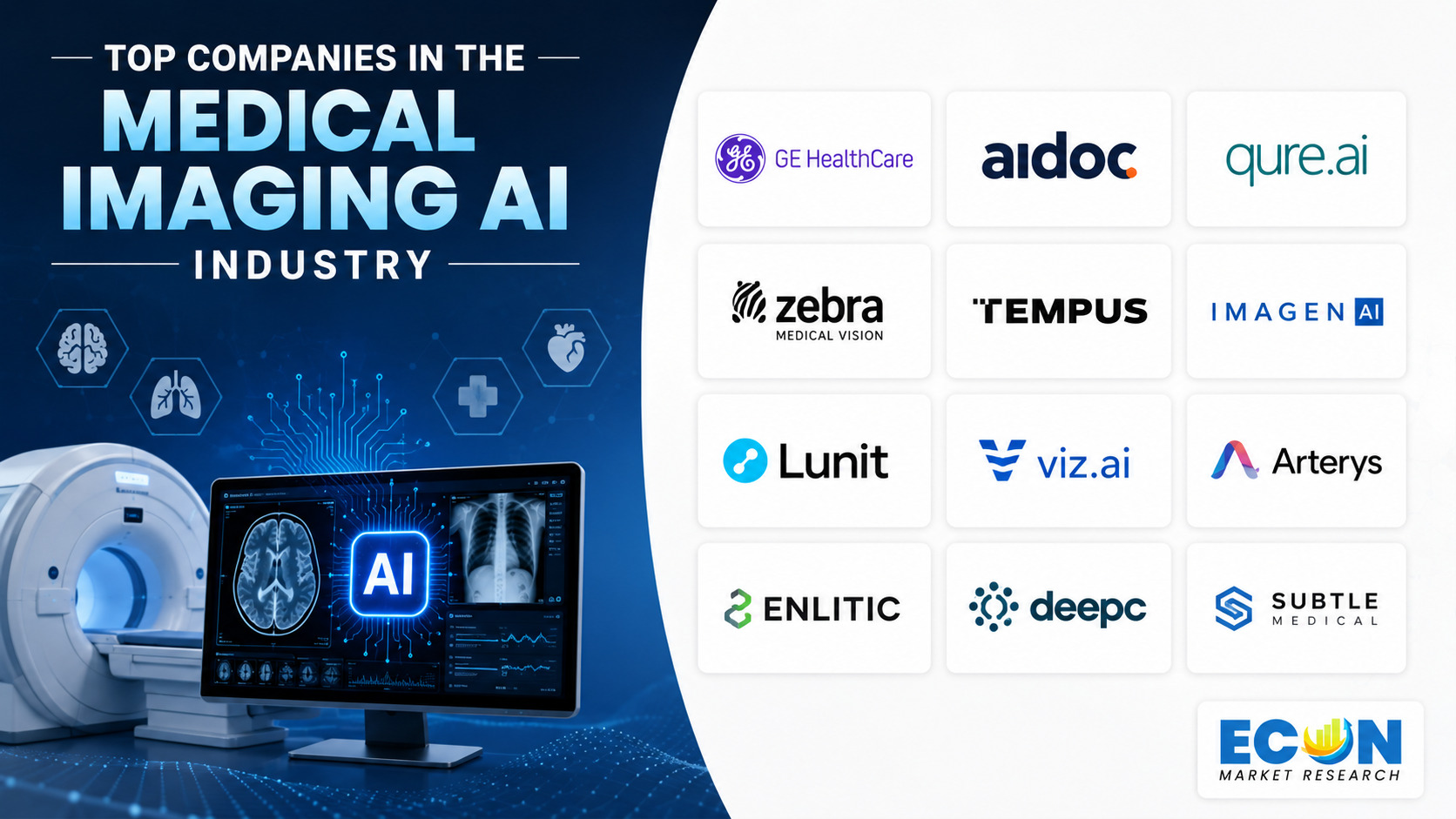
Commercial deployment spans individual detection algorithms and enterprise platforms that manage dozens of clinical pathways. Aidoc supports diagnostic decisions across nearly 2,000 hospitals and has analyzed over 120 million patient cases, while Viz.ai operates in 2,000 hospitals serving an estimated 230 million patients. Lunit’s cancer-imaging systems are used at over 10,000 sites in more than 65 countries, and RapidAI operates in 2,500 hospitals across over 100 countries. The competitive structure includes imaging-equipment manufacturers, cloud-software vendors, specialist AI developers and care-coordination platforms. Product maturity varies by use case: stroke triage and mammography have established regulatory histories, while foundation-model reporting and multimodal generative systems remain in earlier clinical and regulatory stages.
Market Evolution and Growth Drivers
Medical imaging AI evolved rapidly after deep-learning systems demonstrated that image classifiers could identify clinically relevant patterns across large radiology datasets. Commercial development initially focused on narrow tasks such as detecting intracranial hemorrhage, pulmonary embolism or suspicious mammographic lesions. By 2026, platforms were expanding into comprehensive systems that detect over 100 findings, quantify abnormalities, prioritize worklists, generate structured measurements and connect specialist teams. Harrison.ai’s chest X-ray system detects up to 124 findings in under 20 seconds, while its non-contrast head CT product evaluates up to 130 findings in under 90 seconds. This expansion reflects greater computing capacity, cloud infrastructure, improved annotation methods and access to diverse clinical datasets.
Adoption is also being driven by rising imaging volumes, delayed reporting and shortages of trained specialists. Aidoc reported in 2026 that outpatient imaging interpretation turnaround times had more than doubled between 2014 and 2023, while delays involving CT interpretation can add up to 150 minutes to emergency-department stays. Regulatory expectations are becoming more defined: the FDA continues to update its AI-enabled device list, Health Canada introduced pre-market guidance for Class II, III and IV machine-learning-enabled devices in April 2026, and the European AI Act entered into force on August 1, 2024. These frameworks require manufacturers to address clinical evidence, human oversight, bias, cybersecurity and performance monitoring throughout the device lifecycle.
Top 5 Latest Trends in the Medical Imaging AI Industry
Enterprise AI orchestration across imaging workflows
Foundation models and generative radiology reporting
Comprehensive multi-finding image interpretation
AI-enabled cardiovascular and stroke care pathways
Real-world performance monitoring and lifecycle governance
Trend 1: Enterprise AI Orchestration Across Imaging Workflows
Enterprise orchestration is replacing the earlier model in which hospitals purchased and integrated isolated algorithms separately. A centralized platform can route CT, MRI, X-ray and ultrasound studies to appropriate models, send findings into PACS or electronic medical records, manage alerts and monitor algorithm performance. Aidoc’s radiology environment connects 17 internally developed FDA-cleared algorithms and 8 partner algorithms through one operating layer. Viz.ai provides over 50 AI-supported care pathways across radiology, neurology, cardiology, oncology and pulmonology. These systems became commercially important after health systems discovered that operating 10 independent applications created duplicated interfaces, fragmented alerts and inconsistent governance. Enterprise deployment also enables hospitals to control user permissions, cybersecurity, audit logs and software updates across multiple facilities.
Trend 2: Foundation Models and Generative Radiology Reporting
Foundation models are being developed to support multiple imaging tasks using one underlying architecture rather than a separate model for every abnormality. In June 2026, Aidoc received FDA Breakthrough Device Designation for First Read, an investigational chest X-ray system designed to identify 4 life-threatening findings and generate preliminary report text. Harrison.ai has also released a radiology foundation model capable of combining images, prior examinations and clinical context when drafting reports. These systems could reduce repetitive documentation, but every sentence in a radiology report carries clinical and legal consequences. Human review therefore remains essential. Generative systems must demonstrate control over omissions, hallucinated findings, measurement accuracy and performance across different scanner types, populations and hospital protocols before routine autonomous reporting becomes feasible.
Trend 3: Comprehensive Multi-Finding Image Interpretation
Medical imaging AI is moving from single-condition detection toward comprehensive interpretation. Harrison.ai’s chest CT software evaluates up to 167 radiological features, its head CT system examines up to 130 findings and its chest X-ray product covers up to 124 findings. This approach can provide a second review layer across fractures, masses, effusions, consolidation, pneumothorax and other abnormalities rather than flagging only 1 emergency condition. Comprehensive systems can also support workload management by distinguishing examinations with no detected abnormality from studies requiring urgent review. One retrospective evaluation found that AI could identify 24.5%–52.7% of unremarkable chest radiographs at sensitivity levels of at least 98%. Prospective clinical validation remains necessary before such systems can independently remove examinations from radiologist worklists.
Trend 4: AI-Enabled Cardiovascular and Stroke Care Pathways
Stroke and cardiovascular imaging have become major commercial applications because treatment effectiveness can decline within minutes. RapidAI processes more than 20,000 scans each day through a platform deployed in 2,500 hospitals, while Viz.ai reports that 90% of large-vessel-occlusion alerts are reviewed by the intended specialist within 5 minutes. HeartFlow converts coronary CT angiography into personalized 3D models that show blood-flow limitations, plaque volume and plaque composition. Its technologies have supported diagnostic and treatment decisions for over 500,000 patients. These platforms extend beyond image detection by notifying clinicians, transferring images, coordinating referrals and tracking treatment milestones. Their importance lies in converting an AI result into a clinical action rather than leaving the output inside a radiology workstation.
Trend 5: Real-World Performance Monitoring and Lifecycle Governance
Regulators and health systems are placing greater emphasis on monitoring algorithms after deployment. In September 2025, the FDA requested information on methods for detecting performance changes, evaluating real-world outcomes and mitigating deterioration across the AI-enabled device lifecycle. Health Canada and international regulatory partners have also established 10 good machine-learning-practice principles covering representative datasets, human-AI team performance and clinically relevant testing. Real-world monitoring matters because an algorithm trained on 1 population may perform differently after deployment with new scanners, protocols or disease patterns. Hospitals increasingly require dashboards that track sensitivity, false-alert rates, turnaround time and user interaction. The strongest medical imaging AI providers will therefore compete through continuous validation and transparent governance, not only through initial regulatory clearance.
Top 10 Companies in the Medical Imaging AI Industry
The following 10 companies are presented according to their regulatory portfolios, technical expertise, clinical evidence, geographic reach, deployment scale and relevance to medical imaging AI. The order does not represent a strict market ranking.
1. Aidoc
Company Overview: Aidoc was established in 2016 and supports clinical decision-making in nearly 2,000 hospitals. Its systems have analyzed over 120 million patient cases and support approximately 60 million patients each year. Headquarters: New York, United States, with major operations in Tel Aviv, Israel. Core Medical Imaging AI Expertise: Aidoc specializes in radiology triage, incidental-finding detection, quantification, care coordination and enterprise algorithm management. Major Products and Services: Its aiOS platform connects imaging systems, electronic records and clinical teams. The portfolio includes 17 internally developed FDA-cleared radiology algorithms and 8 cleared partner algorithms. Applications address intracranial hemorrhage, pulmonary embolism, pneumothorax, fractures, aortic abnormalities and other urgent findings. The CARE foundation model also supports development of broader multi-condition applications and investigational radiology-report drafting.
2. Viz.ai
Company Overview: Viz.ai was founded in 2016 and reached its 10-year operating milestone in 2026. Its platform is deployed in 2,000 hospitals and serves an estimated population of 230 million patients. Headquarters: San Francisco, California, United States. Core Medical Imaging AI Expertise: Viz.ai combines imaging analysis with specialist notification, mobile image viewing, clinical data and care-pathway coordination. Major Products and Services: The company operates more than 50 AI-supported pathways and holds 13 FDA clearances. Its applications cover large-vessel occlusion, intracranial hemorrhage, pulmonary embolism, aortic disease and selected cardiac conditions. The platform helps 1 patient every 6 seconds and is supported by over 125 publications. Viz.ai also provides Agent Studio, enabling health systems to design workflow pathways using multimodal clinical information.
3. Qure.ai
Company Overview: Qure.ai was founded in 2016 and had deployed its technology at more than 3,000 sites across over 90 countries by 2024. Headquarters: Mumbai, India. Core Medical Imaging AI Expertise: Qure.ai develops deep-learning systems for chest X-rays, head CT scans, lung cancer, tuberculosis, stroke and population-screening programs. Major Products and Services: qXR detects chest abnormalities and supports tuberculosis and lung-cancer screening, while qER analyzes head CT studies for emergency findings such as hemorrhage and infarction. The company also offers qCT, qTrack and care-coordination capabilities. Qure.ai received its first United States medical-imaging clearance in 2020 and had accumulated 29 patents globally by August 2024, including 12 granted in India. Its products are designed for hospitals, mobile screening services and health systems with limited specialist availability.
4. RapidAI
Company Overview: RapidAI was founded in 2011 and operates in 2,500 hospitals across more than 100 countries. Headquarters: San Mateo, California, United States. Core Medical Imaging AI Expertise: RapidAI focuses on neurovascular, cardiac and vascular imaging, with integrated clinical decision support and care coordination. Major Products and Services: Its platform contains 30 FDA-cleared modules and processes more than 20,000 scans daily. Products support non-contrast CT, CT angiography, CT perfusion, MRI and automated 3D reconstruction. In 2025, the company obtained 5 additional FDA clearances covering applications such as large-vessel occlusion, midline shift, hemorrhage and aortic measurement. Clinical validation includes over 750 peer-reviewed studies and 11 publications in the New England Journal of Medicine.
5. Lunit
Company Overview: Lunit was founded in 2013 and supports cancer screening and imaging workflows at more than 10,000 sites in over 65 countries. Headquarters: Seoul, South Korea. Core Medical Imaging AI Expertise: The company specializes in chest X-ray analysis, mammography, digital breast tomosynthesis, cancer-risk assessment and AI-supported biomarker analysis. Major Products and Services: Lunit INSIGHT CXR identifies pulmonary abnormalities, while INSIGHT MMG and DBT support 2D and 3D breast imaging. The company’s technology is supported by more than 100 peer-reviewed publications and has received FDA clearances and European certifications. Following the integration of Volpara, Lunit expanded into breast-density measurement and risk assessment. Its SCOPE platform applies AI to pathology images for biomarker research and pharmaceutical development.
6. Harrison.ai
Company Overview: Harrison.ai was founded in 2018 and supports 3,500 clinicians at over 1,000 sites across 4 continents. Its radiology products have regulatory clearance in more than 40 countries. Headquarters: Sydney, Australia. Core Medical Imaging AI Expertise: Harrison.ai develops comprehensive decision-support systems for X-ray and CT interpretation and is expanding into radiology-specific foundation models. Major Products and Services: Harrison.ai Chest X-Ray can detect up to 124 findings in under 20 seconds. Its CT Brain application identifies up to 130 findings in under 90 seconds, while CT Chest covers up to 167 radiological features. More than 35% of chest X-rays in NHS England are processed using its technology, and over 130 hospitals across at least 45 NHS trusts use its systems.
7. HeartFlow
Company Overview: HeartFlow was founded in Silicon Valley in 2010 and has supported coronary-artery-disease decisions for over 500,000 patients. Headquarters: Mountain View, California, United States. Core Medical Imaging AI Expertise: HeartFlow applies computational fluid dynamics, AI and 3D anatomical modeling to coronary CT angiography. Major Products and Services: HeartFlow FFRCT evaluates how coronary narrowing affects blood flow without requiring an invasive pressure-wire procedure. Plaque Analysis quantifies total plaque volume and identifies plaque composition, including non-calcified components. The company obtained European authorization for its FFRCT analysis in 2011 and United States clearance in 2014, followed by clearance for Plaque Analysis in 2022. The HeartFlow One platform combines anatomical, functional and longitudinal information for coronary-disease assessment.
8. Siemens Healthineers
Company Overview: Siemens Healthineers maintains over 140 years of medical-technology history in Erlangen and operates imaging, laboratory and digital-health businesses worldwide. Headquarters: Erlangen, Germany. Core Medical Imaging AI Expertise: Its capabilities cover AI-supported CT, MRI, nuclear imaging, ultrasound, radiation-therapy planning and automated post-processing. Major Products and Services: The AI-Rad Companion family includes applications for chest CT, brain MRI, prostate MRI and automatic contouring of organs at risk. Chest CT software can segment lung nodules, calculate 2D and 3D dimensions and quantify coronary calcium. Brain MRI software compares measured volumes with normative databases, while Organs RT reduces repetitive contouring work in radiation oncology. These solutions are deployed through the teamplay digital-health platform, enabling cloud distribution, updates and integration with PACS-based workflows.
9. GE HealthCare
Company Overview: GE HealthCare became an independent public company in 2023, building on approximately 130 years of healthcare technology experience. It employs about 54,000 people and serves customers in over 160 countries. Headquarters: Chicago, Illinois, United States. Core Medical Imaging AI Expertise: The company embeds AI into CT, MRI, ultrasound, molecular imaging, image reconstruction and enterprise visualization platforms. Major Products and Services: Its portfolio includes deep-learning reconstruction technologies, MIM Software applications and automated ultrasound measurements. The FDA’s 2026 list includes GE systems such as AutoAS for aortic-stenosis analysis, True Definition DL, SIGNA MRI products and multiple LOGIQ ultrasound configurations. A 2026 hospital partnership included plans to install over 1,300 technology units across hospital and ambulatory locations, combining imaging equipment with AI-supported operations and diagnostics.
10. Royal Philips
Company Overview: Royal Philips employs approximately 64,300 people and supplies health technologies and services in over 100 countries. Headquarters: Amsterdam, Netherlands. Core Medical Imaging AI Expertise: Philips integrates AI into MRI, CT, ultrasound, interventional imaging, radiology informatics and image-guided therapy. Major Products and Services: Its portfolio includes AI-enabled reconstruction, automated cardiac analysis, workflow tools and enterprise imaging software. FDA-listed products during 2026 included EchoNavigator R5.0, AV Cardiac CT, AV Vascular and AI-supported ultrasound and MRI systems. Philips’ BlueSeal MRI platform requires 7 liters of liquid helium compared with the 1,500 liters used by conventional systems, combining imaging access with resource efficiency. The company’s 2026 healthcare survey covered 2,000 clinicians and 20,000 patients across 10 countries.
Regional Outlook
North America
North America has the most mature regulated environment for medical imaging AI. The FDA list contained 1,524 AI-enabled devices through March 30, 2026, with 1,164 classified under radiology. The United States hosts the headquarters of Aidoc’s American operations, Viz.ai, RapidAI, HeartFlow and GE HealthCare, alongside major research centers and imaging-equipment manufacturers. Hospitals increasingly purchase enterprise platforms instead of isolated algorithms, as demonstrated by Aidoc and Viz.ai each reaching nearly 2,000 hospital deployments. The region also supports reimbursement experiments, including Viz.ai’s status as the first AI software provider to receive Medicare New Technology Add-On Payment support.
Canada regulates machine-learning-enabled devices through its existing medical-device framework and issued updated pre-market guidance for Class II, III and IV products in April 2026. Health Canada, the FDA and the United Kingdom regulator previously developed 10 principles for good machine-learning practice, creating a foundation for coordinated oversight. Canada’s publicly funded systems offer opportunities for provincial-scale procurement across 10 provinces and 3 territories, while Mexico provides a growing base of public hospitals, private imaging networks and teleradiology services across 32 federal entities. Regional challenges include fragmented hospital IT systems, cybersecurity requirements, reimbursement uncertainty and the need to monitor algorithm performance across ethnically and geographically diverse populations.
Europe
Europe combines advanced imaging infrastructure with complex medical-device and AI regulation. The European AI Act entered into force on August 1, 2024, and identifies medical-purpose AI as a high-risk application requiring risk mitigation, high-quality datasets, user information and human oversight. Medical imaging software must also comply with Regulation (EU) 2017/745 when it meets the definition of a medical device. Mandatory use of 4 initial EUDAMED modules began on May 28, 2026, covering actor registration, device registration, notified bodies, certificates and market surveillance. These overlapping requirements create a more formal lifecycle-governance environment for AI vendors operating across 27 European Union member states.
The United Kingdom, Germany, France, Italy, Spain, the Netherlands and Nordic countries are important deployment markets because they combine national health systems with established radiology networks. Harrison.ai reports that its technology processes over 35% of chest X-rays in NHS England and is used in more than 130 hospitals across at least 45 NHS trusts. Germany remains an important manufacturing and research base for Siemens Healthineers, while Philips coordinates global imaging activities from the Netherlands. Europe’s opportunities include national procurement, cross-border research and standardized data spaces. Challenges include notified-body capacity, country-level reimbursement differences, GDPR compliance and the need to demonstrate performance across multiple languages, scanner fleets and clinical protocols.
Asia-Pacific
Asia-Pacific contains important medical imaging AI developers, including Qure.ai in India, Lunit in South Korea and Harrison.ai in Australia. Qure.ai operates at more than 3,000 sites across over 90 countries, while Lunit’s systems are used at over 10,000 sites in more than 65 countries. Harrison.ai supports more than 1,000 sites across 4 continents and reports that over 50% of Australian radiologists have access to its chest X-ray technology. Regional deployment is strongest in lung-cancer screening, tuberculosis detection, mammography, stroke imaging and teleradiology. China, Japan, South Korea and Taiwan also maintain substantial imaging-equipment and electronics manufacturing capabilities that support local and international supply chains.
Government-backed digital-health programs and specialist shortages are encouraging adoption in India, Southeast Asia and remote Australian communities. South Korea selected Lunit in 2026 to deploy imaging AI across 6 regional referral hospitals under a public clinical-support initiative. Hong Kong reports that 100% of public accident-and-emergency departments use Harrison.ai technology, while RapidAI had obtained approval and entered more than 10 Taiwanese hospitals by 2021. Regional barriers include country-specific approvals, local data-hosting rules, uneven PACS infrastructure and limited specialist support outside major cities. Vendors that provide edge processing, multilingual interfaces and local service partnerships are better positioned to expand across geographically diverse markets.
Middle East and Africa
The Middle East is adopting medical imaging AI through hospital modernization, national digital-health strategies and partnerships with global technology providers. The 6 Gulf Cooperation Council countries operate expanding networks of tertiary hospitals, cancer centers and emergency services. Saudi Arabia and the United Arab Emirates are emphasizing AI, cloud infrastructure and workforce development through national programs extending toward 2030. AI-based stroke triage, chest imaging and oncology analysis can improve specialist access across geographically dispersed healthcare systems. Israel also remains an important development center for clinical AI, with Aidoc maintaining major operations in Tel Aviv. The region’s main implementation requirements include Arabic-language support, secure cloud hosting and integration with government-managed clinical systems.
Africa presents a different opportunity centered on tuberculosis screening, mobile imaging and specialist shortages. In June 2025, WHO approved 6 computer-aided detection products for tuberculosis screening on digital chest X-rays. WHO has recommended CAD as an alternative to human interpretation for pulmonary tuberculosis screening in people aged 15 years and older since 2021. The African health workforce reached 5.72 million workers in 2024, but the region had only 46% of the personnel it required and faced a projected shortage of 5.85 million workers by 2030. Imaging AI can expand screening capacity, but sustainable use depends on digital radiography, electricity, connectivity, calibration, local threshold validation and access to confirmatory testing.
Future Opportunities in the Medical Imaging AI Industry
Future opportunities for the Top Companies in the Medical Imaging AI Industry will extend beyond detecting isolated abnormalities. Foundation models may combine CT, MRI, X-ray, pathology, laboratory results and prior clinical records within one controlled workflow. Aidoc’s investigational report-drafting system covers 4 life-threatening chest X-ray findings, while Harrison.ai is developing models that use images, previous examinations and clinical context. Analytical expectations include broader automated measurements, longitudinal disease tracking and multi-condition screening. These systems will still require radiologist approval because generative errors, missed findings and incorrect comparisons can affect treatment decisions. Companies that demonstrate transparent reasoning, uncertainty estimates and reliable human-AI interaction will gain stronger clinical acceptance.
Cloud and edge technologies will enable hospitals to operate dozens of algorithms without maintaining separate local servers for each product. Enterprise platforms can distribute updates, monitor performance and route studies across networks containing 10, 50 or 100 facilities. The FDA’s request for real-world performance methods and Canada’s 2026 machine-learning-device guidance indicate that post-deployment governance will become a central product capability. Vendors may create subscription models that combine software, clinical validation, cybersecurity, operator training and performance dashboards. Small and medium-sized developers can enter global markets through partnerships with PACS vendors and imaging manufacturers rather than building independent distribution networks in over 100 countries.
Sustainability also offers a measurable innovation pathway. AI reconstruction can reduce scan time, improve image quality from lower-input data and help imaging departments use equipment more efficiently. Philips’ BlueSeal MRI reduces liquid-helium requirements from 1,500 liters to 7 liters, demonstrating how imaging innovation can combine clinical and resource objectives. Future systems may optimize protocol selection, scanner scheduling and repeat-examination prevention. Workforce development will remain critical: a 2026 survey found that 70% of clinicians considered AI training inadequate, inconsistent or unavailable. Companies that provide structured education and explain model limitations will be better positioned to convert regulatory clearance into safe routine adoption.
Conclusion
The Top Companies in the Medical Imaging AI Industry operate within a regulated landscape containing 1,524 FDA-listed AI-enabled devices through March 30, 2026, including 1,164 radiology products. Enterprise orchestration, foundation models, comprehensive multi-finding analysis, cardiovascular workflows and real-world monitoring are defining current competition. Aidoc, Viz.ai, Qure.ai, RapidAI, Lunit, Harrison.ai, HeartFlow, Siemens Healthineers, GE HealthCare and Philips contribute distinct strengths across triage, cancer screening, stroke, cardiovascular imaging, reconstruction, reporting and clinical coordination.
Regional adoption differs substantially. North America has the deepest FDA-authorized portfolio, Europe combines 27 national markets with high-risk AI requirements, Asia-Pacific hosts globally active developers, and Africa is using computer-aided chest X-ray analysis to expand tuberculosis screening. The strongest future opportunities involve multimodal models, enterprise deployment, longitudinal measurements, sustainable imaging and governed generative reporting. Clinical success will depend on more than algorithm accuracy: vendors must demonstrate reliable integration, representative datasets, cybersecurity, human oversight and measurable performance throughout the device lifecycle.