


Top Companies in the Generative AI Server Industry 2026
The top generative AI server companies in 2026, their latest AI infrastructure, GPU server expertise, key products, industry trends, regional outlook.
Introduction
Overview of the Global Generative AI Server Industry
The global generative AI server industry has moved from a specialized high-performance computing segment into a foundational part of enterprise digital infrastructure. A mode generative AI server may contain 4, 8, or more accelerators, several terabytes of system memory, high-speed NVMe storage, and networking links operating at 400 Gb/s or above. Unlike conventional servers designed primarily for databases, websites, or business applications, generative AI servers process billions of model parameters and support training, fine-tuning, retrieval, and real-time inference. In 2026, enterprises are increasingly deploying these systems as integrated AI factories rather than isolated computing nodes, making server architecture, cooling, networking, security, and software compatibility equally important purchasing considerations.
Market Evolution and Growth Drivers
The generative AI server market has evolved rapidly since 2022, when public interest in large language models accelerated demand for GPU-based infrastructure. Early enterprise deployments frequently relied on 1 or 2 accelerator cards, while current platforms commonly integrate 8 GPUs through high-bandwidth interconnects. The NVIDIA DGX B200, for example, combines 8 Blackwell GPUs, 1,440 GB of total GPU memory, 14.4 TB/s of aggregate NVLink bandwidth, and up to 4 TB of system memory. Growth is being driven by larger AI models, multimodal applications, autonomous AI agents, sovereign AI programs, stricter data-residency requirements, and enterprise demand for lower-latency inference within private infrastructure.
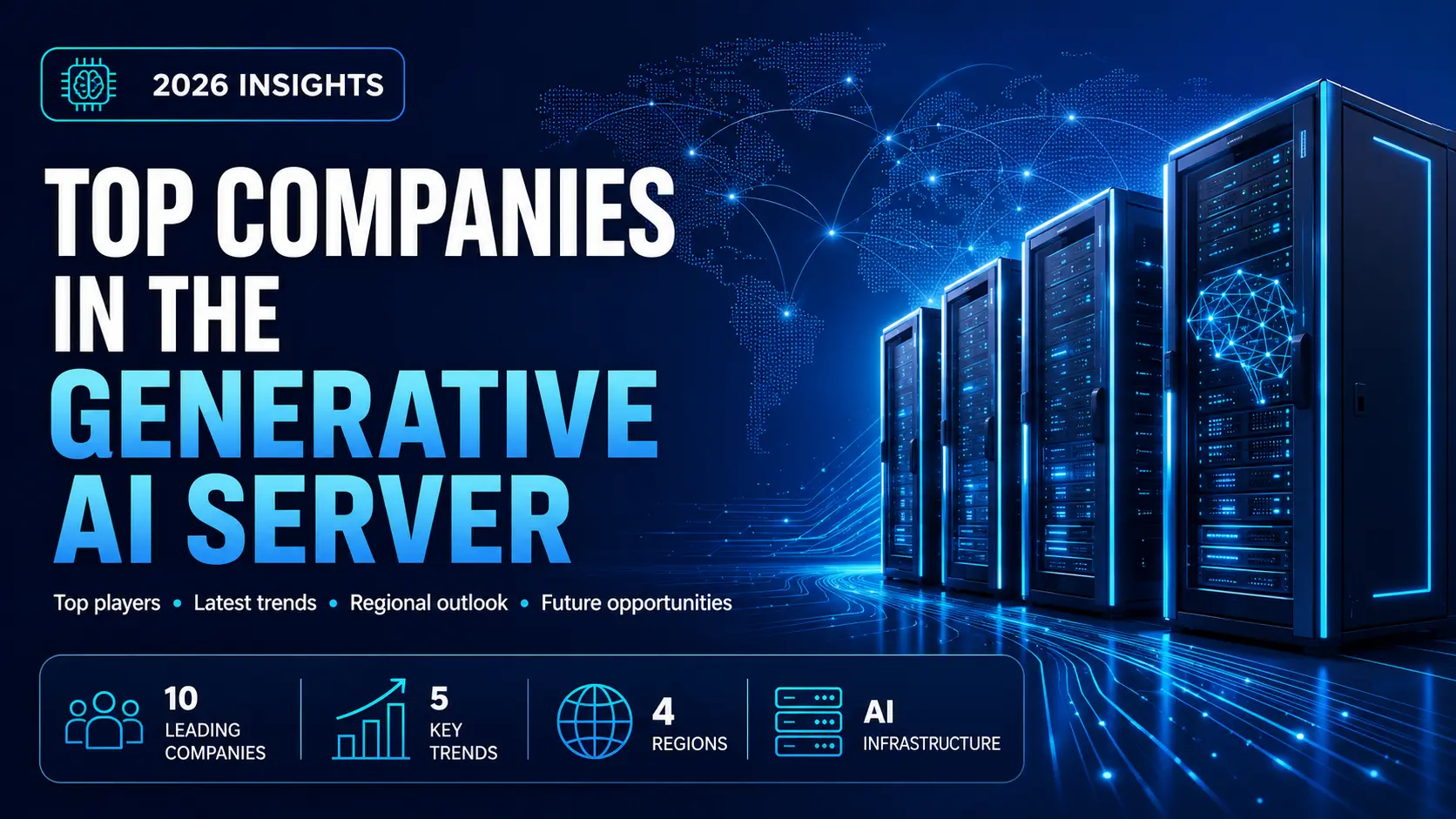
Top 5 Latest Trends in the Generative AI Server
1. Transition from Individual GPU Servers to AI Factories
The first major generative AI server trend is the transition from individual GPU systems to interconnected AI factories containing dozens, hundreds, or thousands of accelerators. A single 8-GPU node can support departmental model development, but training frontier-scale or domain-specific models often requires multiple nodes connected through low-latency fabrics. One commercial AI supercluster design combines 32 liquid-cooled, 8-GPU systems to provide 256 GPUs across 5 racks. This clustered approach allows organizations to distribute training workloads, scale inference capacity, and operate multiple AI services simultaneously. It also increases the importance of workload schedulers, distributed storage, telemetry, high-speed Ethe et, InfiniBand, and fault-tolerant software because the failure of 1 component can affect an entire training job.
AI factories are also changing procurement decisions because buyers must evaluate complete systems rather than focusing only on accelerator performance. An enterprise may need 8 GPUs per server, 400 Gb/s network interfaces, multiple NVMe drives, redundant power systems, and orchestration software that can manage 100 or more nodes. As a result, leading generative AI server companies are combining compute hardware with networking, storage, cooling, cybersecurity, deployment services, and lifecycle management. Organizations increasingly prefer validated architectures because these reduce integration time and help ensure that firmware, drivers, libraries, interconnects, and operating systems work together from the first deployment stage.
2. Rapid Adoption of Direct-to-Chip Liquid Cooling
Direct-to-chip liquid cooling is becoming a critical generative AI server trend as accelerator power consumption and rack density increase. High-end AI servers can consume more than 10 kW per system, and a DGX B200 has a maximum system power rating of approximately 14.3 kW. Conventional air cooling can struggle when several such systems are installed in 1 rack, particularly when rack densities move beyond 50 kW or approach 100 kW. Direct liquid cooling transfers heat from processors and accelerators through cold plates and circulating coolant, reducing dependence on large volumes of chilled air and enabling more computing capacity within limited floor space.
Independent testing on 2 systems containing 8 H100 GPUs each found that liquid-cooled GPUs operated within approximately 41°C to 50°C, compared with about 54°C to 72°C for air-cooled systems under load. The liquid-cooled configuration delivered around 17% higher computational performance in the test, demonstrating that thermal design can directly affect sustained AI throughput. Server manufacturers now offer air-cooled and liquid-cooled configurations because not every data center has the plumbing, coolant distribution units, facility water loops, or maintenance procedures required for liquid cooling. Buyers must therefore assess both server specifications and the readiness of the building that will support the equipment.
3. Higher GPU Memory and High-Bandwidth Interconnects
The third major trend is the expansion of GPU memory and high-speed accelerator interconnection. Generative AI workloads require large memory pools because model weights, training data, attention operations, activation states, and inference caches may need to remain close to the processors. A current 8-GPU DGX B200 configuration provides 1,440 GB of GPU memory and 64 TB/s of HBM3e memory bandwidth. Its 2 NVSwitch components provide 14.4 TB/s of aggregate NVLink bandwidth, allowing the 8 accelerators to cooperate more efficiently than isolated PCIe cards.
This architecture is particularly important for models containing tens or hundreds of billions of parameters. A model with 70 billion parameters may require approximately 140 GB for weights alone when represented at 16-bit precision, before accounting for runtime memory, attention caches, or training states. Quantization can reduce memory usage to 8-bit or 4-bit formats, but many enterprises still require substantial capacity for large context windows, multiple concurrent users, retrieval pipelines, and multimodal inputs. Consequently, leading generative AI server companies compete on total accelerator memory, interconnect speed, system memory, storage bandwidth, and the ability to scale across multiple nodes without creating communication bottlenecks.
4. Growth of Enterprise Inference and AI Agent Infrastructure
Generative AI server demand is shifting from training-focused deployments toward large-scale inference, where trained models answer requests, analyze documents, generate content, write software, or operate AI agents. Training may occur periodically over several days or weeks, but inference systems can operate 24 hours a day and process thousands or millions of requests. This changes infrastructure priorities because predictable latency, energy efficiency, uptime, security, and cost per generated token become as important as peak training performance. Inference platforms may use 1, 4, or 8 GPUs depending on model size, user volume, response-time requirements, and precision format.
Agentic AI intensifies this requirement because 1 user request can trigger multiple model calls, database searches, software-tool executions, verification steps, and follow-up actions. A conventional chatbot might generate 1 response, while an autonomous workflow could complete 10 or more model interactions before retu ing a result. Server vendors are therefore introducing systems specifically optimized for inference at enterprise sites, regional data centers, telecommunications facilities, and edge locations. Lenovo, for example, introduced 3 new inference-server platforms in January 2026, illustrating how the market is broadening beyond centralized training clusters.
5. Expansion of Sovereign and Private Generative AI Infrastructure
Sovereign AI and private generative AI deployments represent the fifth major trend affecting the generative AI server market. Gove ments, banks, healthcare organizations, defense agencies, manufacturers, and regulated enterprises may be unable to send confidential data to shared public services. Instead, they deploy generative AI servers inside national, regional, or private environments where data residency, model access, network controls, encryption, and audit policies can be managed directly. Infrastructure development is particularly visible across North America, Europe, China, South Korea, the Middle East, and emerging African technology hubs.
Private AI infrastructure also supports customization. An organization can fine-tune a model using 5 years of inte al documents, connect it to 10 or more enterprise databases, establish role-based access controls, and retain complete logs of model activity. However, private deployment transfers responsibility for uptime, model gove ance, cybersecurity, patching, capacity planning, and energy management to the organization. Leading generative AI server companies are addressing these challenges through validated stacks, confidential-computing features, remote management tools, managed services, and preconfigured software environments that shorten implementation cycles from several months to a few weeks.
Top 10 Companies in the Generative AI Server
1. NVIDIA
Company overview: NVIDIA was established in 1993 and is headquartered in Santa Clara, Califo ia, United States. The company has become one of the most influential suppliers in the generative AI server ecosystem because it develops GPUs, interconnects, networking equipment, server platforms, software libraries, and enterprise AI software. Its position extends beyond supplying accelerator chips because many server manufacturers build their highest-performance systems around NVIDIA HGX platforms.
Core generative AI server expertise: NVIDIA specializes in tightly integrated accelerated-computing architectures for model training, fine-tuning, inference, analytics, simulation, and AI-agent workloads. The DGX B200 combines 8 Blackwell GPUs, 1,440 GB of accelerator memory, 2 NVSwitch units, 14.4 TB/s of aggregate NVLink bandwidth, and approximately 14.3 kW of maximum system power. This integration reduces the complexity of assembling a comparable platform from independent components.
Major products and services: Major offerings include DGX B200, DGX B300, HGX B200, HGX B300, HGX Rubin NVL8, DGX SuperPOD, Spectrum-X Ethe et, Quantum InfiniBand, ConnectX networking, BlueField data-processing units, and NVIDIA AI Enterprise software. The HGX Rubin NVL8 architecture connects 8 Rubin GPUs and is designed to provide up to 10 times the token-factory throughput of an HGX B200 system for selected workloads.
2. Dell Technologies
Company overview: Dell Technologies was founded in 1984 and is headquartered in Round Rock, Texas, United States. With more than 40 years of enterprise hardware experience, the company provides servers, storage, networking, workstations, data-protection products, deployment services, and infrastructure-management software. Dell is a major generative AI server supplier for enterprises that require globally supported systems and established data-center management tools.
Core generative AI server expertise: Dell focuses on GPU-dense systems that combine accelerators with high-capacity memory, NVMe storage, PCIe Gen5 connectivity, integrated management, and enterprise support. Its PowerEdge XE9680 supports up to 8 accelerator devices, as many as 32 DDR5 DIMM slots, up to 4 TB of RAM, and storage capacity reaching approximately 122.88 TB in supported configurations. These specifications make it suitable for large-model training, multimodal workloads, and private enterprise inference.
Major products and services: Key offerings include PowerEdge XE9680, XE9680L, XE7740, PowerScale storage, high-performance networking, data-protection platforms, professional deployment services, and integrated AI infrastructure developed with accelerator and software partners. The company’s portfolio enables organizations to connect 8-GPU servers with scale-out storage and high-speed fabrics rather than operating each system as an isolated node.
3. Hewlett Packard Enterprise
Company overview: Hewlett Packard Enterprise became an independent company in 2015 and maintains its headquarters in Spring, Texas, United States. The company brings decades of experience from enterprise computing, supercomputing, networking, storage, and managed infrastructure. Its generative AI server strategy addresses organizations that require standalone systems, liquid-cooled clusters, consumption-based services, and large-scale high-performance computing environments.
Core generative AI server expertise: HPE specializes in dense, enterprise-managed AI and HPC platforms. The HPE ProLiant Compute XD685 supports 8 accelerators from NVIDIA or AMD and can be configured in a 5U direct-liquid-cooled chassis or a 6U air-cooled form factor. Supported options include NVIDIA B300, B200, H200, and AMD MI355X accelerators, allowing buyers to align the system with different training, tuning, and inference requirements.
Major products and services: Major offerings include HPE ProLiant Compute XD685, HPE Cray supercomputing systems, HPE Private Cloud AI, GreenLake consumption services, Slingshot networking, storage platforms, and lifecycle services. HPE has also reported 18 number-1 positions in the MLPerf Inference v6.0 benchmark category, highlighting its continuing focus on tested AI performance.
4. Lenovo
Company overview: Lenovo was founded in 1984 and operates major headquarters functions in Beijing, China, and Morrisville, North Carolina, United States. The company has more than 40 years of computing experience and supplies systems across personal computing, servers, storage, edge infrastructure, and high-performance computing. Lenovo’s generative AI server position is strengthened by its Neptune cooling technology and broad enterprise distribution network.
Core generative AI server expertise: Lenovo specializes in flexible GPU-rich platforms for training and inference across centralized and distributed environments. The ThinkSystem SR675 V3 is a 3U server that supports up to 8 double-width or single-width GPUs, including NVIDIA H200 and L40S options. It can also support a 4-GPU HGX H200 configuration with NVLink and Lenovo Neptune hybrid liquid-to-air cooling.
Major products and services: Important offerings include ThinkSystem SR675 V3, SR675i V3, SR680a V3, ThinkEdge systems, Neptune liquid cooling, storage infrastructure, AI professional services, and validated software solutions. The SR675i V3 can support up to 8 NVIDIA RTX PRO 6000 Blackwell Server Edition GPUs, providing a dense option for enterprise inference, digital twins, visual computing, and generative AI applications.
5. Supermicro
Company overview: Supermicro was founded in 1993 in San Jose, Califo ia, United States, and has accumulated more than 30 years of server-design experience. The company is recognized for rapidly bringing new CPU, GPU, storage, networking, and cooling technologies into configurable server platforms. Its modular building-block strategy allows customers to select different processors, accelerators, chassis designs, storage arrangements, and cooling technologies.
Core generative AI server expertise: Supermicro focuses on high-density, rack-scale, and liquid-cooled AI systems. Its GPU portfolio includes 4U systems with 8 H100 or H200 GPUs, support for as many as 24 DIMM slots and approximately 6 TB of DDR5 memory, plus multiple PCIe Gen5 and NVMe connections. The company also offers universal GPU systems supporting as many as 10 PCIe accelerators.
Major products and services: Key products include 8-GPU HGX systems, SuperCluster platforms, liquid-cooled rack solutions, universal GPU servers, SuperCloud Composer management software, storage systems, and deployment services. One reference AI supercluster design incorporates 32 servers, 256 H200 GPUs, and 5 racks, demonstrating Supermicro’s emphasis on moving from individual server sales to complete cluster-level infrastructure.
6. GIGABYTE and Giga Computing
Company overview: GIGABYTE was founded in 1986 and is headquartered in New Taipei City, Taiwan. Its enterprise subsidiary, Giga Computing, supplies server, workstation, edge, cloud, and high-performance computing systems. With approximately 4 decades of hardware engineering experience, the group competes in the generative AI server market through broad accelerator support and multiple thermal-management options.
Core generative AI server expertise: The company designs GPU systems supporting 4, 8, or 16 accelerators from NVIDIA, AMD, and Intel. Available cooling choices include air cooling, direct liquid cooling, and immersion cooling. This range allows customers to select systems for departmental AI development, large-model training, high-volume inference, scientific computing, or agentic AI without being restricted to 1 accelerator architecture.
Major products and services: Major offerings include G-series GPU servers, G4L3 liquid-cooled systems, HGX B300 platforms, H200-based servers, RTX PRO systems, cluster management, and professional integration support. The XL44-SX2-AAS1, announced in 2025, combines NVIDIA RTX PRO 6000 Blackwell Server Edition GPUs with BlueField-3 data-processing units and ConnectX-8 networking, targeting enterprise AI and high-speed data movement.
7. Fujitsu
Company overview: Fujitsu was established in 1935 and is headquartered in Kawasaki, Japan, giving it more than 90 years of experience in information and communications technology. The company operates across more than 50 countries and regions and has expertise in enterprise servers, supercomputers, storage, networking, cloud services, consulting, and specialized processors.
Core generative AI server expertise: Fujitsu’s strength lies in combining enterprise computing with large-scale supercomputing and energy-efficient processor design. Its experience with the 48-core A64FX processor and the Fugaku supercomputer supports work involving advanced simulation, scientific AI, model development, and hybrid high-performance workloads. Generative AI users can benefit from infrastructure that combines accelerators with high-bandwidth memory, parallel file systems, orchestration, and research-grade computing expertise.
Major products and services: Major offerings include PRIMERGY servers, PRIMEHPC platforms, integrated AI systems, storage, managed infrastructure, cloud services, and AI consulting. Fujitsu is particularly relevant for gove ment, research, manufacturing, healthcare, and scientific organizations that need to combine generative AI with simulation, optimization, or high-performance data processing.
8. Cisco Systems
Company overview: Cisco Systems was founded in 1984 and is headquartered in San Jose, Califo ia, United States. Although widely associated with networking, Cisco has supplied unified computing systems since 2009 and has expanded its role in AI infrastructure. Its strength is the integration of servers, switching, observability, security, and policy management across data-center environments.
Core generative AI server expertise: Cisco focuses on connecting AI compute nodes through high-bandwidth Ethe et infrastructure while providing centralized management and security. Generative AI clusters may require 100 Gb/s, 200 Gb/s, 400 Gb/s, or faster connections to move model parameters, training data, and inference traffic. Cisco’s expertise in Ethe et switching, telemetry, segmentation, and application monitoring makes it relevant for enterprises building AI systems within existing network environments.
Major products and services: Major products include Unified Computing System servers, Nexus data-center switches, Silicon One networking platforms, security products, observability tools, and AI-ready infrastructure solutions. Cisco’s opportunity is particularly strong in organizations that need to deploy 10 or more AI nodes while maintaining consistent network policies, workload visibility, identity controls, and operational monitoring.
9. IBM
Company overview: IBM was incorporated in 1911 and is headquartered in Armonk, New York, United States. With more than 100 years of enterprise technology experience, IBM has worked across mainframes, servers, storage, semiconductors, artificial intelligence, hybrid cloud, consulting, and research. Its generative AI infrastructure strategy emphasizes regulated enterprise workloads, hybrid environments, gove ance, security, and integration with existing business systems.
Core generative AI server expertise: IBM specializes in enterprise-grade computing platforms designed for high availability, sensitive workloads, data-intensive applications, and hybrid-cloud deployment. Its Power server architecture, storage systems, Red Hat software ecosystem, and AI gove ance technologies can support private generative AI implementations where 24-hour availability, controlled data access, explainability, and auditability are mandatory.
Major products and services: Important offerings include IBM Power servers, Storage Scale, FlashSystem, watsonx, Red Hat OpenShift, consulting services, model-gove ance tools, and hybrid-cloud infrastructure. IBM is especially relevant for banks, insurers, gove ment organizations, telecommunications companies, and large enterprises that may operate 2 or more computing architectures while integrating generative AI into decades-old transaction systems.
10. Inspur
Company overview: Inspur has roots extending to 1945 and maintains its headquarters in Jinan, China. The company supplies servers, storage, cloud infrastructure, artificial intelligence systems, and data-center solutions. Its generative AI server position is supported by strong participation in the Chinese enterprise and public-sector computing markets, where domestic AI infrastructure and data sovereignty have become increasingly important.
Core generative AI server expertise: Inspur designs dense GPU systems, rack-scale computing platforms, AI clusters, and server-management technologies. Its platforms are developed for model training, inference, computer vision, natural-language processing, scientific computing, and cloud AI services. Systems may support 4 or 8 accelerators, high-capacity storage, and high-speed interconnects, depending on configuration and regional availability.
Major products and services: Major offerings include NF-series GPU servers, AIStation management software, storage systems, rack-scale infrastructure, cloud platforms, and AI cluster integration. Inspur is particularly significant in Asia-Pacific deployments where organizations require locally supported systems, domestic supply-chain options, private model hosting, and infrastructure capable of scaling from 1 departmental server to clusters containing hundreds of accelerators.
Regional Outlook
North America
North America remains a central region for generative AI server development because it contains a large concentration of semiconductor designers, server manufacturers, cloud providers, enterprise software companies, universities, and AI research laboratories. The United States hosts the headquarters of NVIDIA, Dell Technologies, HPE, Supermicro, Cisco, and IBM, giving the region direct access to many of the companies shaping AI compute architecture. As of early 2026, approximately 15.9 GW of data-center capacity was under construction in the United States, compared with 23.1 GW across 831 sites globally. This concentration demonstrates the scale at which AI and cloud infrastructure are being built.
Demand in North America is supported by hyperscale AI training, enterprise inference, defense mode ization, healthcare analytics, financial services, automotive development, and public-sector AI programs. Organizations are deploying systems containing 4 or 8 GPUs and linking multiple nodes through 400 Gb/s networking. However, electricity availability is becoming a decisive constraint. AI infrastructure requires not only server procurement but also substation capacity, backup power, cooling systems, water planning, and long-term access to reliable energy. Large facilities are increasingly measured in hundreds of megawatts rather than the 10 MW to 30 MW ranges associated with many earlier data centers.
Canada is also becoming more significant because of land availability, cooler climates, energy resources, and proximity to major United States technology markets. One large Canadian AI data-center project announced in 2026 was designed around approximately 932 MW of dedicated generation capacity and a closed-loop cooling system. Such projects illustrate the physical scale of next-generation generative AI infrastructure and the need for server suppliers to support liquid cooling, high-density racks, automated management, and multi-year service programs.
Europe
Europe’s generative AI server market is being shaped by data-protection rules, sovereign AI strategies, advanced research institutions, industrial digitalization, and requirements to keep sensitive information within national or regional borders. The region consists of more than 40 countries with different electricity systems, languages, procurement rules, and data-center markets, creating both complexity and opportunity. Major hubs include Germany, France, the United Kingdom, Ireland, the Netherlands, Spain, Italy, Sweden, Finland, and Norway.
Approximately 2.9 GW of data-center capacity was under construction across 258 EMEA locations in early 2026, although this figure also includes projects outside Europe. European customers increasingly evaluate generative AI servers not only by model-training speed but also by energy efficiency, heat reuse, water consumption, data sovereignty, and compliance capabilities. Dense 8-GPU systems can create thermal loads exceeding 10 kW per node, which encourages data-center operators to install direct-liquid cooling or locate infrastructure in regions with cooler climates and abundant low-carbon electricity.
Sovereign AI initiatives are likely to produce demand for national computing clusters, public research platforms, regulated-industry infrastructure, and multilingual model development. A European deployment may need to support models in 10 or more languages, comply with data-retention policies, and provide separate environments for gove ment, healthcare, banking, and industrial users. Regional server demand will therefore extend beyond hyperscale facilities to include research centers, colocation providers, telecommunications operators, manufacturers, and private enterprise data centers.
Europe also has an opportunity to use generative AI servers for automotive design, pharmaceutical research, industrial automation, energy optimization, climate modeling, and engineering simulation. These applications combine AI with high-performance computing, making servers with 8 accelerators, several terabytes of memory, high-speed storage, and low-latency fabrics particularly relevant. Vendors that can demonstrate energy reporting, secure supply chains, local support, and compliance-ready management will be better positioned in this diverse market.
Asia-Pacific
Asia-Pacific represents one of the most diverse generative AI server markets, including advanced semiconductor economies, global electronics-manufacturing centers, rapidly expanding cloud markets, and countries with large populations of digital users. China, Japan, South Korea, Taiwan, India, Singapore, and Australia are major contributors. The region had approximately 3.2 GW of data-center capacity under construction across 283 sites in early 2026, marginally exceeding the 2.9 GW under construction across the broader EMEA region.
Taiwan plays a critical role because it contains major manufacturers of server boards, thermal systems, networking components, and semiconductor-related equipment. Companies such as GIGABYTE are able to offer platforms supporting 4, 8, or 16 GPUs and 3 cooling approaches: air, direct liquid, and immersion cooling. Japan contributes expertise in supercomputing, energy-efficient processors, robotics, manufacturing, and enterprise IT. South Korea is investing in AI semiconductors, cloud infrastructure, telecommunications-based AI, and sovereign model development.
India is emerging as a significant demand center because it has more than 1 billion residents, a large software workforce, expanding digital public infrastructure, and increasing demand for regional-language AI. Generative AI servers can support models covering 10 or more major Indian languages, private banking assistants, healthcare tools, education platforms, gove ment services, and enterprise automation. However, high temperatures, electricity constraints, imported hardware costs, and limited availability of AI-ready data-center space may affect deployment decisions.
China remains an important market for domestic AI servers, sovereign infrastructure, cloud AI, research computing, and large-scale inference. Regional supply-chain restrictions are encouraging organizations to consider alte ative accelerators, domestic server vendors, and locally developed software stacks. Across Asia-Pacific, the winning generative AI server companies will be those that offer flexible accelerator choices, localized technical support, energy-efficient cooling, regional manufacturing, and platforms that can scale from 1 server to clusters with 100 or more nodes.
Middle East and Africa
The Middle East and Africa generative AI server market is developing from a smaller installed base but is receiving substantial attention from gove ments, energy companies, telecommunications operators, universities, financial institutions, and sovereign investment organizations. Gulf countries are using national AI strategies to diversify their economies, develop digital services, and establish regional technology hubs. The United Arab Emirates, Saudi Arabia, Qatar, and Bahrain are among the markets exploring large-scale AI infrastructure and local model development.
The region’s energy resources and access to capital create advantages for building AI facilities, but environmental conditions introduce substantial cooling challenges. Summer temperatures in several Gulf locations can exceed 40°C, while high-density AI racks may require more than 50 kW of cooling capacity. Direct-to-chip liquid cooling, closed-loop systems, dry coolers, heat exchangers, and carefully designed water-management systems are therefore particularly important. Research comparing AI inference across 4 countries has highlighted the need to consider local energy mix, climate, and carbon intensity when selecting data-center locations.
Generative AI servers in the Middle East can support Arabic-language models, smart-city systems, energy exploration, gove ment services, cybersecurity, logistics, aviation, healthcare, and tourism. Arabic includes numerous regional dialects, creating demand for models trained on diverse datasets rather than a single standardized language form. Sovereign infrastructure also allows gove ment agencies and regulated enterprises to retain sensitive data within national borders while operating models 24 hours a day.
Africa offers longer-term opportunities in South Africa, Egypt, Kenya, Nigeria, Morocco, and other emerging technology centers. Constraints include electricity reliability, fiber connectivity, capital availability, technical skills, and limited AI-ready data-center capacity. Smaller deployments using 1 to 4 GPUs may therefore grow faster initially than hyperscale clusters. Over time, regional cloud providers, universities, telecommunications companies, and public institutions could create shared AI infrastructure that gives hundreds of organizations access to generative AI servers without requiring each institution to build a dedicated facility.
Future Opportunities in the Generative AI Server
The future of the generative AI server industry will extend beyond training increasingly large models. One major opportunity is inference optimization, where enterprises seek to support thousands of simultaneous users while reducing latency, power usage, and computing cost. Technologies such as 8-bit and 4-bit quantization, speculative decoding, model routing, caching, and accelerator-aware scheduling can increase the number of requests handled by 1 server. This creates opportunities for vendors that combine hardware performance with inference software, observability, workload management, and model-optimization services.
A second opportunity involves industry-specific AI factories. A pharmaceutical company might deploy 32 or more GPUs for molecular research, while a bank may operate a smaller 8-GPU environment for document analysis, compliance, fraud investigation, and customer service. Manufacturers can combine generative AI with digital twins, computer vision, robotics, and engineering simulation. Hospitals can use private AI servers for medical documentation, imaging workflows, research, and clinical decision support, provided that access controls and human oversight are maintained.
Edge generative AI is another developing opportunity. Not every workload requires a 100-GPU cluster, and many businesses need inference close to factories, stores, hospitals, telecommunications sites, or branch offices. Compact systems using 1, 2, or 4 accelerators can process sensitive information locally and continue operating when exte al connectivity is interrupted. This creates a wider addressable market for generative AI server companies offering quiet systems, lower-power configurations, remote management, and ruggedized edge platforms.
Cooling and energy innovation will create additional opportunities because AI server performance is increasingly limited by facility infrastructure. A single 14.3 kW server can require substantial power-distribution and cooling upgrades, while a rack containing 4 such systems can exceed 57 kW before networking and storage are included. Vendors offering direct-liquid-cooled servers, coolant distribution units, rack integration, heat-reuse systems, energy monitoring, and predictive thermal management can address one of the most urgent barriers to AI deployment.
Open and heterogeneous AI infrastructure will also become more important. Enterprises may combine accelerators from 2 or more suppliers to reduce supply-chain risk, improve negotiating flexibility, or optimize different workloads. Server platforms that support NVIDIA, AMD, Intel, and specialized accelerators can help customers avoid dependence on 1 architecture. However, heterogeneous environments increase software complexity, so there will be strong demand for common orchestration, containerization, model portability, monitoring, and security tools.
Finally, managed private AI represents a major service opportunity. Many organizations want the control of on-premises generative AI servers but do not have teams capable of managing 8-GPU nodes, liquid cooling, high-speed networking, model software, security patches, and 24-hour operations. Manufacturers, integrators, and service providers can offer subscription-based private AI infrastructure, remote operations, performance tuning, model deployment, capacity planning, and compliance reporting. This model could make advanced generative AI servers accessible to mid-sized enterprises rather than limiting adoption to hyperscalers and large research institutions.
Conclusion
The generative AI server industry has become one of the most strategically important segments of enterprise infrastructure since the widespread adoption of large language models after 2022. Mode systems are no longer conventional servers fitted with 1 accelerator card. Leading platforms now combine 8 GPUs, more than 1 TB of accelerator memory, several terabytes of system memory, high-speed NVMe storage, 400 Gb/s networking, and power requirements exceeding 10 kW per node. These specifications demonstrate why generative AI deployment requires coordinated decisions involving compute, networking, cooling, software, security, power, and data-center design.
The top companies in the generative AI server market include NVIDIA, Dell Technologies, Hewlett Packard Enterprise, Lenovo, Supermicro, GIGABYTE, Fujitsu, Cisco, IBM, and Inspur. Each company contributes a different combination of accelerator technology, server engineering, networking, storage, cooling, management software, and professional services. NVIDIA leads in integrated accelerator platforms, while Dell, HPE, Lenovo, Supermicro, and GIGABYTE provide broad server choices. Cisco contributes network infrastructure, IBM supports regulated hybrid environments, Fujitsu brings supercomputing expertise, and Inspur serves large sovereign and regional deployments.
During the next 5 years, generative AI server competition will increasingly focus on sustained inference throughput, liquid cooling, energy availability, sovereign infrastructure, model security, and complete AI-factory deployment. Organizations selecting a platform should evaluate at least 6 factors: workload type, accelerator memory, interconnect performance, cooling readiness, software compatibility, and long-term support. The strongest generative AI server companies will not simply deliver faster processors; they will help customers operate reliable, secure, scalable, and energy-efficient AI infrastructure across the complete technology lifecycle.