

Top Companies in the E-commerce Logistics Industry
The top companies in the e-commerce logistics industry, including DHL, UPS, FedEx, GXO, Maersk, DSV, JD Logistics, Cainiao, trends, and regional insights.
Introduction
Overview of the Global E-commerce Logistics Industry
The global e-commerce logistics industry now operates on a digital customer base of 5.5 billion internet users, equal to 68% of the world’s population in 2024. Parcel networks, fulfillment centers, cross-border gateways, automated warehouses, pickup points, and reverse-logistics systems have consequently become core retail infrastructure rather than supporting services. DHL’s eCommerce division alone handled 1.7 billion parcels through operations spanning 20+ countries, supported by 167,000 service points and 53,000 parcel lockers. Current demand comes from fashion, electronics, beauty, consumer goods, healthcare, home products, marketplace sellers, and direct-to-consumer brands, creating a competitive structure that combines global integrators, contract-logistics specialists, postal operators, technology-driven fulfillment providers, and regional delivery networks.
Customer expectations are also defining operational standards. A 2025 study involving 24,000 online shoppers across 24 markets found that 81% would abandon a purchase when their preferred delivery option was unavailable, while 79% would abandon the transaction when the returns process failed to meet expectations. Returns are now a routine logistics activity: 64% of global online shoppers reported having returned an item to an online retailer. These figures explain why warehouse execution, real-time tracking, delivery choice, returns consolidation, cross-border customs management, and out-of-home collection infrastructure increasingly influence online conversion as directly as website functionality or product availability.
Market Evolution and Growth Drivers
E-commerce logistics has evolved alongside the expansion of global connectivity. Internet penetration increased from 40% of the world population in 2015 to 68% in 2024, widening the addressable population for digital retail and placing greater pressure on fulfillment infrastructure. The operating model has progressed from centralized warehouses and fixed parcel routes toward distributed inventory, algorithmic forecasting, autonomous material movement, dynamic carrier allocation, and digitally managed returns. The International Federation of Robotics recorded 542,000 new industrial robot installations during 2024, while Asia represented 74% of those deployments, demonstrating the scale at which automation technology is entering industrial and logistics ecosystems.
Automation is increasingly supported by artificial intelligence and standardized software integration. A 2025 survey of 350 North American supply-chain executives found that 73% expected greater reliance on AI during the following 5 years, while 68% expected greater use of robotics for routine tasks. Customer-facing digitalization is progressing at the same time: 55% of global e-commerce businesses reported using AI across their platforms in a 2025 business survey. Logistics providers are therefore being pushed to combine physical distribution assets with warehouse-management systems, predictive analytics, API connectivity, inventory orchestration, automated picking, digital customs processing, and real-time delivery intelligence.
2. Top 5 Latest Trends in the E-commerce Logistics Industry
AI-Enabled Warehouse Robotics and Fulfillment Orchestration
Expansion of Parcel Lockers and Out-of-Home Delivery
Integrated Reverse Logistics and Frictionless Returns
Cross-Border Fulfillment and Localized Inventory
Sustainable Packaging and Low-Emission Last-Mile Operations
Trend 1: AI-Enabled Warehouse Robotics and Fulfillment Orchestration
Warehouse automation has moved from isolated equipment installations toward connected robotic ecosystems controlled through common software layers. This is one of the most important trends affecting the Top Companies in the E-commerce Logistics Industry because fulfillment operators must scale automation across different building designs, customers, product categories, and peak-demand cycles. DHL reported 8,000+ collaborative robots operating across its global network in 2026, while its robotics-integration platform can deploy integrations up to 12 times faster than traditional custom coding. The platform was operating at 30 sites with expansion planned for 100+ locations. Robotic unloading systems have also demonstrated handling rates of 700 cases per hour, showing how automation is shifting from experimental deployment to repeatable operational infrastructure.
Trend 2: Expansion of Parcel Lockers and Out-of-Home Delivery
Out-of-home delivery is becoming a defined component of e-commerce network design as carriers seek to consolidate delivery stops and consumers demand greater collection flexibility. In current shopper research, 40% of global consumers indicated a preference for redirecting parcels to an out-of-home location, while 35% reported using parcel shops for returns and 28% used parcel lockers. European adoption is stronger, with 49% of shoppers indicating parcel redirection to an out-of-home point and 33% using lockers for returns. DHL eCommerce’s operating network reflects this transition through 53,000 parcel lockers and 167,000 service points. Locker density increasingly influences urban route productivity, failed-delivery rates, consumer convenience, reverse-logistics accessibility, and the ability to consolidate multiple residential deliveries into controlled collection points.
Trend 3: Integrated Reverse Logistics and Frictionless Returns
Returns management has become a dedicated logistics discipline rather than a post-sale exception. In 2025, 64% of global shoppers said they had returned an online purchase, while 54% cited incorrect sizing as a return reason. Consumer expectations also affect conversion before an order is placed: 79% would abandon their cart if the preferred returns option was unavailable, and 75% would avoid purchasing from a retailer when they did not trust the returns provider. Logistics operators are responding through QR-based returns, consolidated drop-off networks, automated inspection, inventory disposition, refurbishment routing, and direct integration with merchant platforms. UPS’s Happy Returns network, for example, provides close to 8,000 drop-off locations, demonstrating how reverse logistics is becoming a physical network product with measurable geographic density.
Trend 4: Cross-Border Fulfillment and Localized Inventory
Cross-border e-commerce logistics is shifting toward inventory placement closer to destination consumers. Instead of routing every international order directly from the manufacturing country, providers increasingly use bonded facilities, overseas warehouses, regional distribution centers, and localized last-mile networks. Cainiao handled 5 million+ cross-border and international packages per day during fiscal 2024 and has developed 5-day and 10-day international delivery products. JD Logistics operated 130+ bonded, direct-mail, and overseas warehouses by June 2025, managing 1.3 million+ square meters across 23 countries and regions. This localization strategy shortens final delivery distances, enables domestic-style returns, supports marketplace inventory synchronization, and reduces the operational dependence of merchants on a single intercontinental parcel route.
Trend 5: Sustainable Packaging and Low-Emission Last-Mile Operations
Environmental requirements are becoming embedded in packaging engineering, warehouse design, delivery-fleet planning, and fulfillment procurement. The European Union’s packaging regulation requires grouped, transport, and e-commerce packaging to maintain a maximum 50% empty-space ratio from 2030, creating a measurable design constraint for pack-size algorithms and automated cartonization. Consumer behavior reinforces the regulatory pressure, with 85% of e-commerce decision-makers in a 2025 global business study describing sustainability as important to their business. Logistics providers are also testing electric fleets, autonomous delivery systems, reusable packaging, optimized routing, and energy-efficient fulfillment facilities. Sustainability therefore affects not only emissions reporting but parcel dimensions, vehicle utilization, packaging material consumption, delivery density, and warehouse-energy management.
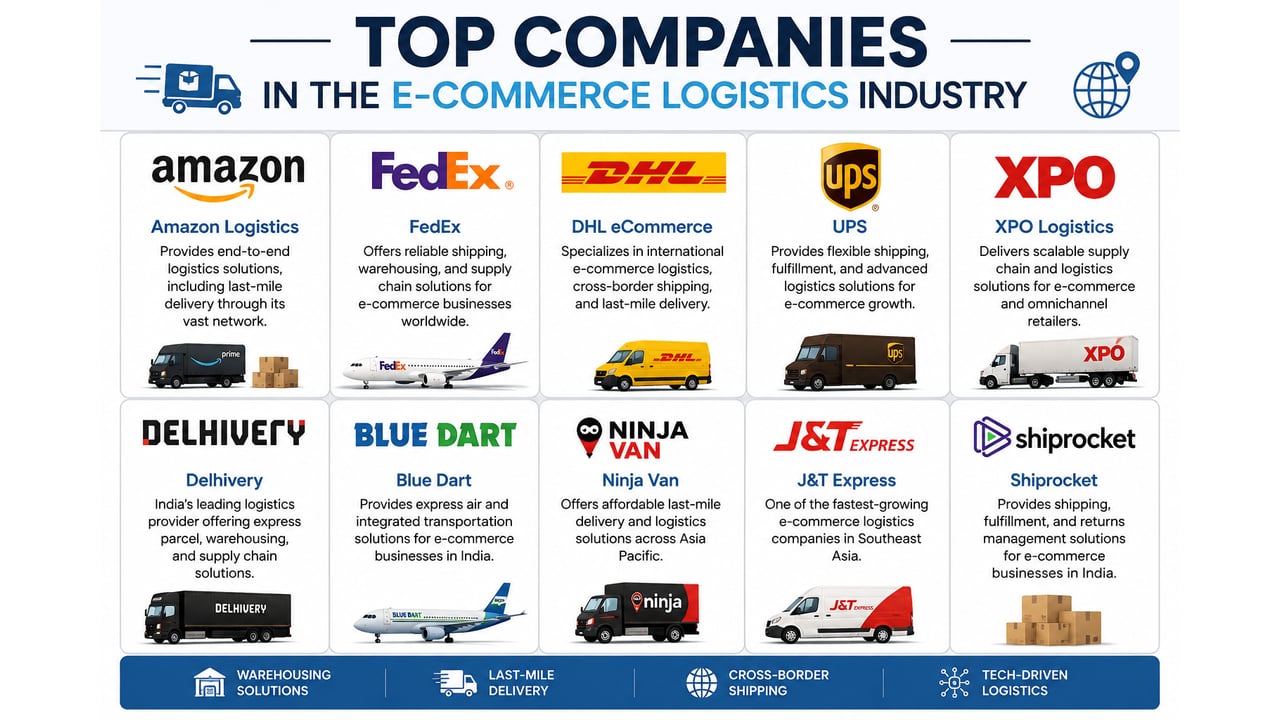
Top 10 Companies in the E-commerce Logistics Industry
The following 10 companies are presented as major e-commerce logistics market participants based on fulfillment capabilities, parcel-network scale, technical expertise, geographic reach, automation deployment, cross-border services, and industry relevance rather than as a strict ranking. Their operating models range from global parcel transportation to contract logistics, automated fulfillment, international freight integration, localized warehousing, and technology-driven delivery networks.
1. DHL Group
Company Overview: DHL was founded in 1969, while DHL Group employed 583,998 people at the end of 2025. Headquarters: Bonn, Germany. Core E-commerce Logistics Expertise: The group combines parcel transportation, contract logistics, fulfillment, cross-border shipping, warehouse automation, returns, and out-of-home delivery. Its dedicated eCommerce division employed 47,262 people in 2025 and handled 1.7 billion parcels through operations covering 20+ countries. Major Products and Services: DHL operates domestic parcel networks, deferred cross-border delivery, fulfillment services, 167,000 service points, and 53,000 parcel lockers. Its wider supply-chain operations had integrated 8,000+ collaborative robots by 2026, providing a measurable automation base for high-volume retail and omnichannel fulfillment.
2. United Parcel Service
Company Overview: UPS was founded in Seattle in 1907 and had a workforce of 460,000 employees in 2025. Headquarters: Atlanta, Georgia, United States. Core E-commerce Logistics Expertise: UPS combines parcel pickup, sorting, transportation, residential delivery, digital shipment management, returns, fulfillment support, and international distribution across 200+ countries and territories. Major Products and Services: The network delivers 20.8 million packages per day and operates approximately 1,000 U.S. package facilities plus approximately 800 facilities in international package operations. E-commerce capabilities include UPS My Choice, Access Point collection and drop-off services, electronic return labels, doorstep return collection, and Happy Returns, whose U.S. network provides close to 8,000 Return Bar and partner locations.
3. FedEx Corporation
Company Overview: Federal Express was founded in 1971 and began operating in 1973 with 14 aircraft serving 25 U.S. cities. Headquarters: Memphis, Tennessee, United States. Core E-commerce Logistics Expertise: FedEx combines express transportation, fulfillment, reverse logistics, digital tracking, cross-border delivery, and AI-enabled shipment visibility across 220+ countries and territories. Major Products and Services: The company operates about 4,000 facilities, 700 aircraft, and 175,000+ motorized vehicles, with daily shipment volume close to 18 million. FedEx Supply Chain also supports 130+ North American warehouse and fulfillment operations and processes 475 million returns annually, while International Connect Plus provides selected cross-border e-commerce delivery within 3–4 business days.
4. GXO Logistics
Company Overview: GXO began operating as an independent company in 2021 and now has 150,000+ team members. Headquarters: Greenwich, Connecticut, United States. Core E-commerce Logistics Expertise: GXO focuses on outsourced contract logistics, omnichannel fulfillment, warehouse automation, inventory management, returns, machine learning, and technology-led supply-chain orchestration. Major Products and Services: Its operating footprint includes 1,000+ warehouses in 27 countries covering 200 million square feet. GXO reports productivity improvements of 4–6 times when employees are supported by robotics, while machine-learning deployments can produce average labor-efficiency improvements of 5–7%. The GXO IQ platform, introduced for wider commercial availability in 2025, adds AI-first orchestration to physical fulfillment infrastructure.
5. Kuehne+Nagel
Company Overview: Kuehne+Nagel was founded in 1890 and employed roughly 85,000 people across 1,300+ sites in close to 100 countries during 2025. Headquarters: Schindellegi, Switzerland. Core E-commerce Logistics Expertise: Its capabilities combine contract logistics, e-commerce fulfillment, air logistics, sea logistics, road logistics, last-mile coordination, returns, automation, and inventory integration for retailers and digitally native brands. Major Products and Services: E-commerce fulfillment supports platform and marketplace integration, customized packaging, multichannel inventory, technology-driven order handling, and reverse flows. During 2025, the company expanded contract-logistics capacity through new distribution centers in Japan, Turkey, Vietnam, and the UAE while adding 5 hubs in India, strengthening inventory positioning for regional and cross-border commerce.
6. CEVA Logistics
Company Overview: CEVA traces its operating history to 1946, while the CEVA name emerged from the restructuring of TNT Logistics in 2006. Headquarters: Marseille, France, where its current global headquarters was inaugurated in 2019. Core E-commerce Logistics Expertise: CEVA combines contract logistics, omnichannel fulfillment, freight management, warehousing, final-mile activities, reverse logistics, and consumer-retail supply-chain services. Major Products and Services: The company operates in 170 countries with 110,000 employees, 1,700 locations, and 11.5 million square meters of warehouse space. Its long-running fulfillment relationship with Dutch retailer bol operates across 5 Netherlands sites, with a renewed contract extending through 2029 and an option through 2032.
7. A.P. Moller - Maersk
Company Overview: A.P. Moller - Maersk was established on April 16, 1904 and now employs 100,000+ people. Headquarters: Copenhagen, Denmark. Core E-commerce Logistics Expertise: Maersk integrates ocean transportation with warehousing, distribution, fulfillment, inland transport, customs, and supply-chain management, enabling merchants to connect international inventory flows with regional consumer delivery. Major Products and Services: Its contract-logistics footprint includes 500+ facilities, 8.8 million+ square meters of warehousing capacity, and operations in 55+ countries. A 75,000-square-meter warehouse opened in France in 2025 with Amazon as its initial customer, while Maersk’s European network contains 40+ warehouses and distribution centers across 15 countries.
8. DSV
Company Overview: DSV was established in 1976 by Leif Tullberg and 10 independent hauliers before expanding into international transport and contract logistics. Headquarters: Hedehusene, Denmark. Core E-commerce Logistics Expertise: Following its combination with Schenker in 2025, DSV provides parcel, fulfillment, warehousing, inventory management, API integration, reverse logistics, road transport, air freight, and ocean freight across 90+ countries. Major Products and Services: Its global structure includes 3,000+ offices and logistics facilities, 150,000+ employees, and 17 million square meters of contract-logistics warehousing. DSV also operates 25+ dedicated e-commerce fulfillment centers and reports 99.9% of orders shipped on time within that e-commerce network.
9. JD Logistics
Company Overview: JD Logistics was formally established as a business group in Beijing in 2017 after JD began building its proprietary B2C logistics network 10 years earlier. Headquarters: Beijing, China. Core E-commerce Logistics Expertise: The company integrates warehousing, sorting, delivery, international freight, automated fulfillment, inventory optimization, reverse logistics, and omnichannel distribution. Major Products and Services: JD Logistics manages 1,600+ warehouses across its broader network and had 130+ bonded, direct-mail, and overseas warehouses spanning 23 countries and regions by June 2025. During 2025, 20+ LangzuTech automated warehouses became operational in close to 20 Chinese cities, while its first overseas LangzuTech installation in the United Kingdom used hundreds of robots to support same-day fulfillment.
10. Cainiao
Company Overview: Cainiao was founded in 2013 within Alibaba’s e-commerce ecosystem and has developed an international smart-logistics network centered on cross-border commerce. Headquarters: Hangzhou, Zhejiang, China. Core E-commerce Logistics Expertise: Cainiao combines international express delivery, overseas fulfillment, supply-chain management, logistics technology, digital routing, customs integration, and consumer collection infrastructure. Major Products and Services: The network processed 5 million+ cross-border and international packages per day on average during fiscal 2024 and operates international products including Global 5-Day Delivery and Global 10-Day Delivery. Cainiao’s longer-term technology development has incorporated IoT, algorithms, automated warehousing, smart delivery, and data integration to coordinate high-volume merchant and marketplace logistics.
Regional Outlook
North America
North America combines high online-shopping penetration with dense parcel and fulfillment infrastructure. In the United States, e-commerce represented 17.1% of total retail sales during the second quarter of 2026, demonstrating the proportion of retail activity that directly depends on parcel transportation, distribution centers, inventory-management systems, and last-mile capacity. Consumer delivery expectations are correspondingly demanding: 76% of U.S. shoppers in a 2025 survey said they would abandon a purchase when preferred delivery choices were unavailable, while 71% would abandon the transaction if returns options were unsuitable. This environment supports investment in regional fulfillment, automated sorting, delivery visibility, residential parcel density, and returns consolidation.
Canada has a smaller online share but a similarly complex geographic distribution requirement, with retail e-commerce accounting for 6.1% of total retail trade in December 2025. Mexico presents a different opportunity profile because internet use among people aged 6+ reached 86.1% in 2025, widening access to app-based and marketplace commerce. Across the 3-country region, companies must balance high consumer expectations with long delivery distances, customs movement under continental trade arrangements, urban congestion, warehouse labor availability, and seasonal peak capacity. Technology adoption is advanced but incomplete: a 2025 North American executive study found that only 44% of respondents had deployed warehouse robotics, leaving substantial scope for additional automation.
Europe
Europe combines high digital-shopping participation with increasingly prescriptive packaging and sustainability rules. In 2024, 77% of EU internet users purchased goods or services online, compared with 59% in 2014. Adoption varies materially between countries: Ireland recorded 96%, the Netherlands 94%, while Bulgaria recorded 57%. These differences influence the density and economics of parcel-locker networks, fulfillment centers, international line-haul routes, and return operations. Out-of-home delivery is particularly developed in Europe, where 49% of shoppers report redirecting parcels to collection locations and 42% use parcel shops for returns. This consumer behavior supports continued investment in lockers, convenience-store partnerships, automated pickup technology, and consolidated urban delivery.
Regulation is becoming equally influential. From 2030, EU rules will cap the empty-space ratio in grouped, transport, and e-commerce packaging at 50%, requiring fulfillment operators to improve carton selection and packaging automation. European warehouse automation is also moving into scaled deployment: DHL announced 1,000+ additional robots for UK operations in 2025, building on 3,200 digitalization projects already deployed across the UK, Ireland, and EMEA. Germany, France, the Netherlands, Poland, Spain, Italy, and Nordic markets provide mature distribution infrastructure, while Central and Eastern Europe offer expanding fulfillment capacity. The principal operating challenge is coordinating automation, packaging compliance, labor availability, emissions requirements, and cross-border service consistency across different national logistics environments.
Asia-Pacific
Asia-Pacific combines large-scale manufacturing, dense urban populations, expanding digital commerce, and the world’s highest concentration of new industrial-robot deployment. Asia accounted for 74% of global industrial robot installations in 2024, while China alone installed 295,000 units. China’s logistics ecosystem includes extensive automated fulfillment, rapid parcel sorting, and direct integration between marketplaces and distribution networks. JD Logistics operates 1,600+ warehouses, while 90%+ of JD retail orders can be fulfilled within 24 hours. Japan also maintains a mature online retail environment, with the B2C electronic-commerce ratio reaching 9.8% in 2024. These markets support increasingly sophisticated demand forecasting, automated picking, same-day distribution, and high-frequency urban delivery.
India and Southeast Asia represent a different phase of network expansion. By December 2025, India’s Open Network for Digital Commerce had 116,000+ retail sellers active across 630+ cities and towns, increasing the potential addressable base for interoperable logistics providers. India Post completed its first ONDC order as a logistics service provider in January 2026, illustrating how public delivery infrastructure is being connected with digital marketplaces. JD Logistics, meanwhile, operates 7 overseas warehouses in Southeast Asia and has established international cargo connections serving Vietnam, Thailand, Malaysia, the Philippines, and Bangladesh. Regional opportunities remain substantial, although infrastructure consistency, customs procedures, archipelagic geography, and differences in last-mile address quality create operational complexity.
Middle East & Africa
The Middle East is developing logistics capacity through national infrastructure strategies and advanced last-mile experimentation. Saudi Arabia’s logistics transformation includes a network target of 59 logistics hubs, while operational logistics centers had reached 24 according to the country’s 2025 transformation reporting. The UAE is simultaneously positioning autonomous transportation as a logistics technology platform. Dubai targets 25% of transportation trips through autonomous modes by 2030, and its commercial and logistics land-transport sector already contains 61,290 heavy vehicles within the regulated heavy-vehicle segment. Autonomous-delivery pilots, smart logistics platforms, free-zone warehousing, and airport-linked fulfillment facilities are creating new operating models for regional e-commerce distribution.
Africa presents strong urban e-commerce potential but a pronounced infrastructure divide. In 2024, 57% of Africa’s urban population used the internet compared with 23% of its rural population, a 34-percentage-point gap that directly affects addressability, delivery economics, and digital-payment accessibility. Parcel activity nevertheless continues to develop: Kenya recorded 3.4 million parcels between July and September 2025, prompting regulators to adapt licensing and parcel-security requirements to a logistics-oriented postal market. Companies entering African e-commerce logistics therefore need flexible combinations of pickup locations, mobile communication, regional hubs, local courier partnerships, and route optimization rather than relying exclusively on dense home-delivery networks designed for mature markets.
Future Opportunities in the E-commerce Logistics Industry
Future opportunities for the Top Companies in the E-commerce Logistics Industry will increasingly come from connecting automation rather than simply installing individual machines. DHL’s robotics-integration platform is planned for deployment at 100+ locations during the next 3 years, illustrating how standardized orchestration can shorten implementation cycles across multi-customer networks. AI can extend this architecture into labor planning, slotting, inventory forecasting, dynamic routing, exception management, fraud screening, and predictive returns. Small and medium-sized merchants are also likely to gain greater access to automation through shared-user warehouses, modular fulfillment platforms, and API-based logistics services, reducing the need for individual businesses to operate proprietary distribution infrastructure.
Sustainability and regulation will create a second development track. The EU’s 50% maximum e-commerce packaging empty-space requirement begins in 2030, encouraging investment in right-sized packaging, cartonization software, reusable shipping systems, and dimension-aware automation. Dubai’s target for 25% autonomous transportation by 2030 creates a separate opportunity for autonomous commercial vehicles, robotic delivery, and AI fleet orchestration. Large logistics networks are also working toward longer-duration decarbonization milestones, including Maersk’s 2040 net-zero target and DHL Group’s 2050 net-zero logistics objective. These are verified corporate or regulatory targets; the scale and timing of individual technology deployments will still depend on infrastructure, vehicle economics, grid availability, regulation, customer demand, and operating performance.
Geographic localization offers an additional opportunity because overseas warehousing can turn cross-border transactions into shorter domestic fulfillment movements. JD Logistics had already established 130+ bonded, direct-mail, and overseas warehouses across 23 countries and regions by mid-2025, while Maersk operates 500+ distribution facilities globally. Future competitive differentiation is therefore likely to depend on how effectively providers integrate international transportation, customs clearance, localized inventory, last-mile delivery, returns, and real-time inventory data in a single operating model. Partnerships between carriers, robotics companies, marketplaces, postal operators, and software platforms can accelerate this integration while allowing merchants to access sophisticated logistics capabilities without constructing their own physical networks.
Conclusion
The Top Companies in the E-commerce Logistics Industry operate within a global retail environment supported by 5.5 billion internet users and increasingly defined by delivery speed, automation, flexibility, returns, and cross-border connectivity. The 5 major trends shaping current competition—robotic fulfillment, out-of-home delivery, reverse logistics, localized cross-border inventory, and sustainability—are already visible in operating networks. DHL has deployed 8,000+ collaborative robots, Cainiao processes 5 million+ international and cross-border parcels daily, and JD Logistics manages 1,600+ warehouses, illustrating the physical and technological scale required to serve modern online commerce.
Regional requirements remain distinct. U.S. e-commerce accounted for 17.1% of retail sales in the second quarter of 2026, EU online shopping participation reached 77% in 2024, Asia represented 74% of new industrial robot installations, and Africa retained a 34-percentage-point urban-rural internet-use gap. Future competitive advantage will therefore depend on adapting logistics architecture to different infrastructure conditions while meeting measurable regulatory targets such as the EU’s 50% packaging empty-space limit for 2030. Companies capable of linking fulfillment automation, intelligent inventory placement, digital visibility, flexible returns, efficient cross-border movement, and lower-emission delivery systems will be positioned to address the next stage of e-commerce logistics development.