


Top Companies in the Autonomous Security Operations Center Industry
The top autonomous security operations center companies are profiled by their AI capabilities, security platforms, incident response tools, and global presence.
Introduction
Overview of the Global Autonomous Security Operations Center Industry
The global Autonomous Security Operations Center (SOC) industry is undergoing a technological transformation as enterprises adopt artificial intelligence, machine learning, behavioral analytics, and automated incident response to protect increasingly complex digital environments. In 2025, approximately 6 billion people, representing 74% of the global population, used the internet, compared with 60% in 2020. This expansion has increased the digital infrastructure requiring cybersecurity monitoring across banking, healthcare, manufacturing, telecommunications, energy, retail, and government services. Autonomous SOC platforms address these requirements by combining continuous threat detection, automated investigation, contextual analysis, and coordinated response across distributed technology environments.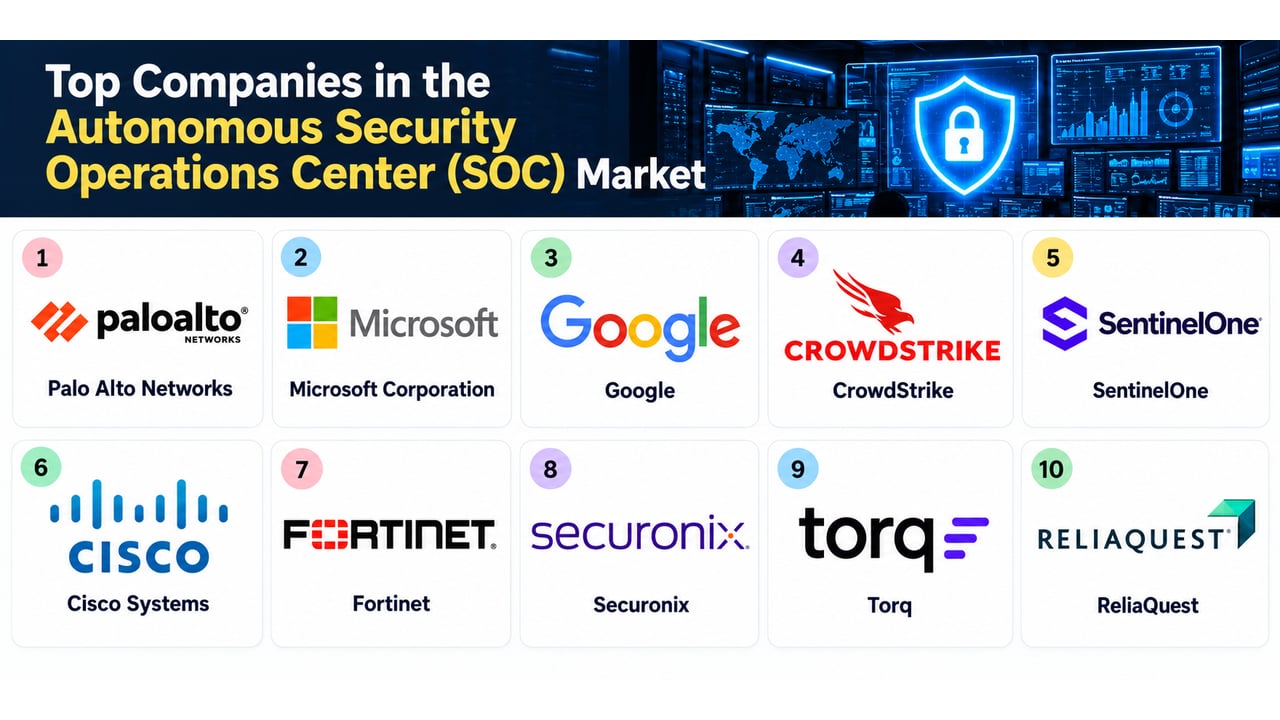
The industry's operational scale is reflected in the infrastructure processed by established security platforms rather than a universally reported count of autonomous SOC installations. During 2025, Palo Alto Networks reported that its Cortex XSIAM ecosystem processed approximately 15 petabytes of security data daily and supported more than 10,000 detectors and 2,600 machine-learning models. In 2026, Microsoft reported processing more than 100 trillion daily security signals across its broader security ecosystem. These figures illustrate the volume of information available to AI-enabled security operations, although they do not represent industry-wide autonomous SOC adoption. The competitive landscape includes established cybersecurity vendors, cloud technology providers, and specialized AI-native security companies.
Market Evolution and Growth Drivers
Security operations have evolved from manually reviewing logs and isolated alerts toward integrated platforms capable of coordinating detection, investigation, and response. Conventional SOC environments often require analysts to correlate security information from endpoints, cloud services, networks, identity systems, and business applications. By 2026, autonomous platforms increasingly used specialized AI agents to perform these activities through multiple connected investigation steps. The transition has been accelerated by cloud adoption, expanding attack surfaces, workforce constraints, and the availability of security-specific language models capable of interpreting technical evidence and executing approved workflows.
Cybersecurity threat patterns provide measurable evidence of the need for improved defensive operations. The 2026 Data Breach Investigations Report identified vulnerability exploitation as the initial entry point in 31% of analyzed breaches. Separately, cybersecurity workforce research published in 2026 found that 95% of surveyed respondents reported at least one cybersecurity skills need within their organizations. Regulatory requirements are also influencing security operations. The NIST Cybersecurity Framework 2.0, introduced in February 2024, established six functions covering governance, identification, protection, detection, response, and recovery. Together, these developments encourage organizations to adopt more consistent, auditable, and automated security practices.
Top 5 Latest Trends in the Autonomous Security Operations Center Industry
The competitive position of the top companies in the Autonomous Security Operations Center industry is increasingly shaped by their ability to automate complete security workflows rather than individual analyst tasks. Five developments are particularly important in 2026:
Agentic AI for autonomous threat investigation and alert triage.
Unified security telemetry and context-driven threat correlation.
Integrated protection across cloud, identity, endpoint, and network environments.
Governed autonomous response with human oversight and explainable decisions.
AI-powered managed security operations for enterprises and smaller organizations.
Trend 1: Agentic AI for Autonomous Threat Investigation and Alert Triage
Agentic artificial intelligence represents a substantial advancement in automated cybersecurity operations. Unlike traditional rule-based systems, agentic security technologies can analyze evidence, establish investigation objectives, select appropriate tools, evaluate competing explanations, and complete multiple workflow steps. This approach became commercially prominent during 2025 and expanded through major enterprise security platforms in 2026. Google Security Operations, for example, describes a Triage and Investigation agent designed to reduce a representative 30-minute manual analysis process to approximately 60 seconds. Such performance measurements demonstrate potential efficiency improvements for supported investigations, rather than guaranteed results across every customer environment.
The introduction of coordinated AI agents has also changed how cybersecurity platforms approach complex incidents. In September 2026, CrowdStrike introduced expanded multi-agent investigation capabilities across endpoint, identity, software-as-a-service, cloud, and network domains. These systems coordinate evidence across five security environments instead of requiring an analyst to manually reconstruct activities across separate consoles. Financial institutions, healthcare providers, technology enterprises, and managed security providers can use this approach to prioritize investigations while retaining human responsibility for consequential actions. The operational benefit depends on investigation accuracy, integration quality, and whether the system produces sufficient evidence to justify its conclusions.
Trend 2: Unified Security Telemetry and Context-Driven Threat Correlation
Autonomous security operations increasingly require a unified data foundation that connects otherwise fragmented security systems. Organizations operating multiple security products need AI agents to understand relationships among identities, applications, devices, vulnerabilities, and business assets. During 2025, Palo Alto Networks expanded Cortex XSIAM with more than 1,000 integrations, enabling information from different security technologies to support consolidated detection and investigation. This architecture can reduce repetitive data collection and improve the consistency of incident analysis, particularly where enterprises operate hybrid infrastructure and multiple cloud platforms.
Context-driven investigations gained further attention in 2026 as companies introduced technologies that combine security telemetry with organizational relationships. In May 2026, Torq announced the acquisition of Jit to strengthen enterprise-specific context graph capabilities within its AI SOC platform. Context graphs help investigations distinguish routine activities from suspicious behavior by connecting users, systems, access permissions, and operational conditions. This approach is particularly relevant for organizations managing hundreds of business applications or frequent infrastructure changes. The principal technical challenge is keeping relationships accurate as environments evolve, since automation based on incomplete asset information can produce incorrect threat priorities or inappropriate response recommendations.
Trend 3: Integrated Cloud, Identity, Endpoint, and Network Security
The expansion of cloud computing and distributed enterprise infrastructure has increased demand for cross-domain security monitoring. Modern attacks can progress through compromised identities, cloud management interfaces, endpoints, and externally accessible applications during a single intrusion. In 2026, Microsoft described security infrastructure protecting approximately 1 billion identities and processing more than 100 trillion daily security signals. These volumes emphasize why autonomous security platforms need to correlate identity behavior, infrastructure activity, and endpoint telemetry instead of evaluating each security domain independently.
Cloud-native security platforms increasingly combine SIEM, extended detection and response, threat intelligence, and security posture information. Google Security Operations integrates threat investigation with intelligence developed from more than 20 years of Mandiant incident-response experience. Meanwhile, Cisco has expanded the relationship between Splunk security analytics and its broader network security capabilities following its 2024 acquisition of Splunk. Cross-domain correlation can help financial institutions detect account compromise, manufacturers identify suspicious connections to operational systems, and healthcare organizations investigate unauthorized access to patient information. Effectiveness depends on complete telemetry, consistent asset identification, and permissions that allow security systems to investigate without unnecessarily expanding their access privileges.
Trend 4: Governed Autonomous Response and Explainable Security Decisions
Governance has become a central requirement for autonomous security operations because automated response tools may isolate endpoints, disable user accounts, modify security policies, or interrupt business processes. In August 2026, SentinelOne announced governed, closed-loop response capabilities through Purple AI and Singularity Hyperautomation. The approach allows security teams to establish operational boundaries before AI systems investigate alerts, reach verdicts, and execute permitted responses. Actions outside those boundaries can require explicit human approval, helping organizations balance response speed with accountability.
Regulatory developments reinforce the importance of transparent and controlled automation. Under the European Union's Cyber Resilience Act, reporting obligations for actively exploited vulnerabilities and severe product-security incidents began on September 11, 2026. The legislation includes an early-warning requirement within 24 hours and a subsequent notification within 72 hours. Although the obligations apply to relevant manufacturers rather than every SOC operator, they increase the importance of structured incident records and reliable escalation workflows. Autonomous security platforms supporting regulated organizations must therefore prioritize access controls, audit trails, evidence retention, approval mechanisms, and the ability to explain how particular decisions were reached.
Trend 5: AI-Powered Managed Security Operations and SOC Consolidation
AI-powered security operations are expanding beyond enterprises maintaining dedicated cybersecurity departments. Managed security service providers and smaller organizations increasingly require technologies that consolidate monitoring, investigation, automation, and incident management. In June 2026, Fortinet launched FortiSOC, a cloud-delivered platform combining six security operations functions through a unified service. Its architecture supports investigation and correlation across security assets and identities while maintaining analyst oversight of response actions. Consolidated delivery can reduce the integration work required to operate separate SIEM, SOAR, and threat intelligence systems.
The availability of managed and AI-enabled security platforms is important because workforce capacity remains a limitation across organizations of different sizes. ReliaQuest describes its GreyMatter platform as supporting six agentic security roles, more than 200 agent skills, and over 400 AI tools. These capabilities illustrate the shift toward reusable security expertise delivered through software and managed services. For smaller organizations, the commercial importance lies in accessing continuous monitoring and standardized incident handling without recreating a large enterprise SOC. Nevertheless, providers must demonstrate dependable integrations, measurable service levels, and clear responsibility for decisions executed automatically.
Top 10 Companies in the Autonomous Security Operations Center Industry
The following companies are selected based on their active security operations technologies, autonomous investigation capabilities, technical expertise, software platforms, geographic operations, and relevance to enterprise cybersecurity. The list is not a numerical ranking by market share or company performance.
1. Palo Alto Networks
Company Overview: Founded in 2005, Palo Alto Networks is an enterprise cybersecurity company that develops integrated technologies for network, cloud, endpoint, and security operations protection. The company has progressively expanded its security analytics and automation capabilities through the Cortex product family. Its 2025 platform milestones included more than 1.2 billion playbook executions and a security analytics environment supporting thousands of detection models.
Headquarters: Santa Clara, California, United States, where the company maintains its global corporate headquarters.
Core Autonomous Security Operations Center Expertise: Palo Alto Networks specializes in security information management, extended detection and response, threat investigation, exposure management, and automated remediation. Cortex XSIAM integrates previously separate security operations functions, allowing automated workflows to operate across large enterprise environments. In 2025, the company introduced Cortex AgentiX to extend agent-based automation and provide governance for AI-driven security work.
Major Products and Services: Cortex XSIAM, Cortex XDR, Cortex XSOAR, Cortex Xpanse, Cortex Cloud, and Cortex AgentiX form the company's principal security operations portfolio. Cortex XSIAM 3.0, introduced in April 2025, expanded proactive exposure management and email security capabilities. The ecosystem supports enterprise monitoring, automated case management, investigation enrichment, and coordinated security response.
2. Microsoft Corporation
Company Overview: Microsoft was founded in 1975 and has developed a global enterprise technology ecosystem spanning cloud computing, identity management, productivity software, and cybersecurity. Its security operations technologies benefit from the company's extensive enterprise infrastructure and threat intelligence activities. In 2026, Microsoft reported processing more than 100 trillion daily security signals and protecting approximately 1 billion identities across its security ecosystem.
Headquarters: Redmond, Washington, United States, the location of Microsoft's corporate headquarters since 1986.
Core Autonomous Security Operations Center Expertise: Microsoft's autonomous SOC capabilities combine centralized security analytics with AI-assisted investigations, identity protection, automated alert handling, and cloud threat detection. Microsoft Sentinel supports security information and event management, while Microsoft Defender XDR correlates threats across identities, devices, applications, and cloud services. Microsoft Security Copilot extends these capabilities through natural-language investigations and specialized security agents.
Major Products and Services: Microsoft Sentinel, Microsoft Defender XDR, Microsoft Security Copilot, Microsoft Entra, and related security automation services provide integrated defensive capabilities. In 2026, Microsoft's agent portfolio included a Security Alert Triage Agent in preview, a Threat Intelligence Briefing Agent, a Threat Hunting Assistant, and other specialized investigation tools. These technologies support incident summaries, hunting queries, intelligence analysis, and governed automation.
3. Google
Company Overview: Founded in 1998, Google operates across cloud infrastructure, enterprise software, artificial intelligence, and cybersecurity. Google Cloud's security operations capabilities have expanded through cloud-native analytics and the integration of Mandiant security expertise. By 2026, Google Security Operations offered an agentic security architecture designed to automate alert triage, detection engineering, threat hunting, and selected investigation workflows.
Headquarters: Mountain View, California, United States.
Core Autonomous Security Operations Center Expertise: Google's technical expertise centers on cloud-scale event processing, AI-based security analytics, detection engineering, and threat intelligence. Google Security Operations combines enterprise telemetry with Gemini-powered investigation capabilities and intelligence derived from Mandiant's more than 20 years of incident-response experience. Its architecture is intended to support complex investigations using correlated evidence rather than isolated security alerts.
Major Products and Services: Google Security Operations, Gemini in Security Operations, Google Threat Intelligence, Security Command Center, and Mandiant security services support the company's autonomous SOC offering. Its Triage and Investigation agent is designed to automate multi-step alert analysis, with a published example reducing a typical 30-minute manual task to approximately 60 seconds. The platform supports security analysts working across cloud and hybrid infrastructure environments.
4. CrowdStrike
Company Overview: CrowdStrike was incorporated in 2011 and developed its cybersecurity portfolio around cloud-native endpoint protection, threat intelligence, and managed threat detection. The company subsequently expanded into identity protection, cloud workload security, security analytics, and AI-powered incident investigation. In September 2026, CrowdStrike announced expanded coordinated investigations covering five security domains: endpoint, identity, SaaS, cloud, and network.
Headquarters: Austin, Texas, United States.
Core Autonomous Security Operations Center Expertise: CrowdStrike combines endpoint telemetry, threat intelligence, AI investigation agents, and integrated security data processing through the Falcon platform. Charlotte AI supports investigation reasoning, security workflows, and response coordination. Its architecture allows multiple agents to analyze related evidence simultaneously, helping analysts reconstruct cross-domain attacks without manually transferring information between disconnected applications.
Major Products and Services: Falcon Next-Gen SIEM, Charlotte AI, Charlotte AI AgentWorks, Charlotte Agentic SOAR, Falcon Fusion, and Falcon Foundry support CrowdStrike's security operations capabilities. In 2026, the company introduced additional functionality for coordinated agent investigations and customer-defined autonomy levels. These services enable organizations to build custom workflows, automate investigations, and configure human approval requirements for sensitive defensive actions.
5. SentinelOne
Company Overview: SentinelOne was founded in 2013 and developed a cybersecurity platform emphasizing behavioral analysis, autonomous endpoint protection, and machine learning. Its product portfolio has expanded beyond endpoint security into cloud protection, identity security, security analytics, and AI-assisted investigations. During 2026, the company introduced further autonomous investigation and response capabilities within the Singularity platform.
Headquarters: Mountain View, California, United States.
Core Autonomous Security Operations Center Expertise: SentinelOne specializes in automated detection, behavioral threat analysis, incident investigation, and policy-controlled response. Purple AI provides investigative reasoning and evidence-based analysis, while Singularity Hyperautomation coordinates repetitive workflows. The company's approach combines autonomous analysis with customer-defined permissions to reduce the risk of inappropriate security actions.
Major Products and Services: Singularity Platform, Purple AI, Singularity AI SIEM, Singularity Hyperautomation, and related endpoint and cloud security solutions form its autonomous SOC portfolio. In June 2026, SentinelOne expanded access to Purple AI Agentic Investigation, followed by an August 2026 announcement introducing governed closed-loop response capabilities. These services support automated alert assessment, documented investigation decisions, and security actions operating within administrator-defined boundaries.
6. Cisco Systems
Company Overview: Cisco was founded in 1984 and has developed enterprise networking, infrastructure security, and operational analytics technologies. The company completed its acquisition of Splunk on March 18, 2024, substantially expanding its security information management and analytical capabilities. Cisco's broader infrastructure presence enables security operations technologies to incorporate network telemetry alongside endpoint, cloud, and application information.
Headquarters: San Jose, California, United States.
Core Autonomous Security Operations Center Expertise: Cisco combines network detection, security analytics, threat intelligence, extended detection and response, and incident automation. The integration of Cisco XDR and Splunk security technologies creates opportunities for correlating events across networking infrastructure and enterprise applications. In 2026, Cisco demonstrated agentic SOC operations using live event network traffic and integrated security analytics.
Major Products and Services: Splunk Enterprise Security, Splunk SOAR, Cisco XDR, Cisco Secure Firewall, and related network security technologies support automated detection and response. In June 2026, Splunk announced additional purpose-built AI agents covering alert triage, threat detection engineering, malware analysis, and response automation. These capabilities serve enterprises requiring visibility across hybrid networking, infrastructure operations, and security monitoring environments.
7. Fortinet
Company Overview: Fortinet was established in 2000 and develops enterprise networking and cybersecurity infrastructure, including security appliances, cloud security services, and security operations software. By June 30, 2026, the company reported more than 1 million lifetime customers, over 50 enterprise cybersecurity products, and 1,448 global patents. These figures represent its broader cybersecurity operations rather than autonomous SOC installations alone.
Headquarters: Sunnyvale, California, United States.
Core Autonomous Security Operations Center Expertise: Fortinet's autonomous SOC capabilities combine network telemetry, SIEM, SOAR, threat intelligence, behavioral analytics, and AI-assisted incident response. Its Security Fabric architecture enables integrated monitoring across networking and security infrastructure. The company's FortiAI capabilities extend investigation support and automated workflow execution while maintaining security policies and analyst oversight.
Major Products and Services: FortiSOC, FortiSIEM, FortiSOAR, FortiAnalyzer, FortiTIP, FortiAI, and FortiGuard services comprise its primary security operations offering. FortiSOC, launched in June 2026, combines six security operations functions in a cloud-delivered platform. FortiSOAR 8.0 also introduced enhanced agentic automation capabilities, including evidence-driven investigation and configurable workflows for enterprise security teams and managed service providers.
8. Securonix
Company Overview: Founded in 2008, Securonix specializes in security analytics, user and entity behavior analytics, cloud-native SIEM, and automated security operations. Its enterprise security platform supports organizations in regulated industries, including financial services, healthcare, energy, and government. During 2025 and 2026, the company expanded its AI capabilities to support automated investigation and security analyst workflows.
Headquarters: Plano, Texas, United States.
Core Autonomous Security Operations Center Expertise: Securonix focuses on integrating behavioral intelligence, threat detection, investigation, and response automation within a common security operations environment. Its Agentic Mesh architecture coordinates specialized AI agents while maintaining policy-based controls, decision transparency, and analyst supervision. Behavioral analytics provide context for suspicious activity involving identities, applications, and enterprise infrastructure.
Major Products and Services: Securonix Unified Defense SIEM, Securonix EON, Sam AI SOC Analyst, Agentic Mesh, and related threat investigation capabilities form its security operations portfolio. In February 2026, Securonix introduced Sam and expanded its Agentic Mesh model to support governed automation across incident triage, investigation, and response. These technologies address repetitive Tier 1 and Tier 2 analyst work while retaining documented security decisions.
9. Torq
Company Overview: Torq was founded in 2020 by Ofer Smadari, Eldad Livni, and Leonid Belkind. The company focuses on AI-powered security operations and enterprise security automation. By 2026, Torq reported a workforce exceeding 430 people across its international operations. Its development strategy emphasizes integrating AI agents with security workflows rather than limiting automation to a single security technology category.
Headquarters: Tel Aviv, Israel, serves as Torq's international headquarters, while Denver, Colorado, United States, serves as its Americas headquarters.
Core Autonomous Security Operations Center Expertise: Torq specializes in agentic threat investigation, automated alert triage, contextual analysis, and coordinated remediation. Its platform uses AI reasoning and workflow automation to maintain continuity from initial detection through incident resolution. In May 2026, the company acquired Jit to strengthen enterprise context graph technology, enabling security investigations to incorporate dynamic relationships between assets and operational conditions.
Major Products and Services: Torq AI SOC Platform, Torq HyperSOC, Torq Hyperautomation, and context-driven investigation technologies support enterprise security operations. The company reported that customers using Torq Auto Triage achieved a mean time to triage of approximately 45 seconds in reported implementations. These results illustrate platform capabilities under particular customer conditions rather than a universal performance benchmark.
10. ReliaQuest
Company Overview: Founded in 2007, ReliaQuest develops AI-enabled security operations technologies and provides managed cybersecurity services. The company has reported more than 1,200 employees and over 1,000 customers across its broader operations. Its international presence includes operating centers in the United States, Ireland, the United Kingdom, and India, supporting security monitoring and response for geographically distributed enterprises.
Headquarters: Tampa, Florida, United States.
Core Autonomous Security Operations Center Expertise: ReliaQuest combines managed security operations with agentic investigation, automated threat containment, security analytics, and cross-platform integration. Its GreyMatter architecture can coordinate investigations across existing enterprise security tools, reducing the need to replace every monitoring system. This approach is relevant for organizations operating heterogeneous environments across multiple cloud providers and security vendors.
Major Products and Services: GreyMatter provides autonomous investigation, threat detection, security orchestration, threat intelligence, and managed detection and response capabilities. The company describes six agentic personas, over 200 agent skills, and more than 400 AI tools within the platform. ReliaQuest also reports a mean time to contain threats of approximately 4.48 minutes in its published platform performance measurements, although actual results depend on customer configuration and incident characteristics.
Regional Outlook
North America
North America remains a central location for autonomous security operations technology development, supported by enterprise software companies, cloud infrastructure providers, cybersecurity research organizations, and managed security services. The United States hosts the global headquarters of 9 of the 10 companies included in this analysis, while Israel hosts the international headquarters of Torq. Demand for advanced security operations comes from financial services, healthcare, government agencies, critical infrastructure, manufacturing, and technology enterprises. In 2025, the FBI's Internet Crime Complaint Center received 1,008,597 complaints, compared with 859,532 in 2024. Although these complaints cover broader cyber-enabled crimes rather than SOC-specific incidents, their volume highlights the scale of digital threats requiring monitoring, investigation, and response.
Government standards and disclosure rules also influence adoption. The United States introduced the NIST Cybersecurity Framework 2.0 in 2024, establishing six core cybersecurity functions that organizations can use to strengthen security governance and operational practices. Public companies subject to applicable U.S. Securities and Exchange Commission rules generally must disclose material cybersecurity incidents within four business days after determining materiality, subject to specified exceptions. Such requirements increase the importance of reliable incident classification, evidence collection, documentation, and coordination between cybersecurity teams and corporate management. AI-enabled SOC technologies can assist with these operational processes, but regulatory judgment and disclosure decisions remain the responsibility of authorized personnel.
Canada contributes through cybersecurity research, government-led threat intelligence, cloud services, and managed security operations. Its National Cyber Threat Assessment 2025–2026 identifies ransomware as a major threat to critical infrastructure and emphasizes risks affecting public services and enterprise systems. Mexico offers opportunities for security monitoring across manufacturing, banking, logistics, and multinational supply chains. The country's updated federal personal data protection law was published on March 20, 2025, reinforcing the importance of accountable information handling. Across the three countries, enterprises differ in cloud maturity, regulatory obligations, and access to specialist personnel. Regional opportunities include multilingual security operations, secure cross-border data processing, and automated monitoring of manufacturing facilities connected to North American industrial supply chains.
Europe
Europe's autonomous SOC industry is influenced by cybersecurity regulation, digital sovereignty requirements, financial-sector resilience obligations, and the protection of essential services. The European Union comprises 27 member states, while the wider European cybersecurity technology environment includes major activity in the United Kingdom, Switzerland, and other non-EU markets. The NIS2 Directive, with an October 17, 2024 national transposition deadline, expanded cybersecurity obligations across critical and important sectors. The Digital Operational Resilience Act became applicable on January 17, 2025, introducing additional operational resilience requirements for financial entities. Together, these frameworks increase demand for incident monitoring, documented security controls, third-party risk visibility, and repeatable response procedures.
Country-level industry conditions reflect different enterprise strengths. Germany's industrial manufacturing and automotive infrastructure require security monitoring across factory networks, enterprise applications, and operational technology systems. France has substantial activity in telecommunications, public-sector cybersecurity, aerospace, and financial services, while the Netherlands supports international cloud infrastructure and data center operations. The United Kingdom provides a significant market for financial services security and managed detection and response. Its 2025–2026 Cyber Security Breaches Survey found that 43% of businesses experienced a cybersecurity breach or attack during the preceding 12 months, with incidence rising to 65% among medium-sized businesses and 69% among large businesses. These figures indicate the importance of security monitoring across organizations of different sizes.
European regulations increasingly affect product engineering and incident-response processes. From September 11, 2026, applicable manufacturers have been required under the Cyber Resilience Act to report specified exploited vulnerabilities and severe product-security incidents. Autonomous SOC platforms supporting such organizations need accurate event timelines, traceable investigations, and controlled escalation procedures. Nordic countries offer opportunities for cloud-based and energy-conscious security infrastructure, while Italy and Spain represent additional markets for financial services, industrial operations, and managed cybersecurity. Europe also benefits from its connected population: approximately 92% of individuals used the internet in 2025. Key challenges include fragmented national implementation requirements, data residency restrictions, legacy system integration, and the need for cybersecurity specialists capable of supervising automated decisions.
Asia-Pacific
Asia-Pacific represents a diverse environment for autonomous security operations, combining established digital economies with expanding cloud infrastructure, industrial production, and enterprise technology adoption. Approximately 77% of the region's population used the internet in 2025. China, Japan, South Korea, and Taiwan support complex manufacturing and technology supply chains, creating demand for security monitoring across enterprise IT and industrial systems. Japan's automotive and electronics sectors require careful integration of security automation with operational continuity, while South Korea's semiconductor, telecommunications, and digital services activities create substantial requirements for identity and network monitoring. Taiwan's semiconductor ecosystem makes supply-chain visibility and industrial network protection particularly relevant.
India provides a large base of information technology professionals, cybersecurity services providers, enterprise software development operations, and managed security teams. Government data released in March 2026 recorded 2,944,248 cybersecurity incidents observed by CERT-In during 2025, compared with 2,041,360 in 2024. These figures cover reported and tracked cybersecurity incidents rather than the number of autonomous SOC deployments. India also reported incidents involving unauthorized activity by AI agents in October 2026, emphasizing the importance of securing the automation technologies used by both attackers and defenders. Opportunities exist in financial services, telecommunications, government services, healthcare, and the provision of remote security operations to international enterprises.
Australia and Singapore demonstrate different approaches to cybersecurity monitoring and national resilience. During the 2024–2025 reporting year, Australia's cybersecurity authorities received more than 84,700 cybercrime reports and responded to over 1,200 cybersecurity incidents. Singapore recorded approximately 284,300 instances of infected infrastructure in 2025 and 165 reported ransomware cases, compared with 159 in 2024. These indicators reinforce the need for continuous monitoring, rapid investigation, and risk-based threat prioritization. Across Southeast Asia, digital banking, e-commerce, cloud adoption, and telecommunications modernization create additional opportunities. Challenges include unequal cybersecurity workforce availability, multilingual operations, inconsistent technology maturity, and the need to protect systems distributed across different national jurisdictions.
Middle East & Africa
The Middle East is developing stronger cybersecurity infrastructure through national digital transformation programs, government security initiatives, industrial diversification, and critical infrastructure protection. The Gulf Cooperation Council includes six countries: Saudi Arabia, the United Arab Emirates, Bahrain, Kuwait, Oman, and Qatar. Saudi Arabia's Essential Cybersecurity Controls ECC 2:2024 and its Operational Technology Cybersecurity Controls OTCC-1:2022 establish structured requirements for relevant organizations and industrial systems. These frameworks support demand for security monitoring, incident management, asset visibility, and operational technology protection. Energy production, utilities, transportation, financial services, and government digital platforms are important sectors for autonomous and AI-assisted SOC technologies.
The United Arab Emirates approved a national cybersecurity strategy in February 2025 built around five pillars, including governance, protection, innovation, capability development, and partnerships. Qatar's National Cyber Security Strategy 2024–2030 similarly emphasizes cyber resilience, workforce development, research, and international cooperation. Israel provides a technologically developed cybersecurity research and enterprise software environment. During 2025, the Israel National Cyber Directorate issued approximately 2,480 alerts, including 2,304 proactive notifications to organizations about specific attack indicators. Such activities reinforce opportunities for threat intelligence integration, automated detection engineering, and enterprise security investigation. Regional organizations must also consider data sovereignty, security policy requirements, and the operational sensitivity of energy and industrial infrastructure.
Across Africa, adoption opportunities are shaped by financial technology expansion, mobile communications, data protection legislation, and the availability of cybersecurity infrastructure. Internet usage reached approximately 36% of the African population in 2025, compared with a global average of 74%, demonstrating substantial differences in digital access. South Africa's Protection of Personal Information Act, which became fully enforceable in 2021, has strengthened organizational attention to personal data governance. Nigeria's Data Protection Act of 2023 and Kenya's Data Protection Act of 2019 also influence enterprise information security practices. Egypt, Kenya, Nigeria, and South Africa provide opportunities for regional managed security services, particularly among banks, telecommunications operators, public institutions, and digitally connected businesses. However, infrastructure gaps, workforce development needs, and uneven access to advanced cybersecurity tools remain challenges.
Future Opportunities in the Autonomous Security Operations Center Industry
Future opportunities for the top companies in the Autonomous Security Operations Center industry will depend increasingly on their ability to deliver reliable, governed security outcomes across heterogeneous technology environments. One important development is the expansion of agentic security platforms from alert triage toward complete incident management. The 2026 generation of security agents can already perform specialized tasks such as evidence gathering, investigation planning, correlation, and approved response execution. Further development could improve coordination between these functions while reducing manual handoffs. However, a fully autonomous security operation remains different from simply deploying an AI assistant. Organizations will need to validate the accuracy of investigations, define response permissions, and retain qualified personnel to manage ambiguous or high-impact decisions.
Cloud and edge computing present opportunities for distributing security analytics across geographically separated operations. Centralized platforms can process enterprise events, while local monitoring components can support manufacturing plants, hospitals, and remote facilities where network reliability is essential. The experience of large security data platforms processing petabytes of telemetry daily illustrates the importance of efficient data pipelines. Future development is likely to emphasize retaining useful security evidence while reducing unnecessary information processing, duplicate alerts, and inefficient data transfers. These improvements may also support energy efficiency by limiting avoidable computing activity. Operational priorities should include measurable detection coverage, response latency, evidence completeness, and infrastructure utilization rather than treating automation volume alone as evidence of security effectiveness.
Regulatory requirements create further opportunities for security automation that supports compliance without replacing human judgment. The European Cyber Resilience Act's reporting obligations, which began in September 2026, establish 24-hour and 72-hour notification milestones for specified cases. Additional product cybersecurity requirements become applicable in December 2027. These deadlines provide concrete reasons for affected organizations to improve incident classification, evidence preservation, and escalation processes. Cybersecurity platforms capable of producing consistent technical timelines and auditable response records may become especially useful in regulated manufacturing, financial services, and critical infrastructure environments.
Small and medium-sized enterprises represent another practical area for development. Managed security providers can use multi-tenant AI platforms to deliver continuous monitoring, standardized investigations, and escalation services across multiple customers. Organizations without dedicated 24-hour security teams may benefit from automation that separates low-risk routine activity from incidents requiring expert attention. Partnerships between cybersecurity software vendors, cloud providers, telecommunications companies, and managed service providers could expand geographic coverage. Acquisitions involving security data management, contextual analytics, and specialized AI technologies may also strengthen platform capabilities, although commercial success will depend on integration quality and measurable customer outcomes.
Workforce development will remain essential. Cybersecurity research published in 2026 found that 59% of surveyed respondents considered their organizations' skills deficiencies critical or significant. This gap creates opportunities for technology providers to develop training programs focused on AI supervision, threat analysis, detection engineering, and automated response governance. Future SOC performance should be assessed through carefully defined measures such as mean time to detect, mean time to investigate, mean time to contain, false-positive rates, and the proportion of consequential actions requiring human approval. Improvements in these measures can provide evidence of operational value while ensuring that efficiency gains do not undermine accountability or security resilience.
Conclusion
The global autonomous security operations center industry has entered a more advanced phase of technological development as AI agents, integrated security analytics, and automated incident response become established capabilities within enterprise cybersecurity platforms. By 2026, companies have introduced systems capable of coordinating investigations across multiple security domains, analyzing complex telemetry, and executing permitted defensive workflows. The industry's progress is reflected in capabilities such as processing 15 petabytes of daily security telemetry and conducting investigations across five interconnected security domains. Nevertheless, autonomous security operations remain a developing discipline, and the effectiveness of each deployment depends on accurate data, clear governance, technical integration, and qualified human supervision.
The five major trends shaping the sector—agentic investigation, unified telemetry, cross-domain protection, governed response, and managed AI security operations—demonstrate how enterprise security requirements are moving beyond traditional alert monitoring. The 10 companies examined contribute different technologies and operational models, ranging from cloud-native SIEM and XDR platforms to specialized AI investigation systems and managed security services. North America supports substantial platform development, Europe emphasizes regulatory accountability, Asia-Pacific combines enterprise digitalization with industrial security demand, and the Middle East and Africa present opportunities shaped by infrastructure modernization and national cybersecurity programs.
Looking ahead, the top companies in the Autonomous Security Operations Center industry will be distinguished not simply by the number of automated tasks they perform, but by the reliability and transparency of their security outcomes. The progression from human-led monitoring toward carefully governed AI-assisted operations offers opportunities to improve investigation speed, strengthen incident response consistency, and extend cybersecurity capabilities to organizations with limited specialist resources. Regulatory milestones extending into 2027, workforce development requirements, and continuing advances in cloud and AI infrastructure will influence the industry's evolution. Sustainable adoption will ultimately depend on combining automation efficiency with verified threat detection, operational resilience, responsible AI governance, and accountable security decision-making.