


Top Companies in the API Security Industry and Their Capabilities
The top API security companies are profiled by their protection platforms, technical capabilities, global presence, emerging trends, and future opportunities.
Introduction
Overview of the Global API Security Industry
The global API security industry has become a critical component of enterprise cybersecurity infrastructure in 2026, supporting digital banking, healthcare interoperability, cloud applications, e-commerce, telecommunications, and artificial intelligence systems. Application programming interfaces enable communication between software applications, cloud services, business partners, and connected devices. Their widespread adoption has expanded the number of endpoints requiring authentication, authorization, monitoring, and protection against automated attacks.
The scale of the security challenge is reflected in a 2026 international survey involving 1,840 cybersecurity professionals across 10 countries and 6 industries. The research found that 87% of respondents had experienced an API-related security incident during the preceding 12 months. Organizations reported an average of 3.5 API security incidents during that period, demonstrating that conventional perimeter defenses alone are insufficient for protecting modern application environments.
API security technology now encompasses endpoint discovery, behavioral analysis, application-layer threat prevention, schema validation, authentication monitoring, bot mitigation, and protection against business logic abuse. These capabilities support cloud-native applications, microservices, mobile platforms, and enterprise integration architectures.
The competitive environment includes established cybersecurity providers, cloud infrastructure companies, application delivery specialists, and dedicated API security vendors. Their offerings range from development-stage security testing to continuous runtime protection. This combination of specialized platforms and integrated cybersecurity services reflects an industry transitioning from isolated API monitoring toward broader application and identity-aware security.
Market Evolution and Growth Drivers
API security has evolved from conventional gateway authentication and network filtering into continuous protection across the entire API lifecycle. The OWASP API Security Top 10 framework, updated in 2023, identifies vulnerabilities involving broken object-level authorization, authentication weaknesses, unrestricted resource consumption, security misconfiguration, and improper API inventory management.
A further development occurred in March 2026 when updated United States cybersecurity guidance expanded practical recommendations for protecting cloud-native APIs. The guidance addresses development-stage vulnerabilities, runtime risks, and security controls that organizations can deploy according to their operational requirements.
Artificial intelligence, automated software development, open banking, and enterprise cloud migration are contributing to greater demand for API security capabilities. Research published during the first half of 2026 found that 66% of surveyed organizations reported API inventory growth exceeding 50% during the previous year.
Regulatory developments have reinforced this transition. European cybersecurity requirements cover 18 critical sectors under the NIS2 framework, while digital operational resilience obligations have increased scrutiny of financial technology infrastructure. These developments encourage organizations to establish accurate API inventories, enforce access permissions, maintain monitoring records, and integrate security testing into continuous software delivery.
Top 5 Latest Trends in the API Security Industry
The following developments represent 5 important trends influencing API security technology, enterprise adoption, and competitive strategies in 2026.
Automated API Discovery and Continuous Attack Surface Management
Behavioral Analytics and Business Logic Abuse Prevention
AI Agent and Model Context Protocol Security
Shift-Left Security and API Contract Validation
Unified Web Application, API, and Bot Protection
Trend 1: Automated API Discovery and Continuous Attack Surface Management
Automated API discovery has become an important capability for organizations operating distributed cloud applications and microservices. Enterprise development teams frequently introduce new endpoints, update existing services, and retire outdated integrations without immediately updating central security inventories. This creates shadow APIs, abandoned endpoints, and undocumented interfaces that may remain accessible to unauthorized users.
Research released in April 2026 found that 66% of surveyed organizations experienced API growth exceeding 50% within a single year. Such expansion creates challenges for security teams attempting to maintain complete visibility across production environments, development systems, and third-party integrations.
Modern discovery platforms analyze network traffic, API request patterns, authentication mechanisms, endpoint structures, and response behavior. Automated inventory management helps identify externally exposed APIs, sensitive information flows, and inconsistencies between documented specifications and actual application behavior.
The practical importance extends to financial institutions, healthcare organizations, telecommunications operators, and software service providers. In these environments, a single undocumented endpoint may expose customer information or enable unauthorized transactions.
Continuous discovery also improves operational efficiency by helping development and security teams prioritize endpoints according to their exposure and business criticality. API attack surface management is consequently moving beyond periodic scanning toward continuous monitoring and automated risk classification.
Trend 2: Behavioral Analytics and Business Logic Abuse Prevention
Behavioral API security has gained importance because many sophisticated attacks use technically valid requests and authenticated sessions. Traditional signature-based protection can identify known malicious payloads, but it may fail to recognize unauthorized account access, excessive data extraction, fraudulent transactions, or abnormal sequences of legitimate API calls.
Threat analysis published in 2026 found that unauthorized workflows and abnormal activity represented 61% of observed API attacks in 2025, compared with 30% in 2024. The same research identified a 113% year-over-year increase in average daily API attacks within the analyzed environment.
Behavioral detection platforms analyze the relationship between users, sessions, devices, API endpoints, and transaction sequences. Machine learning techniques establish expected interaction patterns and identify unusual activity that could indicate credential abuse or business logic exploitation.
For example, a financial application may permit authenticated users to retrieve account balances, but repeated requests involving unrelated customer identifiers can indicate broken authorization controls. Similarly, an e-commerce application may experience automated inventory reservation or checkout manipulation without receiving conventionally malicious requests.
The increasing emphasis on contextual detection creates opportunities for technologies combining identity intelligence, rate limiting, session analysis, and application-specific behavioral policies.
Trend 3: AI Agent and Model Context Protocol Security
Artificial intelligence has introduced additional security requirements because autonomous agents increasingly interact with enterprise services through APIs. Large language models, automated assistants, and orchestration frameworks can access databases, retrieve documents, initiate business processes, and communicate with external software systems.
Research involving cybersecurity professionals in 2026 found that 42% reported attacks targeting APIs supporting AI applications, agents, or large language models during the preceding 12 months. These findings demonstrate that AI deployment expands the importance of protecting application interfaces and associated access credentials.
The Model Context Protocol, commonly known as MCP, provides a structured mechanism through which AI applications interact with tools and external resources. However, MCP integrations introduce security challenges involving excessive permissions, compromised credentials, unauthorized tool execution, and manipulation of agent instructions.
During 2026, cybersecurity providers introduced additional controls for discovering MCP servers, monitoring agent interactions, and enforcing permissions on tool requests. These capabilities complement traditional API authentication and runtime protection.
Financial services, enterprise software, customer service automation, and healthcare technology are relevant application areas. Organizations adopting AI agents must distinguish between authorized automation and suspicious activity, particularly when automated systems can perform multiple actions without direct human intervention.
Trend 4: Shift-Left Security and API Contract Validation
Shift-left API security integrates vulnerability identification into software design, development, and testing rather than relying exclusively on production monitoring. This approach has become particularly relevant as organizations adopt continuous integration and continuous delivery pipelines.
The OpenAPI Specification provides machine-readable definitions of API operations, data structures, parameters, and authentication requirements. Security platforms can analyze these specifications before deployment to identify weak authentication configurations, excessive data exposure, insufficient input validation, and incomplete security definitions.
Modern contract-testing tools support OpenAPI 2.0, 3.0, and 3.1 formats, while specialized API security auditing platforms can perform over 200 checks against API specifications. These checks examine structural consistency, data definitions, authentication requirements, and potentially unsafe API behavior.
In March 2026, updated technical guidance emphasized the importance of applying security controls during both development and runtime operations. This supports a lifecycle-based approach in which automated testing, code review, contract validation, and production enforcement operate as complementary controls.
The primary operational advantage is earlier vulnerability identification. Development teams can correct authorization and schema weaknesses before software reaches production, reducing reliance on emergency remediation after customer-facing services have been deployed.
Trend 5: Unified Web Application, API, and Bot Protection
The convergence of web application security, API protection, and automated bot defense is reshaping enterprise security architecture. Organizations increasingly operate websites, mobile applications, partner integrations, and AI-enabled services through shared backend infrastructure.
Threat intelligence published in 2026 identified a 73% increase in web application attacks between 2023 and 2025. Layer 7 distributed denial-of-service attacks also increased by 104% during the same period. These findings illustrate the importance of coordinated protection against application-layer exploitation and automated traffic abuse.
Unified web application and API protection platforms combine traditional web application firewalls with API discovery, bot management, behavioral analytics, schema enforcement, and application-layer DDoS mitigation.
This architecture enables security teams to evaluate multiple attack signals within the same environment. Suspicious API requests can be assessed alongside authentication behavior, device characteristics, request frequency, and broader network activity.
During 2026, providers expanded their offerings with AI-driven threat analysis and stronger controls for automated agents. Financial institutions, online retailers, digital marketplaces, and telecommunications companies benefit from these integrated capabilities because their applications must distinguish legitimate automated interactions from malicious traffic.
The development also affects competition among API security providers, as enterprise customers increasingly evaluate platforms according to integration capabilities and operational visibility rather than individual security features.
3. Top 10 Companies in the API Security Industry
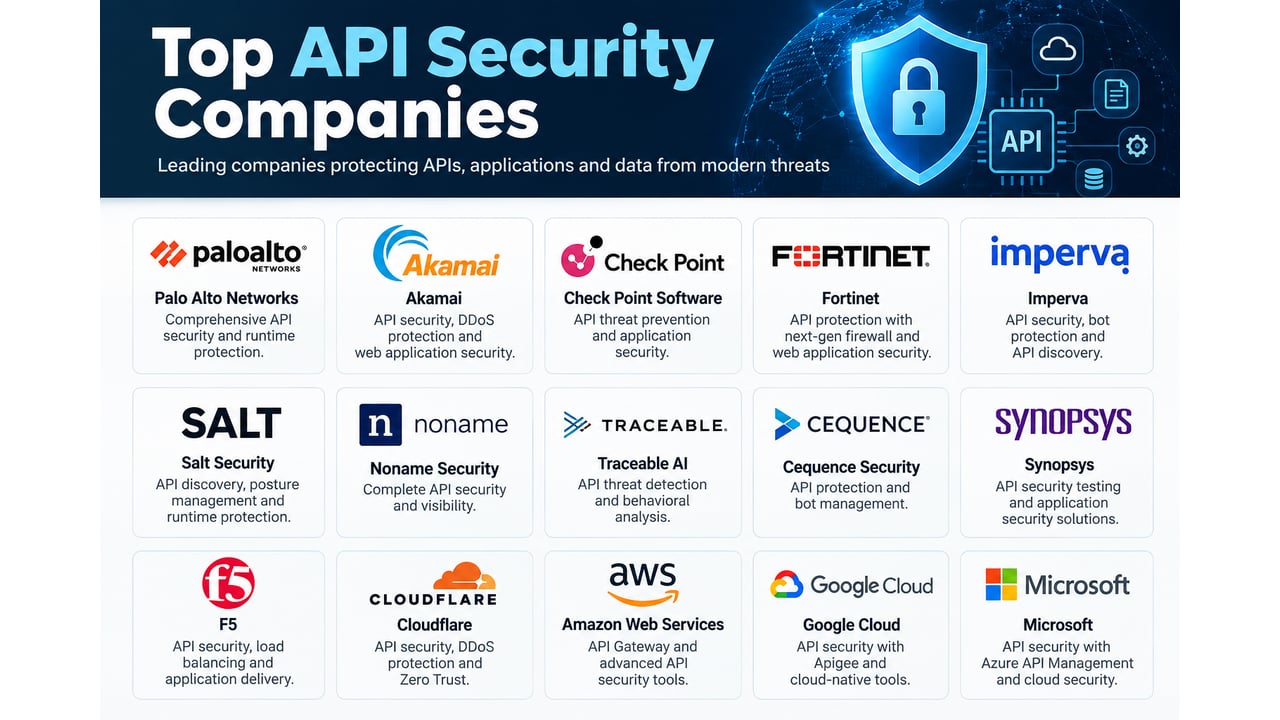
The following 10 companies have been selected based on API security capabilities, technical specialization, product development, operational presence, and relevance to enterprise application protection. The selection is not a numerical ranking by market share, revenue, or overall performance.
1. Akamai Technologies, Inc.
Company Overview: Founded in 1998, Akamai Technologies provides distributed cloud computing, application delivery, and cybersecurity services. Its global infrastructure includes over 4,400 edge points of presence across more than 130 countries, supporting application traffic inspection and distributed threat mitigation. Its infrastructure scale enables security controls to operate near users and application endpoints.
Headquarters: Cambridge, Massachusetts, United States.
Core API Security Expertise: Akamai specializes in API discovery, risk assessment, behavioral threat detection, application-layer attack prevention, and sensitive data exposure analysis. Its API security capabilities address authorization weaknesses, business logic abuse, and suspicious activity associated with cloud and enterprise applications.
Major Products and Services: Akamai API Security, App & API Protector, Bot Manager, and application-layer DDoS protection form important components of its portfolio. Its 2026 threat research also supports the development of controls addressing abnormal API workflows and AI-related application security risks.
2. Cloudflare, Inc.
Company Overview: Established in 2009, Cloudflare provides cloud connectivity, application security, network services, and developer infrastructure. Its distributed architecture supports organizations operating customer-facing applications, internal services, and API-driven business integrations.
Headquarters: San Francisco, California, United States.
Core API Security Expertise: Cloudflare focuses on API traffic visibility, endpoint discovery, request authentication, schema validation, abuse detection, and behavioral sequence analysis. These capabilities help protect applications from undocumented endpoint exposure, unauthorized data access, and automated exploitation.
Major Products and Services: Cloudflare API Shield provides API discovery, JSON Web Token validation, mutual TLS, schema protection, and sequence analytics. Its schema validation functionality supports OpenAPI 3.0-compatible definitions. Enterprise configurations support up to 10,000 enabled schema operations under documented limits, providing structured enforcement across extensive API inventories.
3. F5, Inc.
Company Overview: Founded in 1996, F5 develops application delivery, traffic management, and application security technologies. The company serves organizations operating traditional data centers, public cloud services, and hybrid application environments.
Headquarters: Seattle, Washington, United States.
Core API Security Expertise: F5 combines application-layer threat intelligence, behavioral security, API discovery, bot mitigation, and distributed application protection. Its technologies help organizations secure application interactions across different hosting environments while maintaining centralized operational visibility.
Major Products and Services: F5 Distributed Cloud API Security, Distributed Cloud Web Application Firewall, Bot Defense, and BIG-IP application security technologies support its API protection portfolio. In June 2026, F5 announced additional AI-powered web application and API protection capabilities, including enhanced API discovery and security options for sensitive deployment environments. September 2026 enhancements also strengthened automated traffic analysis and agent-related security controls.
4. Palo Alto Networks, Inc.
Company Overview: Founded in 2005, Palo Alto Networks provides network security, cloud protection, security operations, and application security solutions. Its enterprise portfolio includes technologies addressing cloud-native workloads, application vulnerabilities, and identity-related risks.
Headquarters: Santa Clara, California, United States.
Core API Security Expertise: Palo Alto Networks specializes in identifying exposed APIs, assessing vulnerabilities within cloud-native environments, monitoring runtime behavior, and prioritizing security risks based on application context. Its technology addresses threats identified within the 2023 OWASP API Security Top 10 framework.
Major Products and Services: Prisma Cloud API Security provides API discovery, risk profiling, and runtime protection. Its capabilities include identifying shadow and abandoned APIs, examining internal and external interfaces, and supporting inline or out-of-band monitoring. Integration with continuous development pipelines allows organizations to combine API vulnerability assessment with broader cloud security operations.
5. Fortinet, Inc.
Company Overview: Established in 2000, Fortinet develops integrated cybersecurity products covering network protection, cloud security, secure access, and application defense. Its portfolio includes hardware appliances, virtualized software, and cloud-delivered security services.
Headquarters: Sunnyvale, California, United States.
Core API Security Expertise: Fortinet focuses on machine learning-based API discovery, application traffic inspection, positive security models, automated bot prevention, and protection against malicious requests. Its integrated architecture allows API security to operate alongside network and application-layer controls.
Major Products and Services: FortiWeb provides API discovery, schema-based protection, threat analytics, and automated attack prevention. Documented appliance configurations include protected throughput specifications ranging from 100 Mbps to 10 Gbps across selected models. The platform supports OpenAPI, XML, and JSON-based security policies and incorporates machine learning capabilities for continuously analyzing API request structures.
6. Check Point Software Technologies Ltd.
Company Overview: Founded in 1993, Check Point Software Technologies provides enterprise cybersecurity solutions across network, cloud, and application environments. The company reports a global workforce exceeding 7,000 employees and provides security technologies to over 100,000 organizations.
Headquarters: Tel Aviv, Israel.
Core API Security Expertise: Check Point specializes in API request validation, sensitive data identification, application-layer attack prevention, and automated endpoint discovery. Its cloud application security technologies address suspicious traffic patterns and unauthorized access attempts.
Major Products and Services: CloudGuard WAF provides API discovery, schema enforcement, authentication controls, and web application protection. Its API discovery technology supports REST and GraphQL interfaces and can identify changes in endpoint behavior. The platform also detects sensitive data categories, helping organizations establish more precise protection rules across connected application environments.
7. Salt Security
Company Overview: Established in 2016, Salt Security develops specialized technologies for API security and the protection of AI-connected enterprise systems. Its operations focus on securing business applications throughout development, deployment, and production.
Headquarters: Palo Alto, California, United States.
Core API Security Expertise: Salt Security specializes in API discovery, behavioral threat detection, vulnerability identification, and security controls for AI-driven application interactions. Its research published in 2026 found that 92% of surveyed organizations lacked advanced security maturity for protecting emerging agentic environments.
Major Products and Services: The Salt Agentic Security Platform integrates API security with capabilities addressing AI development and runtime threats. In June 2026, the company introduced Salt Code to extend security policy enforcement into AI-assisted software development. September 2026 additions introduced native AI Detection and Response capabilities for identifying prompt injection, unsafe model behavior, and attacks involving downstream APIs and MCP integrations.
8. Cequence Security
Company Overview: Founded in 2014, Cequence Security develops enterprise application, API, and automated threat protection technologies. The company reports protecting 10 billion daily interactions and safeguarding 4 billion user accounts across its customer environments.
Headquarters: Santa Clara, California, United States.
Core API Security Expertise: Cequence specializes in API discovery, behavioral analytics, bot prevention, account takeover defense, and business logic abuse detection. Its security technologies focus on identifying malicious activity that may occur through legitimate application requests.
Major Products and Services: The Cequence Unified API Protection platform combines API inventory management, risk assessment, and threat mitigation. Platform release 9.1 includes over 260 risk rules spanning roughly 25 categories. Its broader portfolio also addresses AI gateway security and application access governance, supporting businesses integrating automated agents with existing enterprise applications.
9. 42Crunch
Company Overview: Founded in 2016, 42Crunch develops API security technologies focused on contract analysis, security testing, and runtime enforcement. The company has established operations in Europe and the United States, supporting organizations implementing API-focused development security programs.
Headquarters: Dublin, Ireland.
Core API Security Expertise: 42Crunch specializes in identifying security weaknesses through API specifications and validating deployed implementations against documented security requirements. Its API Security Audit functionality performs over 200 checks covering contract structure, data definitions, and authentication requirements.
Major Products and Services: The 42Crunch API Security Platform includes API Security Audit, API Scan, and runtime API protection capabilities. It supports OpenAPI 2.0, 3.0, and 3.1 specifications. During 2026, the company introduced additional functionality for GraphQL federation, development environment integration, and improved security audit workflows, strengthening its role in development-stage API protection.
10. Wallarm
Company Overview: Wallarm develops API and AI application security technologies for organizations operating cloud-native and distributed application environments. The company reported a 41% increase in its employee base during 2025, reflecting expansion in security engineering and enterprise support activities.
Headquarters: Austin, Texas, United States.
Core API Security Expertise: Wallarm specializes in API attack surface discovery, runtime threat prevention, vulnerability analysis, and protection against unauthorized API interactions. Its 2026 threat analysis reviewed 67,058 published vulnerabilities from 2025 and classified 11,053 as API-related.
Major Products and Services: Wallarm's security portfolio includes API attack surface management, API discovery, threat detection, and runtime protection. During 2026, the company extended discovery capabilities to IP addresses and network ranges and introduced protection features for MCP servers. These technologies help organizations identify exposed interfaces and apply security controls to both conventional APIs and AI-connected services.
Regional Outlook
North America
North America represents an important center for API security product development, enterprise deployment, and cybersecurity research. The United States hosts established cybersecurity providers, hyperscale cloud operators, financial institutions, and enterprise software developers that rely on API-based architectures. Application security requirements are particularly relevant across digital banking, healthcare, e-commerce, telecommunications, and government services.
The United States strengthened its technical guidance for cloud-native API protection in March 2026 through updated recommendations addressing application design, vulnerability management, and runtime security. Healthcare interoperability requirements also encourage secure API implementation for exchanging patient information through standardized healthcare interfaces. These developments create demand for authentication governance, sensitive data monitoring, API inventory management, and automated security testing.
Payment security requirements provide another operational driver. The PCI DSS 4.0.1 framework introduced additional security obligations that became effective on March 31, 2025, including controls affecting public-facing applications and payment environments. Organizations processing cardholder information must evaluate applicable requirements while maintaining effective access management and application monitoring.
Canada presents a different adoption environment, with increased attention to consumer-driven banking and secure financial data sharing. Government policy development during 2025 and 2026 established a regulatory direction for controlled data exchange between financial institutions and approved third parties. The Canadian government estimated that 9 million individuals were sharing financial data through credential-based screen scraping in the absence of a fully operational standardized framework. Replacing this approach with secure, permission-based interfaces creates an opportunity for API authentication and governance technologies.
Mexico's financial technology legislation, introduced in 2018, also provides a foundation for standardized financial information exchange. API security requirements extend across payment services, banking integrations, and digital commerce.
Regional challenges include complex legacy infrastructure, inconsistent API inventories, and shortages of specialized application security expertise. The strongest opportunities involve automated threat detection, healthcare data protection, financial API governance, and security controls supporting enterprise AI adoption.
Europe
Europe's API security industry is strongly influenced by cybersecurity regulation, financial services modernization, data protection obligations, and enterprise digital transformation. The European Union consists of 27 member states, creating a substantial regulatory environment for cross-border digital services and secure information exchange.
The NIS2 Directive establishes cybersecurity requirements covering 18 critical sectors, including healthcare, energy, transport, banking, digital infrastructure, and public administration. Member states were required to transpose the directive by October 17, 2024. However, implementation has varied, with regulatory authorities continuing enforcement actions during 2026.
Financial institutions face additional operational resilience requirements under the Digital Operational Resilience Act, which became applicable in January 2025. These obligations increase the importance of identifying technology dependencies, protecting critical application interfaces, managing third-party risks, and maintaining incident response procedures.
Germany, France, the Netherlands, and the Nordic countries maintain substantial enterprise technology ecosystems supporting industrial automation, financial services, telecommunications, and cloud applications. These environments require security controls that accommodate distributed workloads and cross-border data processing.
The United Kingdom illustrates the operational scale of API-driven financial services. In January 2026, its open banking ecosystem reported over 16.5 million user connections, while open banking payments reached nearly 33 million during November 2025. This level of API-enabled financial activity creates requirements for transaction authentication, access control, consent management, and continuous anomaly detection.
European healthcare infrastructure also presents future opportunities. The European Health Data Space Regulation entered into force in March 2025, with important implementation milestones scheduled for 2027, 2029, and 2031. Secure interoperability between healthcare systems will require carefully managed access to patient records and standardized electronic information exchange.
Regional challenges include fragmented implementation requirements, complex legacy applications, and the need to maintain cybersecurity controls across multiple jurisdictions. Opportunities are strongest in regulated industries requiring auditable API security practices and consistent identity management.
Asia-Pacific
Asia-Pacific is an important region for API security adoption due to expanding digital payment infrastructure, cloud computing, telecommunications services, manufacturing automation, and government digitization. China, India, Japan, South Korea, Singapore, Australia, and Taiwan support extensive technology ecosystems in which application interfaces connect financial platforms, enterprise systems, and consumer services.
India's API security requirements are closely associated with digital payments, financial technology, enterprise software, and government digital infrastructure. The Digital Personal Data Protection Act was enacted in 2023, followed by notification of implementing rules in November 2025. These developments place greater emphasis on protecting personal information across connected applications and business services.
China's Personal Information Protection Law, effective in 2021, establishes obligations influencing the processing and exchange of personal information. Japan has also expanded government digital standardization initiatives, including updated technical guidance issued in 2026 covering information system development, interoperability, and government cloud adoption.
South Korea and Taiwan contribute through their semiconductor, electronics, telecommunications, and digital service industries. Their connected manufacturing and enterprise environments create requirements for securing interfaces between software platforms, industrial systems, and external service providers.
Singapore remains an important regional center for cloud services and financial technology. Its Personal Data Protection Act and financial-sector technology governance requirements encourage organizations to strengthen access management and protect application data exchanges.
Australia's 2023–2030 Cyber Security Strategy provides a policy framework for improving national cyber resilience. Government discussions during 2026 also emphasized cloud modernization, digital identity, and security capability development.
Southeast Asian countries, including Indonesia, Malaysia, Thailand, Vietnam, and the Philippines, offer opportunities linked to digital banking, mobile commerce, and cloud application modernization.
Regional challenges include differences in cybersecurity maturity, national data governance requirements, and the availability of specialized engineering expertise. API security providers capable of supporting hybrid deployments, multilingual operations, and compliance requirements across national boundaries are positioned to address these needs.
Middle East & Africa
The Middle East and Africa API security industry is influenced by financial technology modernization, digital government programs, cloud infrastructure expansion, and increased adoption of enterprise automation. Saudi Arabia, the United Arab Emirates, Qatar, Israel, South Africa, Egypt, Kenya, and Nigeria represent important markets with distinct regulatory and technology requirements.
Saudi Arabia introduced its Open Banking Framework in November 2022, followed by the launch of an Open Banking Lab in January 2023. The framework establishes technical specifications and testing processes for financial institutions developing secure data-sharing services. These requirements support demand for API authentication, vulnerability assessment, consent enforcement, and secure financial application integration.
The United Arab Emirates has advanced open finance infrastructure through a regulatory framework issued in 2025. The framework includes an API Hub, participant validation mechanisms, digital certificates, and standardized integration requirements. Such infrastructure creates opportunities for API identity verification, encryption, schema enforcement, and transaction monitoring.
Israel contributes through cybersecurity research and software development. Established security companies, including Check Point Software Technologies, founded in 1993, support the region's technical expertise in application defense and enterprise security.
In Africa, South Africa's Protection of Personal Information Act established important personal data processing obligations, with major provisions commencing in July 2020 and subsequent compliance milestones in 2021. Nigeria's Data Protection Act of 2023 and Kenya's Data Protection Act of 2019 also provide regulatory foundations for protecting personal information within digital services.
Financial services, telecommunications, government platforms, and online commerce are important end-use sectors across African markets. Digital payment platforms and mobile-first applications depend on reliable API authentication and secure communication between service providers.
Regional barriers include uneven cloud infrastructure availability, limited specialized security staffing, differences in national regulations, and reliance on imported cybersecurity technologies. Opportunities involve managed security services, cloud-delivered API protection, workforce training, and accessible security solutions for smaller organizations.
Future Opportunities in the API Security Industry
The future development of the API security industry will be influenced by artificial intelligence, automated application development, regulatory compliance, and increasingly interconnected business systems. As enterprise applications expand beyond conventional user interactions, organizations will require security controls capable of governing machine identities, autonomous agents, service accounts, and API-driven workflows.
One important opportunity involves integrating AI security with conventional API protection. Research published in 2026 found that 92% of surveyed organizations lacked the advanced security maturity considered necessary for protecting emerging agentic environments. This gap creates opportunities for platforms capable of identifying AI-related attack paths, monitoring tool execution, and enforcing permissions across applications and automated workflows.
Advanced behavioral analytics also represents a substantial development area. Security technologies can analyze API request sequences, authentication patterns, application context, and transaction characteristics to identify unauthorized activities that conventional signature-based systems may overlook. However, effective implementation requires appropriate training data, controlled false-positive rates, and security policies aligned with business operations.
Automated development security provides another opportunity. Integrating API contract auditing, schema validation, and vulnerability testing into continuous deployment pipelines allows software teams to assess security requirements before releasing updated application services. Technologies supporting OpenAPI 3.1 and GraphQL can extend testing coverage across different API architectures.
Regulatory developments will also influence product requirements. The European Health Data Space framework includes implementation milestones in 2027, 2029, and 2031. These verified regulatory dates create planning horizons for healthcare technology providers developing secure interoperability, patient access controls, and auditable information exchange.
Small and medium-sized enterprises offer opportunities for simplified deployment models. Cloud-delivered API security platforms, automated policy configuration, and managed protection services can help organizations establish security controls without maintaining extensive internal cybersecurity teams.
Partnerships between cloud infrastructure providers, identity management specialists, development platforms, and dedicated API security companies may further improve interoperability and reduce duplicated operational processes.
Energy efficiency and infrastructure optimization are additional considerations. Distributed API security architectures must balance inspection workloads, network latency, and computational resource consumption. Efficient policy enforcement and selective traffic analysis could reduce unnecessary processing while preserving application performance.
Across these opportunities, the strongest competitive differentiation is likely to arise from measurable improvements in detection accuracy, operational visibility, ease of deployment, and integration with existing enterprise security systems.
Conclusion
The global API security industry in 2026 reflects the increasing dependence of enterprises on connected applications, cloud platforms, digital financial infrastructure, and automated business services. Research showing API-related incidents among 87% of surveyed organizations highlights the operational importance of protecting application interfaces against unauthorized access, data exposure, and automated exploitation.
The 5 major trends shaping the industry include automated API discovery, behavioral threat detection, AI agent security, development-stage vulnerability prevention, and integrated application protection. Together, these developments demonstrate the transition from isolated security controls toward continuous, context-aware API protection.
The 10 companies examined in this analysis contribute different technical capabilities, including distributed threat mitigation, API contract testing, cloud-native security, bot prevention, behavioral analytics, and AI-integrated protection.
Regional demand differs according to regulatory frameworks and technology adoption patterns. North America emphasizes cloud security and enterprise integration, Europe maintains extensive regulatory requirements across 18 critical sectors, Asia-Pacific supports expanding digital services, and the Middle East and Africa present opportunities associated with financial modernization and infrastructure development.
Future opportunities for the top companies in the API security industry will depend on effective security automation, improved machine identity governance, stronger protection of AI-connected applications, and accessible solutions for organizations with different operational requirements.
As APIs remain fundamental to digital business infrastructure, sustained investment in vulnerability prevention, authentication controls, continuous monitoring, and responsible technology development will remain essential to building secure and resilient application ecosystems.